

We engineer cells and materials that communicate and process information through synthetic biology
Our inspiration is the ability of organisms and the materials they are made of to adapt to dynamic environmental conditions. Plants adapt growth to light conditions; bacteria develop resistance against antibiotics or bones get stronger when exercised. The basis for this ability to adapt is a fascinating information processing machinery of the organisms: Environmental conditions are captured by molecular sensors, then the signals are processed and integrated with genetic programs to finally yield a targeted response.
In our research, we engineer nature’s molecular sensing, processing, and actuation machinery in order to precisely control the function and properties of cells and materials. We apply these newly developed technologies in different fields of fundamental and applied research.

Team Members


Research
Stimulus-responsive and Information-processing (living) Materials

We develop and apply stimulus-responsive and information-processing biohybrid polymer materials. To this aim, we functionally couple synthetic biological molecular sensors and switches to polymer materials. By wiring these switches according to topologies inspired by electronic circuits, we engineer materials that perform fundamental computational operations. Examples of our work include:
- We engineered a hydrogel based on a bacteria-derived photoreceptor which allows the light-responsive, fully reversibly tuning of its mechanical properties. We applied this hydrogel as extracellular matrix to analyze the impact of dynamic mechanical environments on transcriptome-wide responses in mesenchymal stem cells or on the migration of T-lymphocytes.
See Hörner et al. Advanced Materials 2019 - We integrated synthetic biological switches with polymer materials into a circuit inspired by an electronic counter. The resulting material system was able to count the number of input light pulses and to release different output as a function of the number of light pulses detected. We applied this system to sequentially release different biocatalysts to drive a two-step biochemical reaction.
See Beyer et al., Advanced Materials 2018 - We developed PenTag, a protein tag for the spontaneous, covalent coupling of proteins to ampicillin-functionalized molecules such as dyes, polymers, or solid supports. Based on this strategy, we engineered and assembled material modules to function as encoder for processing different combinations of biochemical input stimuli.
See Mohsenin et al., Advanced Functional Materials 2024 - By engineering modular protease-based switches that can either be activated or repressed, we develop information-processing biohybrid circuits that process binary biomolecular information according to a circuit inspired by electronic decoders. Such circuits can be applied to process and interpret biochemical sensor information for advanced diagnostic applications.
See Mohsenin et al., Advanced Materials 2024
Molecular optogenetics to control cell fate and function
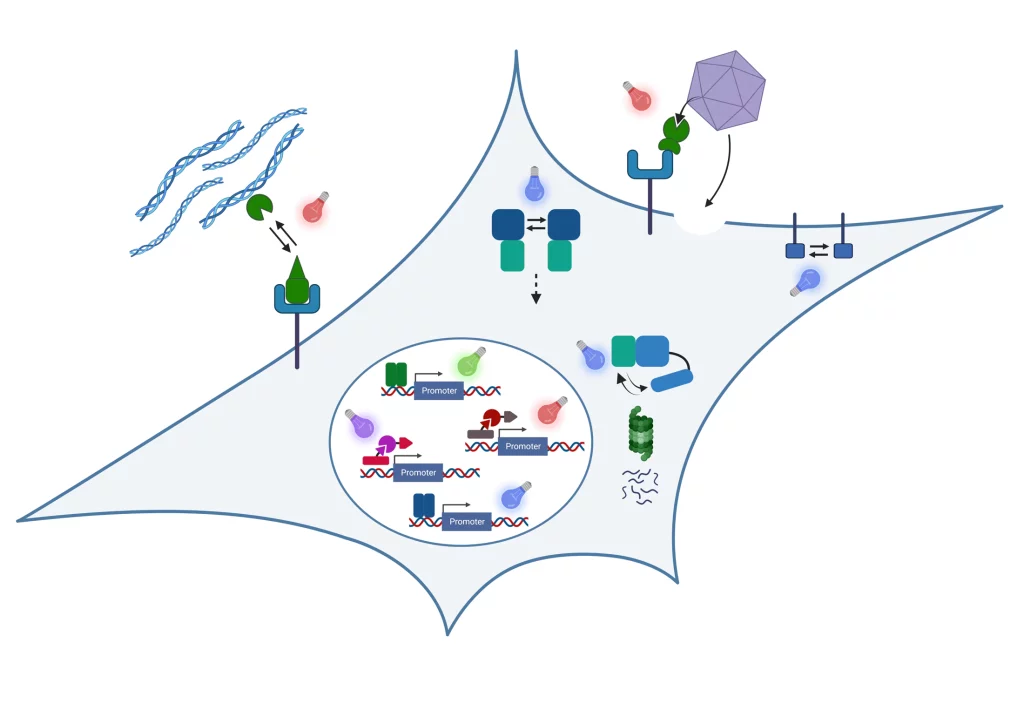
We develop and apply molecular optogenetic tools to control cell fate and function with unprecedented spatial and temporal precision in a dose-dependent and highly specific manner. To this aim, we engineer plant- and bacteria-derived photoreceptors and functionally couple them to proteins involved in cell signaling and gene expression. Examples of our work include:
- Light-inducible formation of liquid or gel-like transcription factor condensates in mammalian cells and mice. We demonstrate that liquid “transcription factor droplets” show a several-fold higher activity in inducing transgene expression compared to native transcription factors. Further, gel-like transcription factor condensates were shown to correlate with decreased transcriptional activation thus providing a materials-based layer of controlling gene expression.
See Schneider et al., Science Advances 2021 and Fischer et al., Small 2024 - Light-guided adeno-associated viral (AAV) vectors. We engineered a light-responsive tropism into AAVs which allows us to selectively transfer genetic information into single cells or to transduce different cells within one culture with different transgenes.
See Hörner et al., Science Advances 2021
Our group is running www.optobase.org, the most comprehensive database on molecular optogenetics. Have a look and discover the amazing opportunities in controlling biology with light!
Biosensors
We integrate natural and engineered molecular sensors for drugs, metabolites or nucleic acids into suitable readout formats for the fast and sensitive quantification of such substances. Together with collaboration partners, we develop biosensor systems for different application fields:
Open Positions
We are always excited to meet curious and creative scientists passionate about synthetic biology, optogenetics, and engineered living materials. If you would like to shape the future of biobased and living materials with us, we warmly welcome your spontaneous application for a PhD thesis or Postdoc position!
Projects and Partners
We perform collaborative research in materials-oriented synthetic biology within interdisciplinary research consortia
STEADY
Within the ERC Advanced Grant STEADY, we develop concepts for dynamically controlling the properties of engineered living materials by advanced synthetic genetic circuits.
LoopOfFun
We coordinate the European Innovation Council (EIC)-funded consortium LoopOfFun in which we aim at developing a platform for the rapid development of industry-scale, one-step, simple casting-based manufacturing processes for fungal mycelia composites. We jointly work towards this goal with our consortium partners:
- Prof. Roman Jerala, National Institute of Chemistry, Ljubljana, Slovenia
- Dr. Achim Weber, Fraunhofer IGB, Stuttgart, Germany
- Prof. Arnold Driessen, University of Groningen, The Netherlands
- Carlotta Borgato and Jan Boelen, Atelier LUMA, Arles, France
DELIVER
In the project DELIVER funded by the Carl-Zeiss-Foundation, we collaborate towards the data-driven engineering of sustainable living materials. We combine synthetic biology with materials sciences and data-driven approaches to design bio-based composite materials with custom-tailored structural properties for construction applications. Within deliver, we collaborate with the following partners:
- Prof. Thomas Speck, University of Freiburg, Germany
- Dr. Clemens Kreutz, University Hospital Freiburg, Germany
BILLARD
We coordinate the BILLARD project funded by the Federal Ministry of Education and Research (BMBF) within the funding line “Biologization of Technology”, we collaborate with PD Dr. Felicitas Bucher from the Clinic of Ophtamology at the University Hospital Freiburg on the development of novel intraocular drug delivery devices.
CIBSS – Centre for Integrative Biological Signalling Studies
We are member of the Cluster of Excellence CIBSS in which we perform research on novel optogenetic technologies to control signaling reactions in mammalian cells. We mainly collaborate with Prof. Dr. Jens Timmer on the model-based design of synthetic biological switches and networks and with Prof. Dr. Wolfgang Schamel on controlling immunological processes such as T cell activation via optogenetics.
Publications
Geraths, C. | Christen, E. H. | Weber, Wilfried
DOI:
Metabolite-responsive hydrogels that detect pathological metabolite concentrations and react by releasing a therapeutic stimulus hold high promises in treating metabolic diseases. In this study, a hydrogel is described that discriminates between physiological and pathological concentrations of urate, the causative agent of gouty arthritis. The hydrogel is synthesized by coupling a dimeric variant of the Deinococcus radiodurans-derived urate repressor HucR to linear polyacrylamide. The protein-grafted polymer is crosslinked to form a hydrogel by a multimeric hucO DNA sequence [hucO]n specifically binding HucR. At elevated urate concentrations, HucR dissociates from [hucO]n thereby weakening the hydrogel structure and resulting in its dissolution. A stimulus-responsive biohybrid material is described that rapidly dissolves at pathological concentrations of the gouty arthritis-causing metabolite urate. The gel consists of polyacrylamide and DNA that are crosslinked by the Deinococcus radiodurans-derived urate sensor HucR, which binds its specific target DNA motif at physiological urate concentrations and dissociates thereof at pathological concentrations. Copyright © 2012 WILEY-VCH Verlag GmbH & Co. KGaA, Weinheim.
Gitzinger, M. | Kemmer, C. | Fluri, D. A. | Daoud El-Baba, M. | Weber, Wilfried | Fussenegger, M.
DOI:
Trigger-inducible transcription-control devices that reversibly fine-tune transgene expression in response to molecular cues have significantly advanced the rational reprogramming of mammalian cells. When designed for use in future gene-and cell-based therapies the trigger molecules have to be carefully chosen in order to provide maximum specificity, minimal side-effects and optimal pharmacokinetics in a mammalian organism. Capitalizing on control components that enable Caulobacter crescentus to metabolize vanillic acid originating from lignin degradation that occurs in its oligotrophic freshwater habitat, we have designed synthetic devices that specifically adjust transgene expression in mammalian cells when exposed to vanillic acid. Even in mice transgene expression was robust, precise and tunable in response to vanillic acid. As a licensed food additive that is regularly consumed by humans via flavoured convenience food and specific fresh vegetable and fruits, vanillic acid can be considered as a safe trigger molecule that could be used for diet-controlled transgene expression in future gene-and cell-based therapies. © 2011 The Author(s).
Gübeli, R. J. | Ehrbar, M. | Fussenegger, M. | Friedrich, C. | Weber, Wilfried
DOI:
Interactive materials being responsive to a biocompatible stimulus represent a promising approach for future therapeutic applications. In this study, we present a novel biohybrid material synthesized from biocompatible components being stimulus-responsive to the pharmaceutically approved small-molecule novobiocin. The hydrogel design is based on the gyrase B (GyrB) protein, which is covalently grafted to multi-arm polyethylene glycol (PEG) using a Michael-type addition reaction. Upon addition of the GyrB-dimerizing substance coumermycin, stable hydrogels form which can be dissolved in a dose-adjustable manner by the antibiotic novobiocin. The switchable properties of this PEG-based hydrogel are favorable for future applications in tissue engineering and as externally controlled drug depot. A polyethylenglycol(PEG)- based biohybrid material is presented being dose-responsive to the small-molecule drug novobiocin. The design is based on a multi-arm PEG functionalized with the protein gyrase B, which can be crosslinked to a hydrogel by coumermycin. Hydrogel dissolution can be triggered dose dependently by the addition of novobiocin. © 2012 WILEY-VCH Verlag GmbH & Co. KGaA, Weinheim.
Haller, C. M. | Buerzle, W. | Kivelio, A. | Perrini, M. | Brubaker, C. E. | Gubeli, R. J. | Mallik, A. S. | Weber, Wilfried | Messersmith, P. B. | Mazza, E. | Ochsenbein-Koelble, N. | Zimmermann, R. | Ehrbar, M.
DOI:
Iatrogenic preterm prelabor rupture of membranes (iPPROM) remains the main complication after invasive interventions into the intrauterine cavity. Here, the proteolytic stability of mussel-mimetic tissue adhesive (mussel glue) and its sealing behavior on punctured fetal membranes are evaluated. The proteolytic degradation of mussel glue and fibrin glue were compared in vitro. Critical pressures of punctured and sealed fetal membranes were determined under close to physiological conditions using a custom-made inflation device. An inverse finite element procedure was applied to estimate mechanical parameters of mussel glue. Mussel glue was insensitive whereas fibrin glue was sensitive towards proteolytic degradation. Mussel glue sealed 3.7 mm fetal membrane defect up to 60 mbar (45 mm Hg) when applied under wet conditions, whereas fibrin glue needed dry membrane surfaces for reliable sealing. The mussel glue can be represented by a neo-Hookean material model with elastic coefficient C1 = 9.63 kPa. Ex-vivo-tested mussel glue sealed fetal membranes and resisted pressures achieved during uterine contractions. Together with good stability in proteolytic environments, this makes mussel glue a promising sealing material for future applications. © 2012 Acta Materialia Inc. Published by Elsevier Ltd. All rights reserved.
Hörner, M. | Reischmann, N. | Weber, Wilfried
DOI:
The emerging field of synthetic biology is a novel biological discipline at the interface between traditional biology, chemistry, and engineering sciences. Synthetic biology aims at the rational design of complex synthetic biological devices and systems with desired properties by combining compatible, modular biological parts in a systematic manner.While the first engineered systems were mainly proof-of-principle studies to demonstrate the power of the modular engineering approach of synthetic biology, subsequent systems focus on applications in the health, environmental, and energy sectors. This review describes recent approaches for biomedical applications that were developed along the synthetic biology design hierarchy, at the level of individual parts, of devices, and of complex multicellular systems. It describes how synthetic biological parts can be used for the synthesis of drug-delivery tools, how synthetic biological devices can facilitate the discovery of novel drugs, and how multicellular synthetic ecosystems can give insight into population dynamics of parasites and hosts. These examples demonstrate how this new discipline could contribute to novel solutions in the biopharmaceutical industry. © 2013 by The Johns Hopkins University Press.
Hörner, M. | Weber, Wilfried
DOI:
Molecular switches are the fundamental building blocks in the field of synthetic biology. The majority of these switches is based on protein-protein, protein-DNA or protein-RNA interactions that are responsive towards endogenous metabolites or external stimuli like small molecules or light. By the rational and predictive reassembling of multiple compatible molecular switches, complex synthetic signaling networks can be engineered. Here we review how these switches were used for the regulation of important cellular processes at every level of the signaling cascade. In the second part we review how these switches can be assembled to open- and closed-loop control signaling networks and how these networks can be applied to facilitate cattle reproduction, to treat diabetes or to autonomously detect and cure disease states like gouty arthritis or cancer. © 2012 Federation of European Biochemical Societies. Published by Elsevier B.V. All rights reserved.
Jakobus, K. | Wend, S. | Weber, Wilfried
DOI:
TSynthetic biology aims at the rational design and construction of devices, systems and organisms with desired functionality based on modular well-characterized biological building blocks. Based on first proof-of-concept studies in bacteria a decade ago, synthetic biology strategies have rapidly entered mammalian cell technology providing novel therapeutic solutions. Here we review how biological building blocks can be rewired to interactive regulatory genetic networks in mammalian cells and how these networks can be transformed into open- and closed-loop control configurations for autonomously managing disease phenotypes. In the second part of this tutorial review we describe how the regulatory biological sensors and switches can be transferred from mammalian cell synthetic biology to materials sciences in order to develop interactive biohybrid materials with similar (therapeutic) functionality as their synthetic biological archetypes. We develop a perspective of how the convergence of synthetic biology with materials sciences might contribute to the development of truly interactive and adaptive materials for autonomous operation in a complex environment. 2012 © The Royal Society of Chemistry.
Kämpf, M. M. | Engesser, R. | Busacker, M. | Hörner, M. | Karlsson, M. | Zurbriggen, M. D. | Fussenegger, M. | Timmer, J. | Weber, Wilfried
DOI:
Modularly structured signaling networks coordinate the fate and function of complex biological systems. Each component in the network performs a discrete computational operation, but when connected to each other intricate functionality emerges. Here we study such an architecture by connecting auxin signaling modules and inducible protein biotinylation systems with transcriptional control systems to construct synthetic mammalian high-detect, low-detect and band-detect networks that translate overlapping gradients of inducer molecules into distinct gene expression patterns. Guided by a mathematical model we apply fundamental computational operations like conjunction or addition to rewire individual building blocks to qualitatively and quantitatively program the way the overall network interprets graded input signals. The design principles described in this study might serve as a conceptual blueprint for the development of next-generation mammalian synthetic gene networks in fundamental and translational research. © 2012 The Royal Society of Chemistry.
Kämpf, M. M. | Weber, Wilfried
DOI:
The rapidly emerging ability to design and construct synthetic gene networks in mammalian cells is based on the availability of mutually compatible genetic switches that enable the time-dependent induction of transgene expression in response to the dose of an externally applied stimulus. As these genetic switches are inherently compatible with mammalian cell physiology, they are as well predestined to control the functionality of cell-free synthetic devices within an overall physiologic background. In this chapter, we describe how a genetic switch that was originally designed for gene therapeutic studies can be applied in materials science to design and construct a biohybrid hydrogel that can be used to release a therapeutic growth factor in response to an externally applied stimulus for controlling cell fate and function in a time- and space-resolved manner. © 2012 Springer Science+Business Media, LLC.
Karlsson, M. | Weber, Wilfried
DOI:
The field of synthetic biology is rapidly expanding and has over the past years evolved from the development of simple gene networks to complex treatment-oriented circuits. The reprogramming of cell fate with open-loop or closed-loop synthetic control circuits along with biologically implemented logical functions have fostered applications spanning over a wide range of disciplines, including artificial insemination, personalized medicine and the treatment of cancer and metabolic disorders. In this review we describe several applications of interactive gene networks, a synthetic biology-based approach for future gene therapy, as well as the utilization of synthetic gene circuits as blueprints for the design of stimuli-responsive biohybrid materials. The recent progress in synthetic biology, including the rewiring of biosensing devices with the body's endogenous network as well as novel therapeutic approaches originating from interdisciplinary work, generates numerous opportunities for future biomedical applications. © 2012 Elsevier Ltd.