

We engineer cells and materials that communicate and process information through synthetic biology
Our inspiration is the ability of organisms and the materials they are made of to adapt to dynamic environmental conditions. Plants adapt growth to light conditions; bacteria develop resistance against antibiotics or bones get stronger when exercised. The basis for this ability to adapt is a fascinating information processing machinery of the organisms: Environmental conditions are captured by molecular sensors, then the signals are processed and integrated with genetic programs to finally yield a targeted response.
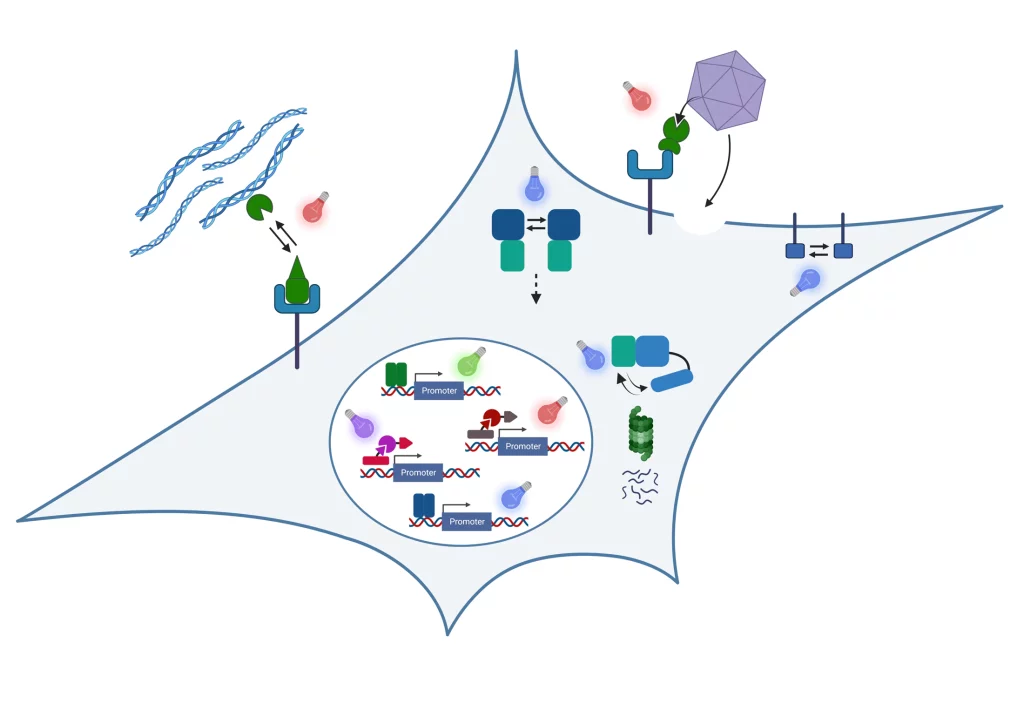
In our research, we engineer nature’s molecular sensing, processing, and actuation machinery in order to precisely control the function and properties of cells and materials. We apply these newly developed technologies in different fields of fundamental and applied research.

Team Members


Research
Stimulus-responsive and Information-processing (living) Materials

We develop and apply stimulus-responsive and information-processing biohybrid polymer materials. To this aim, we functionally couple synthetic biological molecular sensors and switches to polymer materials. By wiring these switches according to topologies inspired by electronic circuits, we engineer materials that perform fundamental computational operations. Examples of our work include:
- We engineered a hydrogel based on a bacteria-derived photoreceptor which allows the light-responsive, fully reversibly tuning of its mechanical properties. We applied this hydrogel as extracellular matrix to analyze the impact of dynamic mechanical environments on transcriptome-wide responses in mesenchymal stem cells or on the migration of T-lymphocytes.
See Hörner et al. Advanced Materials 2019 - We integrated synthetic biological switches with polymer materials into a circuit inspired by an electronic counter. The resulting material system was able to count the number of input light pulses and to release different output as a function of the number of light pulses detected. We applied this system to sequentially release different biocatalysts to drive a two-step biochemical reaction.
See Beyer et al., Advanced Materials 2018 - We developed PenTag, a protein tag for the spontaneous, covalent coupling of proteins to ampicillin-functionalized molecules such as dyes, polymers, or solid supports. Based on this strategy, we engineered and assembled material modules to function as encoder for processing different combinations of biochemical input stimuli.
See Mohsenin et al., Advanced Functional Materials 2024 - By engineering modular protease-based switches that can either be activated or repressed, we develop information-processing biohybrid circuits that process binary biomolecular information according to a circuit inspired by electronic decoders. Such circuits can be applied to process and interpret biochemical sensor information for advanced diagnostic applications.
See Mohsenin et al., Advanced Materials 2024
Molecular optogenetics to control cell fate and function
We develop and apply molecular optogenetic tools to control cell fate and function with unprecedented spatial and temporal precision in a dose-dependent and highly specific manner. To this aim, we engineer plant- and bacteria-derived photoreceptors and functionally couple them to proteins involved in cell signaling and gene expression. Examples of our work include:
- Light-inducible formation of liquid or gel-like transcription factor condensates in mammalian cells and mice. We demonstrate that liquid “transcription factor droplets” show a several-fold higher activity in inducing transgene expression compared to native transcription factors. Further, gel-like transcription factor condensates were shown to correlate with decreased transcriptional activation thus providing a materials-based layer of controlling gene expression.
See Schneider et al., Science Advances 2021 and Fischer et al., Small 2024 - Light-guided adeno-associated viral (AAV) vectors. We engineered a light-responsive tropism into AAVs which allows us to selectively transfer genetic information into single cells or to transduce different cells within one culture with different transgenes.
See Hörner et al., Science Advances 2021
Our group is running www.optobase.org, the most comprehensive database on molecular optogenetics. Have a look and discover the amazing opportunities in controlling biology with light!
Biosensors
We integrate natural and engineered molecular sensors for drugs, metabolites or nucleic acids into suitable readout formats for the fast and sensitive quantification of such substances. Together with collaboration partners, we develop biosensor systems for different application fields:
Open Positions
We are always excited to meet curious and creative scientists passionate about synthetic biology, optogenetics, and engineered living materials. If you would like to shape the future of biobased and living materials with us, we warmly welcome your spontaneous application for a PhD thesis or Postdoc position!
Projects and Partners
We perform collaborative research in materials-oriented synthetic biology within interdisciplinary research consortia
STEADY
Within the ERC Advanced Grant STEADY, we develop concepts for dynamically controlling the properties of engineered living materials by advanced synthetic genetic circuits.
LoopOfFun
We coordinate the European Innovation Council (EIC)-funded consortium LoopOfFun in which we aim at developing a platform for the rapid development of industry-scale, one-step, simple casting-based manufacturing processes for fungal mycelia composites. We jointly work towards this goal with our consortium partners:
- Prof. Roman Jerala, National Institute of Chemistry, Ljubljana, Slovenia
- Dr. Achim Weber, Fraunhofer IGB, Stuttgart, Germany
- Prof. Arnold Driessen, University of Groningen, The Netherlands
- Carlotta Borgato and Jan Boelen, Atelier LUMA, Arles, France
DELIVER
In the project DELIVER funded by the Carl-Zeiss-Foundation, we collaborate towards the data-driven engineering of sustainable living materials. We combine synthetic biology with materials sciences and data-driven approaches to design bio-based composite materials with custom-tailored structural properties for construction applications. Within deliver, we collaborate with the following partners:
- Prof. Thomas Speck, University of Freiburg, Germany
- Dr. Clemens Kreutz, University Hospital Freiburg, Germany
BILLARD
We coordinate the BILLARD project funded by the Federal Ministry of Education and Research (BMBF) within the funding line “Biologization of Technology”, we collaborate with PD Dr. Felicitas Bucher from the Clinic of Ophtamology at the University Hospital Freiburg on the development of novel intraocular drug delivery devices.
CIBSS – Centre for Integrative Biological Signalling Studies
We are member of the Cluster of Excellence CIBSS in which we perform research on novel optogenetic technologies to control signaling reactions in mammalian cells. We mainly collaborate with Prof. Dr. Jens Timmer on the model-based design of synthetic biological switches and networks and with Prof. Dr. Wolfgang Schamel on controlling immunological processes such as T cell activation via optogenetics.
Publications
Kuharenko, Olga V. | Antanovich, Artsiom | Saha, Avijit | Ivanchanka, Aliaksei | Müller, Martin | Lenyak, Vladimir | Kraegeloh, Annette | Rossner, Christian
DOI:
We report a straightforward methodology to access structurally well-defined hybrid assemblies of plasmonic and excitonic nanoparticles (NPs). The developed strategy is based on the incorporation of quantum dots (QDs) coated with zinc-sulfide shells into poly(ethylene glycol) (PEG) brushes at gold NP surfaces, without the necessity of incorporating specialized functional groups to drive the supracolloidal assembly. Based on control experiments involving PEGs with distinct polymeric architecture and Fourier-transform infrared spectroscopy analysis, we attribute the structure formation to attractive interactions between the QD surface and the monomeric repeat unit of the PEG brushes. This combination leads to short interparticle spacings and plasmon/exciton interactions, resulting in photoluminescence (PL) quenching upon assembly. However, using block-copolymers comprising a NP-adjacent spacer block in addition to a NP-remote PEG block, the distance between gold NPs and QDs can be controlled, which in turn affects the PL properties. The versatility of the structure-formation approach is demonstrated by the possibility of applying it to two distinct core/shell QDs (InP/ZnSe/ZnS and CdSe/CdS/ZnS). This offers new perspectives in the quest for efficient nanomaterial fabrication procedures.
Armbruster, Anja | Hörner, Maximilian | Wagner, Hanna J. | Fink-Straube, Claudia | Weber, Wilfried
DOI:
Recombinant adeno-associated viral (rAAV) vectors are a leading platform for in vivo gene therapy, valued for their excellent safety, broad serotype diversity, and scalable production. Targeted delivery through capsid display of ligands holds great promise, yet current retargeting strategies often rely on extensive capsid re-engineering and restrict the use of ligands incompatible with intracellular expression systems. Here, we present a modular AAV retargeting platform that, for the first time, employs the SpyTag/SpyCatcher system via genetic integration into the AAV2 capsid. SpyTag is a small peptide that forms a covalent, irreversible bond with its protein partner, SpyCatcher, allowing site-specific ligand coupling under physiological conditions. Inserting SpyTag into surface-exposed capsid sites enabled postassembly functionalization of AAVs with SpyCatcher-fused targeting proteins. As proof of concept, we used SpyCatcher fusions with designed ankyrin repeat proteins (DARPins) specific for EGFR, EpCAM, and HER2. This conferred highly specific transduction of corresponding cancer cell lines with minimal off-target activity. Therapeutic potential was demonstrated by delivering a suicide gene, inducing selective cancer cell killing upon prodrug administration. This “one-fits-all” platform allows rapid and flexible retargeting without significantly altering the underlying vectors genome or production process. It supports the incorporation of large or complex ligands not amenable to genetic fusion and facilitates high-throughput preclinical evaluation strategies. By uniting capsid engineering with modular ligand display, our approach provides a scalable and versatile framework for precision gene delivery, broadening the applicability of rAAV in both therapeutic and discovery settings.
Pirritano, Marcello | Buescher, Johannes | Staubach, Pauline | Tacken, Thorsten | Yakovleva, Yulia | Sabura, Mark | Shehu, Kristela | Franzenburg, Sören | Schneider, Marc
DOI:
Discrimination of self from non-self RNA is a critical requirement for any cell to respond to infections and to maintain cellular integrity. We report novel functions for two RNA-dependent RNA polymerases (RDRs) in Paramecium. In RNAinterference (RNAi), RDRs are normally involved in the production of large amounts of secondary small interfering RNAs (siRNAs). To characterize the function of RDRs in context of exogenous RNA recognition, we developed a novel double-stranded RNA (dsRNA) application system using dextran nanoparticles to deliver heteroduplex dsRNA to cells as food particles, mimicking the natural phagosomal entry. Small RNA sequencing allows to dissect siRNAs produced from exogenous RNA or RDR transcripts. Contrary to expectations, our data show that Dicer is unable to directly cleave exogenous dsRNA while two RDRs, RDR1 and RDR2, are required for the initial steps of dsRNA-induced RNAi. Paradoxically, these two RDRs must replicate dsRNA before Dicer cleavage. This system works efficiently also with exogenous single-stranded RNA (ssRNA), although RDR2 is dispensable for ssRNA conversion. The function of RDRs is in contrast to that in animals, plants and fungi and extends the functional diversity of these polymerases as RDR-associated complexes appear to control the entry of food RNA into the RNAi machinery.
Zeroug-Metz, Lena | Shehu, Kristela | Bassil, Justine | Podlecki, Justin | Sonntag, Philipp | Koch, Marcus | Christoulaki, Anastasia | Buhler, Eric | Hirsch, Anna K. H. | Kraegeloh, Annette | Schneider, Marc | Lee, Sangeun
DOI:
Catechol-modified polymers, such as DOPA-functionalized systems, have recently gained significant interest for a variety of biomedical applications, particularly in their role as antibacterial adjuvants due to their oxidative activity and ability to generate reactive oxygen species (ROS). Current catechol-functionalized polymers, however, often suffer from a restricted number of catechol groups, limited biocompatibility and solubility, and low stability due to the rapid oxidation under physiological conditions. In this study, we developed a water-soluble, biocompatible DOPA-modified biodynamer (DOPA-BD), leveraging the principles of constitutional dynamic chemistry (CDC). DOPA-BD was synthesized via polycondensation of DOPA-hydrazide and the hexaethylene glycol-conjugated carbazole dialdehyde (CA-HG), forming dynamic imine and acylhydrazone linkages between the monomers. As a result of its dynamic covalent backbone, DOPA-BD exhibits biodegradability and undergoes pH-responsive degradation under mildly acidic conditions typically found at infection sites, leading to a more than 3-fold increase in DOPA-hydrazide release compared to physiological pH. Interestingly, driven by CDC, DOPA-BD folds into a nanorod structure with a hydrodynamic diameter of ∼7.8 nm, surrounded by HG chains that offer water solubility and biocompatibility. Moreover, the incorporation of the DOPA-derivative in each repeating unit yields a polymer with exceptionally high catechol content, which remains stable and resistant to oxidation for 72 h in physiological buffer conditions. Regarding its antibacterial applicability, DOPA-BD demonstrated synergistic antibacterial activity with Azithromycin (AZM) against AZM-resistant E. coli, enhancing the antibiotic’s efficacy by 4-fold. Our study indicates that DOPA-BD induces ROS production in the respective bacterial strain, suggesting ROS generation as one of the possible mechanisms contributing to the observed synergy. Overall, DOPA-BD represents a promising alternative strategy to potentiate antibacterial activity against resistant strains, holding strong potential for future antibacterial applications.
Jerez-Logres, Carolina | Weber, Wilfried
Shehu, Kristela | Osti, Janina | Hittinger, Marius | Kraegeloh, Annette | Schneider, Marc
DOI:
Chronic lung infections caused by Pseudomonas aeruginosa are a major contributor to morbidity and mortality in patients with cystic fibrosis. Biofilm formation and the emergence of antibiotic resistance limit the effectiveness of current inhaled therapies, highlighting the need for innovative formulation strategies that enhance local antibacterial efficacy while preserving epithelial integrity. This study explores a nano-in-micro inhalable formulation design that combines azithromycin (AZM) with the antibiotic adjuvant menadione (MEN) to enhance antibiofilm activity under biorelevant pulmonary exposure conditions. Nano-embedded microparticles (NEMs) were developed as an inhalable “Trojan particle” approach, combining AZM in a microparticle matrix with MEN-loaded polymeric nanoparticles. The formulations were produced by spray drying and characterized in terms of morphology, aerodynamic performance, solid-state properties and redispersibility. Antibiofilm activity against P. aeruginosa biofilms and epithelial safety in Calu-3 cells were evaluated using biorelevant aerosol exposure models, including nebulization and dry powder atomization. NEMs exhibited favorable aerodynamic properties suitable for bronchial delivery. Incorporation of MEN into the NEM system enhanced the antibiofilm efficacy of AZM compared with the microparticle matrix-only formulation, indicating that the adjuvant effect of MEN was retained upon translation into an inhalable formulation. Cytotoxicity studies demonstrated that neither nebulized nor dry powder–delivered formulations compromised the membrane integrity of Calu-3 cells. These results indicate that the combination of azithromycin and menadione within a NEM design preserves drug activity and adjuvant efficacy while enabling effective aerosol delivery. Future studies in more complex and disease-relevant models will further strengthen the understanding of the translational potential of this approach.

Schmachtenberg, Rosanne | Mayer, Hanna | Litwin, Tim | Conrad, Stefan | Auth, Philipp | Teutloff, Nele | Falkenstein, Johannes | Elberskirch, Linda | Goodarzi, Payman | Rauer, Karolin | Wrublewsky, Selina | Laschke, Matthias W. | Weber, Achim | Masselter, Tom | Finkbeiner, Matthias | Speck, Thomas | Kreutz, Clemens | Weber, Wilfried
DOI:
Engineering cells to fabricate and program bio-based materials presents a sustainable alternative to petroleum-derived composites while simultaneously enabling the integration of advanced functionality. This is particularly relevant for engineered wood composites, which are widely used in construction, yet rely on petrol-based, non-biodegradable binders. Here, we develop bio-programmed wood composites using engineered bacteria, addressing both functional enhancement and sustainability. To navigate the large design space linking genetic programs, material composition, and processing conditions to mechanical performance, we combine lab automation with a pretrained transformer model for in-context prediction. This approach enables rapid identification of formulations yielding desired mechanical properties. Beyond mechanical properties, we introduce programmable features such as optogenetically patterned in situ pigmentation, local porosity control, and autonomous damage reporting. We demonstrate the applicability of our approach through manufacturing macro-scale furniture prototypes. Our platform establishes a blueprint for the accelerated, AI-driven development of sustainable, living multifunctional materials with applications in construction and beyond.

Becker, jan | Liu, Yuchen | Banos, Miguel | Schmachtenberg, Rosanne | Hasan, Mahmudul | Fink-Straube, Claudia | Khoury, Luai R. | Weber, Wilfried
DOI:
Engineered living materials (ELMs) promise genetically programmable functions by coupling biological regulation to synthetic material responses. Here, we introduce a strategy for genetically driven bidirectional shape-morphing in a peptide-crosslinked polyethylene glycol (PEG) hydrogel whose network density is modulated by opposing genetically encoded enzyme pairs that induce crosslinking or hydrolysis. These molecular transformations switch the hydrogel between deswelling, swelling, or partial disintegration, producing two- to five-fold changes in mechanical properties. By fabricating a bilayer hydrogel composed of a responsive layer and a passive counterlayer, these network-level modulations are translated into directional actuation with bending angles exceeding 80° and shape recovery. We further show that genetically engineered bacteria and mammalian cells can function as programmable enzyme sources, thereby coupling genetic programs to hydrogel network remodeling and material deformation. Using opposing out-of-equilibrium biochemical reactions with dynamically changing relative reaction rates, we demonstrate hybrid-enzymatic genetic control over bending and autonomous shape recovery in bilayer hydrogels. This work establishes a customizable framework for genetically directed mechanical actuation in ELMs, in which living cells regulate macroscopic shapes through programmed network remodeling. More broadly, it provides proof-of-concept for genetically programmed shape-morphing of ELMs and opens opportunities for future biohybrid actuators, adaptive material systems, and dynamic biomedical interfaces.
Mohamed, Islam | Lohse, Stefan
DOI:
Neutrophils are central first responders in immune defense. They exhibit a remarkable phenotypic and functional plasticity with time- and context-specific properties and activities. Their short lifespan is tightly controlled, with neutrophils surviving hours in circulation before undergoing apoptosis and clearance. Tissue immigration and exposure to the local cytokine microenvironment can significantly expand the lifetime of neutrophils to several days. Various pathological conditions, such as microbial infections, cancers, and other diseases, can modulate the neutrophil lifespan. This can lead to an accumulation of aged neutrophils with specialized phenotypes and modes of action. In this regard, the host-microbe interaction in cancers at body interfaces generates a transkingdom effect on neutrophil lifetime affecting patient survival and treatment susceptibility. Here, we introduce critical modulators of neutrophil survival, including microbe-associated and cancer-related cues, highlighted as hallmarks of neutrophil survival. In this review, we discuss resulting perspectives on the immunotherapeutic potential of neutrophils and the application of engineered IgA antibodies. Integrating these insights into future research efforts could lead to innovative strategies. Targeted programming of neutrophil function will help to increase the efficacy of immunotherapies and improve outcomes in cancer and other neutrophil-associated diseases.
Mohsenin, Hasti | Schmachtenberg, Rosanne | Kemmer, Svenja | Wagner, Hanna J. | Johnston, Midori | Madlener, Sibylle | Dincer, Can | Timmer, Jens | Weber, Wilfried
DOI:
The functional integration of biological switches with synthetic building blocks enables the design of modular, stimulus-responsive biohybrid materials. By connecting the individual modules via diffusible signals, information-processing circuits can be designed. Such systems are, however, mostly limited to respond to either small molecules, proteins, or optical input thus limiting the sensing and application scope of the material circuits. Here, a highly modular biohybrid material is design based on CRISPR/Cas13a to translate arbitrary single-stranded RNAs into a biomolecular material response. This system exemplified by the development of a cascade of communicating materials that can detect the tumor biomarker microRNA miR19b in patient samples or sequences specific for SARS-CoV. Specificity of the system is further demonstrated by discriminating between input miRNA sequences with single-nucleotide differences. To quantitatively understand information processing in the materials cascade, a mathematical model is developed. The model is used to guide systems design for enhancing signal amplification functionality of the overall materials system. The newly designed modular materials can be used to interface desired RNA input with stimulus-responsive and information-processing materials for building point-of-care suitable sensors as well as multi-input diagnostic systems with integrated data processing and interpretation.