

We engineer cells and materials that communicate and process information through synthetic biology
Our inspiration is the ability of organisms and the materials they are made of to adapt to dynamic environmental conditions. Plants adapt growth to light conditions; bacteria develop resistance against antibiotics or bones get stronger when exercised. The basis for this ability to adapt is a fascinating information processing machinery of the organisms: Environmental conditions are captured by molecular sensors, then the signals are processed and integrated with genetic programs to finally yield a targeted response.
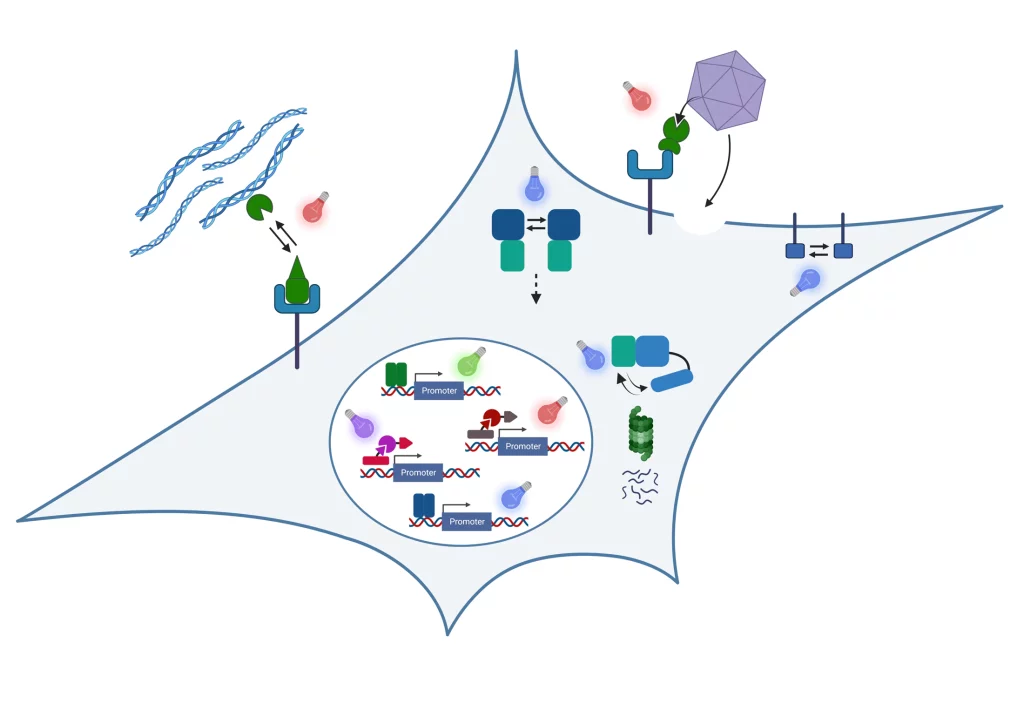
In our research, we engineer nature’s molecular sensing, processing, and actuation machinery in order to precisely control the function and properties of cells and materials. We apply these newly developed technologies in different fields of fundamental and applied research.

Team Members


Research
Stimulus-responsive and Information-processing (living) Materials

We develop and apply stimulus-responsive and information-processing biohybrid polymer materials. To this aim, we functionally couple synthetic biological molecular sensors and switches to polymer materials. By wiring these switches according to topologies inspired by electronic circuits, we engineer materials that perform fundamental computational operations. Examples of our work include:
- We engineered a hydrogel based on a bacteria-derived photoreceptor which allows the light-responsive, fully reversibly tuning of its mechanical properties. We applied this hydrogel as extracellular matrix to analyze the impact of dynamic mechanical environments on transcriptome-wide responses in mesenchymal stem cells or on the migration of T-lymphocytes.
See Hörner et al. Advanced Materials 2019 - We integrated synthetic biological switches with polymer materials into a circuit inspired by an electronic counter. The resulting material system was able to count the number of input light pulses and to release different output as a function of the number of light pulses detected. We applied this system to sequentially release different biocatalysts to drive a two-step biochemical reaction.
See Beyer et al., Advanced Materials 2018 - We developed PenTag, a protein tag for the spontaneous, covalent coupling of proteins to ampicillin-functionalized molecules such as dyes, polymers, or solid supports. Based on this strategy, we engineered and assembled material modules to function as encoder for processing different combinations of biochemical input stimuli.
See Mohsenin et al., Advanced Functional Materials 2024 - By engineering modular protease-based switches that can either be activated or repressed, we develop information-processing biohybrid circuits that process binary biomolecular information according to a circuit inspired by electronic decoders. Such circuits can be applied to process and interpret biochemical sensor information for advanced diagnostic applications.
See Mohsenin et al., Advanced Materials 2024
Molecular optogenetics to control cell fate and function
We develop and apply molecular optogenetic tools to control cell fate and function with unprecedented spatial and temporal precision in a dose-dependent and highly specific manner. To this aim, we engineer plant- and bacteria-derived photoreceptors and functionally couple them to proteins involved in cell signaling and gene expression. Examples of our work include:
- Light-inducible formation of liquid or gel-like transcription factor condensates in mammalian cells and mice. We demonstrate that liquid “transcription factor droplets” show a several-fold higher activity in inducing transgene expression compared to native transcription factors. Further, gel-like transcription factor condensates were shown to correlate with decreased transcriptional activation thus providing a materials-based layer of controlling gene expression.
See Schneider et al., Science Advances 2021 and Fischer et al., Small 2024 - Light-guided adeno-associated viral (AAV) vectors. We engineered a light-responsive tropism into AAVs which allows us to selectively transfer genetic information into single cells or to transduce different cells within one culture with different transgenes.
See Hörner et al., Science Advances 2021
Our group is running www.optobase.org, the most comprehensive database on molecular optogenetics. Have a look and discover the amazing opportunities in controlling biology with light!
Biosensors
We integrate natural and engineered molecular sensors for drugs, metabolites or nucleic acids into suitable readout formats for the fast and sensitive quantification of such substances. Together with collaboration partners, we develop biosensor systems for different application fields:
Open Positions
We are always excited to meet curious and creative scientists passionate about synthetic biology, optogenetics, and engineered living materials. If you would like to shape the future of biobased and living materials with us, we warmly welcome your spontaneous application for a PhD thesis or Postdoc position!
Projects and Partners
We perform collaborative research in materials-oriented synthetic biology within interdisciplinary research consortia
STEADY
Within the ERC Advanced Grant STEADY, we develop concepts for dynamically controlling the properties of engineered living materials by advanced synthetic genetic circuits.
LoopOfFun
We coordinate the European Innovation Council (EIC)-funded consortium LoopOfFun in which we aim at developing a platform for the rapid development of industry-scale, one-step, simple casting-based manufacturing processes for fungal mycelia composites. We jointly work towards this goal with our consortium partners:
- Prof. Roman Jerala, National Institute of Chemistry, Ljubljana, Slovenia
- Dr. Achim Weber, Fraunhofer IGB, Stuttgart, Germany
- Prof. Arnold Driessen, University of Groningen, The Netherlands
- Carlotta Borgato and Jan Boelen, Atelier LUMA, Arles, France
DELIVER
In the project DELIVER funded by the Carl-Zeiss-Foundation, we collaborate towards the data-driven engineering of sustainable living materials. We combine synthetic biology with materials sciences and data-driven approaches to design bio-based composite materials with custom-tailored structural properties for construction applications. Within deliver, we collaborate with the following partners:
- Prof. Thomas Speck, University of Freiburg, Germany
- Dr. Clemens Kreutz, University Hospital Freiburg, Germany
BILLARD
We coordinate the BILLARD project funded by the Federal Ministry of Education and Research (BMBF) within the funding line “Biologization of Technology”, we collaborate with PD Dr. Felicitas Bucher from the Clinic of Ophtamology at the University Hospital Freiburg on the development of novel intraocular drug delivery devices.
CIBSS – Centre for Integrative Biological Signalling Studies
We are member of the Cluster of Excellence CIBSS in which we perform research on novel optogenetic technologies to control signaling reactions in mammalian cells. We mainly collaborate with Prof. Dr. Jens Timmer on the model-based design of synthetic biological switches and networks and with Prof. Dr. Wolfgang Schamel on controlling immunological processes such as T cell activation via optogenetics.
Publications
Wang, Y. | Liao, S. | Guan, N. | Liu, Y. | Dong, K. | Weber, Wilfried | Ye, H.
DOI:
Dynamically adjustable gene- and cell-based therapies are recognized as next-generation medicine. However, the translation of precision therapies into clinics is limited by lack of specific switches controlled by inducers that are safe and ready for clinical use. Ferulic acid (FA) is a phytochemical with a wide range of therapeutic effects, and its salt sodium ferulate (SF) is used as an antithrombotic drug in clinics. Here, we describe an FA/SF-adjustable transcriptional switch controlled by the clinically licensed drug SF. We demonstrated that SF-responsive switches can be engineered to control CRISPR-Cas9 systems for on-command genome/epigenome engineering. In addition, we integrated FA-controlled switches into programmable biocomputers to process logic operations. We further demonstrated the dose-dependent SF-inducible transgene expression in mice by oral administration of SF tablets. Engineered switches responsive to small-molecule clinically licensed drugs to achieve adjustable transgene expression profiles provide new opportunities for dynamic interventions in gene- and cell-based precision medicine. Copyright © 2020 The Authors
Baaske, J. | Mühlhäuser, W. W. D. | Yousefi, O. S. | Zanner, S. | Radziwill, G. | Hörner, M. | Schamel, W. W. A. | Weber, Wilfried
DOI:
Optogenetic approaches have gathered momentum in precisely modulating and interrogating cellular signalling and gene expression. The use of optogenetics on the outer cell surface to interrogate how cells receive stimuli from their environment, however, has so far not reached its full potential. Here we demonstrate the development of an optogenetically regulated membrane receptor-ligand pair exemplified by the optically responsive interaction of an integrin receptor with the extracellular matrix. The system is based on an integrin engineered with a phytochrome-interacting factor domain (OptoIntegrin) and a red light-switchable phytochrome B-functionalized matrix (OptoMatrix). This optogenetic receptor-ligand pair enables light-inducible and -reversible cell-matrix interaction, as well as the controlled activation of downstream mechanosensory signalling pathways. Pioneering the application of optogenetic switches in the extracellular environment of cells, this OptoMatrix–OptoIntegrin system may serve as a blueprint for rendering matrix–receptor interactions amendable to precise control with light. © 2019, The Author(s).
Bruch, R. | Baaske, J. | Chatelle, C. | Meirich, M. | Madlener, S. | Weber, Wilfried | Dincer, C. | Urban, G. A.
DOI:
Noncoding small RNAs, such as microRNAs, are becoming the biomarkers of choice for multiple diseases in clinical diagnostics. A dysregulation of these microRNAs can be associated with many different diseases, such as cancer, dementia, and cardiovascular conditions. The key for effective treatment is an accurate initial diagnosis at an early stage, improving the patient's survival chances. In this work, the first clustered regularly interspaced short palindromic repeats (CRISPR)/Cas13a-powered microfluidic, integrated electrochemical biosensor for the on-site detection of microRNAs is introduced. Through this unique combination, the quantification of the potential tumor markers microRNA miR-19b and miR-20a is realized without any nucleic acid amplification. With a readout time of 9 min and an overall process time of less than 4 h, a limit of detection of 10 pm is achieved, using a measuring volume of less than 0.6 µL. Furthermore, the feasibility of the biosensor platform to detect miR-19b in serum samples of children, suffering from brain cancer, is demonstrated. The validation of the obtained results with a standard quantitative real-time polymerase chain reaction method shows the ability of the electrochemical CRISPR-powered system to be a low-cost, easily scalable, and target amplification-free tool for nucleic acid based diagnostics. © 2019 The Authors. Published by WILEY-VCH Verlag GmbH & Co. KGaA, Weinheim
Hörner, M. | Eble, J. | Yousefi, O. S. | Schwarz, J. | Warscheid, B. | Weber, Wilfried | Schamel, W. W. A.
DOI:
Multiprotein complexes control the behavior of cells, such as of lymphocytes of the immune system. Methods to affinity purify protein complexes and to determine their interactome by mass spectrometry are thus widely used. One drawback of these methods is the presence of false positives. In fact, the elution of the protein of interest (POI) is achieved by changing the biochemical properties of the buffer, so that unspecifically bound proteins (the false positives) may also elute. Here, we developed an optogenetics-derived and light-controlled affinity purification method based on the light-regulated reversible protein interaction between phytochrome B (PhyB) and its phytochrome interacting factor 6 (PIF6). We engineered a truncated variant of PIF6 comprising only 22 amino acids that can be genetically fused to the POI as an affinity tag. Thereby the POI can be purified with PhyB-functionalized resin material using 660 nm light for binding and washing, and 740 nm light for elution. Far-red light-induced elution is effective but very mild as the same buffer is used for the wash and elution. As proof-of-concept, we expressed PIF-tagged variants of the tyrosine kinase ZAP70 in ZAP70-deficient Jurkat T cells, purified ZAP70 and associating proteins using our light-controlled system, and identified the interaction partners by quantitative mass spectrometry. Using unstimulated T cells, we were able to detect the known interaction partners, and could filter out all other proteins. Copyright © 2019 Hörner, Eble, Yousefi, Schwarz, Warscheid, Weber and Schamel. This is an open-access article distributed under the terms of the Creative Commons Attribution License (CC BY). The use, distribution or reproduction in other forums is permitted, provided the original author(s) and the copyright owner(s) are credited and that the original publication in this journal is cited, in accordance with accepted academic practice. No use, distribution or reproduction is permitted which does not comply with these terms.
Hörner, M. | Gerhardt, K. | Salavei, P. | Hoess, P. | Härrer, D. | Kaiser, J. | Tabor, J. J. | Weber, Wilfried
DOI:
Phytochromes are important photoreceptors of plants, bacteria, and fungi responsive to light in the red and far-red spectrum. For increasing applications in basic research, synthetic biology, and materials sciences, it is required to recombinantly produce and purify phytochromes in high amounts. An ideal host organism for this purpose is E. coli due to its widespread use, fast growth, and ability for high-cell-density fermentation. Here, we describe the development of a generic platform for the production of phytochromes in E. coli that is compatible with high-cell-density fermentation. We exemplify our approach by the production of the photosensory domains of phytochrome B (PhyB) from A. thaliana and of the cyanobacterial phytochrome 1 (Cph1) from Synechocystis PCC 6803 in the multigram scale per 10 L fermentation run. Copyright © 2019 American Chemical Society.
Kolb, L. | Allazetta, S. | Karlsson, M. | Girgin, M. | Weber, Wilfried | Lutolf, M. P.
DOI:
As the field of tissue engineering develops, methods for screening combinations of signals for their effects on stem cell behavior are needed. We introduce a microgel-based screening platform for testing combinations of in situ-generated proteins on stem cell fate in ultrahigh-throughput. Compartmentalizing individual sets of growth factors was addressed by encapsulating aggregates of stable recombinant cell lines secreting individual glycoproteins into microgels through an on-chip polymerization. When these 'microniches' are cultured with a cell type of interest, fluorescence reporters indicate positive niches that perform the desired function, and the underlying producer cell lines of these selected microniches are analyzed by barcoded RNA sequencing. The microniche-based screening work-flow was validated via a model system based on engineered mammalian cells expressing yellow fluorescent protein (YFP) upon anti-inflammatory cytokine interleukin 4 (IL4)-based activation. © 2019 The Royal Society of Chemistry.

Hörner, M. | Raute, K. | Hummel, B. | Madl, J. | Creusen, G. | Thomas, O. S. | Christen, E. H. | Hotz, N. | Gübeli, R. J. | Engesser, R. | Rebmann, B. | Lauer, J. | Rolauffs, B. | Timmer, J. | Schamel, W. W. A. | Pruszak, J. | Römer, W. | Zurbriggen, M. D. | Friedrich, C. | Walther, A. | Minguet, S. | Sawarkar, R. | Weber, Wilfried
DOI:
Interrogation and control of cellular fate and function using optogenetics is providing revolutionary insights into biology. Optogenetic control of cells is achieved by coupling genetically encoded photoreceptors to cellular effectors and enables unprecedented spatiotemporal control of signaling processes. Here, a fast and reversibly switchable photoreceptor is used to tune the mechanical properties of polymer materials in a fully reversible, wavelength-specific, and dose- and space-controlled manner. By integrating engineered cyanobacterial phytochrome 1 into a poly(ethylene glycol) matrix, hydrogel materials responsive to light in the cell-compatible red/far-red spectrum are synthesized. These materials are applied to study in human mesenchymal stem cells how different mechanosignaling pathways respond to changing mechanical environments and to control the migration of primary immune cells in 3D. This optogenetics-inspired matrix allows fundamental questions of how cells react to dynamic mechanical environments to be addressed. Further, remote control of such matrices can create new opportunities for tissue engineering or provide a basis for optically stimulated drug depots. © 2019 WILEY-VCH Verlag GmbH & Co. KGaA, Weinheim
Mühlhäuser, W. W. D. | Weber, Wilfried | Radziwill, G.
DOI:
Subcellular localization of signal molecules is a hallmark in organizing the signaling network. OpEn-Tag is a modular optogenetic endomembrane targeting toolbox that allows alteration of the localization and therefore the activity of signaling processes with the spatiotemporal resolution of optogenetics. OpEn-Tag is a two-component system employing (1) a variety of targeting peptides fused to and thereby dictating the localization of mCherry-labeled cryptochrome 2 binding protein CIBN toward distinct endomembranes and (2) the cytosolic, fluorescence-labeled blue light photoreceptor cryptochrome 2 as a customizable building block that can be fused to proteins of interest. The combination of OpEn-Tag with growth factor stimulation or the use of two membrane anchor sequences allows investigation of multilayered signal transduction processes as demonstrated here for the protein kinase AKT. © 2019 American Chemical Society.
Thomas, O. S. | Weber, Wilfried
DOI:
The exploitation of nanosized materials for the delivery of therapeutic agents is already a clinical reality and still holds unrealized potential for the treatment of a variety of diseases. This review discusses physiological barriers a nanocarrier must overcome in order to reach its target, with an emphasis on cancer nanomedicine. Stages of delivery include residence in the blood stream, passive accumulation by virtue of the enhanced permeability and retention effect, diffusion within the tumor lesion, cellular uptake, and arrival at the site of action. We also briefly outline strategies for engineering nanoparticles to more efficiently overcome these challenges: Increasing circulation half-life by shielding with hydrophilic polymers, such as PEG, the limitations of PEG and potential alternatives, targeting and controlled activation approaches. Future developments in these areas will allow us to harness the full potential of nanomedicine. © Copyright © 2019 Thomas and Weber.