

We engineer cells and materials that communicate and process information through synthetic biology
Our inspiration is the ability of organisms and the materials they are made of to adapt to dynamic environmental conditions. Plants adapt growth to light conditions; bacteria develop resistance against antibiotics or bones get stronger when exercised. The basis for this ability to adapt is a fascinating information processing machinery of the organisms: Environmental conditions are captured by molecular sensors, then the signals are processed and integrated with genetic programs to finally yield a targeted response.
In our research, we engineer nature’s molecular sensing, processing, and actuation machinery in order to precisely control the function and properties of cells and materials. We apply these newly developed technologies in different fields of fundamental and applied research.

Team Members


Research
Stimulus-responsive and Information-processing (living) Materials

We develop and apply stimulus-responsive and information-processing biohybrid polymer materials. To this aim, we functionally couple synthetic biological molecular sensors and switches to polymer materials. By wiring these switches according to topologies inspired by electronic circuits, we engineer materials that perform fundamental computational operations. Examples of our work include:
- We engineered a hydrogel based on a bacteria-derived photoreceptor which allows the light-responsive, fully reversibly tuning of its mechanical properties. We applied this hydrogel as extracellular matrix to analyze the impact of dynamic mechanical environments on transcriptome-wide responses in mesenchymal stem cells or on the migration of T-lymphocytes.
See Hörner et al. Advanced Materials 2019 - We integrated synthetic biological switches with polymer materials into a circuit inspired by an electronic counter. The resulting material system was able to count the number of input light pulses and to release different output as a function of the number of light pulses detected. We applied this system to sequentially release different biocatalysts to drive a two-step biochemical reaction.
See Beyer et al., Advanced Materials 2018 - We developed PenTag, a protein tag for the spontaneous, covalent coupling of proteins to ampicillin-functionalized molecules such as dyes, polymers, or solid supports. Based on this strategy, we engineered and assembled material modules to function as encoder for processing different combinations of biochemical input stimuli.
See Mohsenin et al., Advanced Functional Materials 2024 - By engineering modular protease-based switches that can either be activated or repressed, we develop information-processing biohybrid circuits that process binary biomolecular information according to a circuit inspired by electronic decoders. Such circuits can be applied to process and interpret biochemical sensor information for advanced diagnostic applications.
See Mohsenin et al., Advanced Materials 2024
Molecular optogenetics to control cell fate and function
We develop and apply molecular optogenetic tools to control cell fate and function with unprecedented spatial and temporal precision in a dose-dependent and highly specific manner. To this aim, we engineer plant- and bacteria-derived photoreceptors and functionally couple them to proteins involved in cell signaling and gene expression. Examples of our work include:
- Light-inducible formation of liquid or gel-like transcription factor condensates in mammalian cells and mice. We demonstrate that liquid “transcription factor droplets” show a several-fold higher activity in inducing transgene expression compared to native transcription factors. Further, gel-like transcription factor condensates were shown to correlate with decreased transcriptional activation thus providing a materials-based layer of controlling gene expression.
See Schneider et al., Science Advances 2021 and Fischer et al., Small 2024 - Light-guided adeno-associated viral (AAV) vectors. We engineered a light-responsive tropism into AAVs which allows us to selectively transfer genetic information into single cells or to transduce different cells within one culture with different transgenes.
See Hörner et al., Science Advances 2021
Our group is running www.optobase.org, the most comprehensive database on molecular optogenetics. Have a look and discover the amazing opportunities in controlling biology with light!
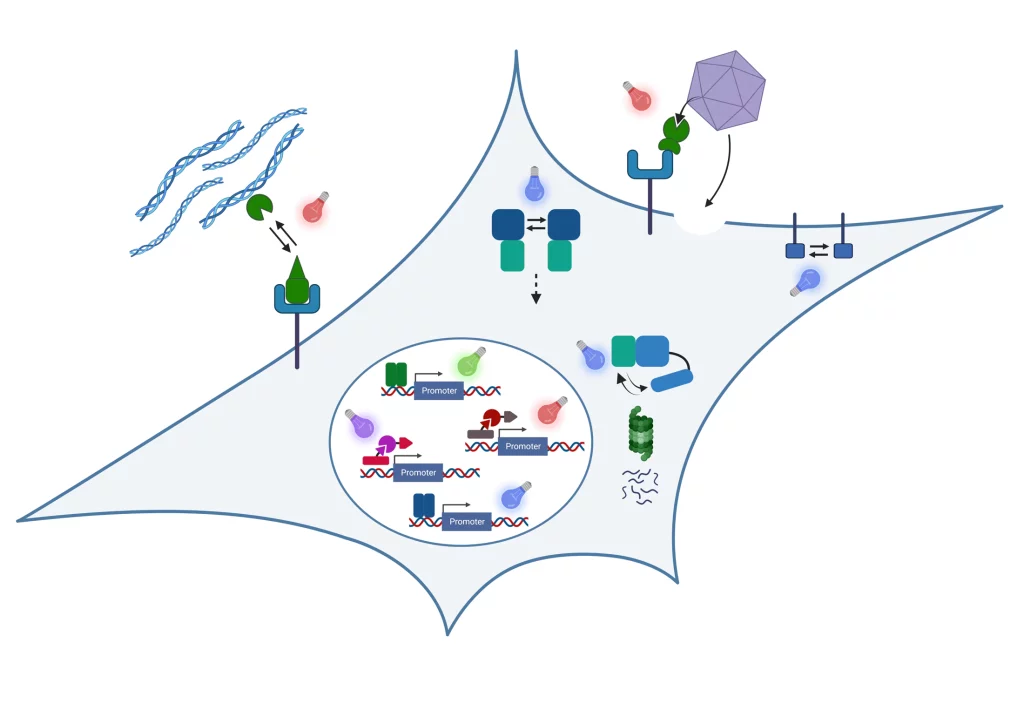
Biosensors
We integrate natural and engineered molecular sensors for drugs, metabolites or nucleic acids into suitable readout formats for the fast and sensitive quantification of such substances. Together with collaboration partners, we develop biosensor systems for different application fields:
Open Positions
We are always excited to meet curious and creative scientists passionate about synthetic biology, optogenetics, and engineered living materials. If you would like to shape the future of biobased and living materials with us, we warmly welcome your spontaneous application for a PhD thesis or Postdoc position!
Projects and Partners
We perform collaborative research in materials-oriented synthetic biology within interdisciplinary research consortia
STEADY
Within the ERC Advanced Grant STEADY, we develop concepts for dynamically controlling the properties of engineered living materials by advanced synthetic genetic circuits.
LoopOfFun
We coordinate the European Innovation Council (EIC)-funded consortium LoopOfFun in which we aim at developing a platform for the rapid development of industry-scale, one-step, simple casting-based manufacturing processes for fungal mycelia composites. We jointly work towards this goal with our consortium partners:
- Prof. Roman Jerala, National Institute of Chemistry, Ljubljana, Slovenia
- Dr. Achim Weber, Fraunhofer IGB, Stuttgart, Germany
- Prof. Arnold Driessen, University of Groningen, The Netherlands
- Carlotta Borgato and Jan Boelen, Atelier LUMA, Arles, France
DELIVER
In the project DELIVER funded by the Carl-Zeiss-Foundation, we collaborate towards the data-driven engineering of sustainable living materials. We combine synthetic biology with materials sciences and data-driven approaches to design bio-based composite materials with custom-tailored structural properties for construction applications. Within deliver, we collaborate with the following partners:
- Prof. Thomas Speck, University of Freiburg, Germany
- Dr. Clemens Kreutz, University Hospital Freiburg, Germany
BILLARD
We coordinate the BILLARD project funded by the Federal Ministry of Education and Research (BMBF) within the funding line “Biologization of Technology”, we collaborate with PD Dr. Felicitas Bucher from the Clinic of Ophtamology at the University Hospital Freiburg on the development of novel intraocular drug delivery devices.
CIBSS – Centre for Integrative Biological Signalling Studies
We are member of the Cluster of Excellence CIBSS in which we perform research on novel optogenetic technologies to control signaling reactions in mammalian cells. We mainly collaborate with Prof. Dr. Jens Timmer on the model-based design of synthetic biological switches and networks and with Prof. Dr. Wolfgang Schamel on controlling immunological processes such as T cell activation via optogenetics.
Publications

Schneider, N. | Wieland, F. G. | Kong, D. | Fischer, A. A. M. | Hörner, M. | Timmer, J. | Ye, H. | Weber, Wilfried
DOI:
Light-inducible gene switches represent a key strategy for the precise manipulation of cellular events in fundamental and applied research. However, the performance of widely used gene switches is limited due to low tissue penetrance and possible phototoxicity of the light stimulus. To overcome these limitations, we engineer optogenetic synthetic transcription factors to undergo liquid-liquid phase separation in close spatial proximity to promoters. Phase separation of constitutive and optogenetic synthetic transcription factors was achieved by incorporation of intrinsically disordered regions. Supported by a quantitative mathematical model, we demonstrate that engineered transcription factor droplets form at target promoters and increase gene expression up to fivefold. This increase in performance was observed in multiple mammalian cells lines as well as in mice following in situ transfection. The results of this work suggest that the introduction of intrinsically disordered domains is a simple yet effective means to boost synthetic transcription factor activity. Copyright © 2021 The Authors, some rights reserved.
Yousefi, O. S. | Ruggieri, M. | Idstein, V. | von Prillwitz, K. U. | Herr, L. A. | Chalupsky, J. | Köhn, M. | Weber, Wilfried | Timmer, J. | Schamel, W. W. A.
DOI:
Activation of T cells by agonistic peptide-MHC can be inhibited by antagonistic ones. However, the exact mechanism remains elusive. We used Jurkat cells expressing two different TCRs and tested whether stimulation of the endogenous TCR by agonistic anti-Vβ8 antibodies can be modulated by ligand-binding to the second, optogenetic TCR. The latter TCR uses phytochrome B tetramers (PhyBt) as ligand, the binding half-life of which can be altered by light. We show that this half-life determined whether the PhyBt acted as a second agonist (long half-life), an antagonist (short half-life) or did not have any influence (very short half-life) on calcium influx. A mathematical model of this cross-antagonism shows that a mechanism based on an inhibitory signal generated by early recruitment of a phosphatase and an activating signal by later recruitment of a kinase explains the data. © 2021 by the authors. Licensee MDPI, Basel, Switzerland.
Emig, R. | Zgierski-Johnston, C. M. | Beyersdorf, F. | Rylski, B. | Ravens, U. | Weber, Wilfried | Kohl, P. | Hörner, M. | Peyronnet, R.
DOI:
Fibrosis is associated with aging and many cardiac pathologies. It is characterized both by myofibroblast differentiation and by excessive accumulation of extracellular matrix proteins. Fibrosis-related tissue remodeling results in significant changes in tissue structure and function, including passive mechanical properties. This research area has gained significant momentum with the recent development of new tools and approaches to better characterize and understand the ability of cells to sense and respond to their biophysical environment. We use a novel hydrogel, termed CyPhyGel, to provide an advanced in vitro model of remodeling-related changes in tissue stiffness. Based on light-controlled dimerization of a Cyanobacterial Phytochrome, it enables contactless and reversible tuning of hydrogel mechanical properties with high spatial and temporal resolution. Human primary atrial fibroblasts were cultured on CyPhyGels. After 4 days of culturing on stiff (~4.6 kPa) or soft (~2.7 kPa) CyPhyGels, we analyzed fibroblast cell area and stiffness. Cells grown on the softer substrate were smaller and softer, compared to cells grown on the stiffer substrate. This difference was absent when both soft and stiff growth substrates were combined in a single CyPhyGel, with the resulting cell areas being similar to those on homogeneously stiff gels and cell stiffnesses being similar to those on homogeneously soft substrates. Using CyPhyGels to mimic tissue stiffness heterogeneities in vitro, our results confirm the ability of cardiac fibroblasts to adapt to their mechanical environment, and suggest the presence of a paracrine mechanism that tunes fibroblast structural and functional properties associated with mechanically induced phenotype conversion toward myofibroblasts. In the context of regionally increased tissue stiffness, such as upon scarring or in diffuse fibrosis, such a mechanism could help to prevent abrupt changes in cell properties at the border zone between normal and diseased tissue. The light-tunable mechanical properties of CyPhyGels and their suitability for studying human primary cardiac cells make them an attractive model system for cardiac mechanobiology research. Further investigations will explore the interactions between biophysical and soluble factors in the response of cardiac fibroblasts to spatially and temporally heterogeneous mechanical cues. © Copyright © 2020 Emig, Zgierski-Johnston, Beyersdorf, Rylski, Ravens, Weber, Kohl, Hörner and Peyronnet.
Fischbach, P. | Gonschorek, P. | Baaske, J. | Davies, J. A. | Weber, Wilfried | Zurbriggen, M. D.
DOI:
Optogenetic approaches facilitate the study of signaling and metabolic pathways in animal cell systems. In the past 10 years, a plethora of light-regulated switches for the targeted control over the induction of gene expression, subcellular localization of proteins, membrane receptor activity, and other cellular processes have been developed and successfully implemented. However, only a few tools have been engineered toward the quantitative and spatiotemporally resolved downregulation of proteins. Here we present a protocol for reversible and rapid blue light-induced reduction of protein levels in mammalian cells. By implementing a dual-regulated optogenetic switch (Blue-OFF), both repression of gene expression and degradation of the target protein are triggered simultaneously. We apply this system for the blue light-mediated control of programmed cell death. HEK293T cells are transfected with the proapoptotic proteins PUMA and BID integrated into the Blue-OFF system. Overexpression of these proteins leads to programmed cell death, which can be prevented by irradiation with blue light. This experimental approach is very straightforward, requires just simple hardware, and therefore can be easily implemented in state-of-the-art equipped mammalian cell culture labs. The system can be used for targeted cell signaling studies and biotechnological applications. © 2020, Springer Science+Business Media, LLC, part of Springer Nature.
Hörner, M. | Hoess, P. | Emig, R. | Rebmann, B. | Weber, Wilfried
DOI:
Synthetic extracellular matrices with reversibly adjustable mechanical properties are essential for the investigation of how cells respond to dynamic mechanical cues as occurring in living organisms. One interesting approach to engineer dynamic biomaterials is the incorporation of photoreceptors from cyanobacteria or plants into polymer materials. Here, we give an overview of existing photoreceptor-based biomaterials and describe a detailed protocol for the synthesis of a phytochrome-based extracellular matrix (CyPhyGel). Using cell-compatible light in the red and far-red spectrum, the mechanical properties of this matrix can be adjusted in a fully reversible, wavelength-specific, and dose-dependent manner with high spatiotemporal control. © 2020, Springer Science+Business Media, LLC, part of Springer Nature.
Hörner, Maximilian | Yousefi, O. Sascha | Schamel, Wolfang W. A. | Weber, Wilfried
DOI:
In the field of extracellular optogenetics, photoreceptors are applied outside of cells to obtain systems with a desired functionality. Among the diverse applied photoreceptors, phytochromes are the only ones that can be actively and reversibly switched between the active and inactive photostate by the illumination with cell-compatible red and far-red light. In this protocol, we describe the production of a biotinylated variant of the photosensory domain of A. thaliana phytochrome B (PhyB-AviTag) in E. coli with a single, optimized expression plasmid. We give detailed instructions for the purification of the protein by immobilized metal affinity chromatography and the characterization of the protein in terms of purity, biotinylation, spectral photoswitching and the light-dependent interaction with its interaction partner PIF6. In comparison to previous studies applying PhyB-AviTag, the optimized expression plasmid used in this protocol simplifies the production process and shows an increased yield and purity.
Kramer, M. M. | Mühlhäuser, W. W. D. | Weber, Wilfried | Radziwill, G.
DOI:
The precise control of signaling proteins is a prerequisite to decipher the complexity of the signaling network and to reveal and to study pathways involved in regulating cellular metabolism and gene expression. Optogenetic approaches play an emerging role as they enable the spatiotemporal control of signaling processes. Herein, a multichromatic system is developed by combining the blue light cryptochrome 2 system and the red/far-red light phytochrome B system. The use of three wavelengths allows the orthogonal control of the RAF/ERK and the AKT signaling pathway. Continuous exposure of cells to blue light leads to activation of AKT while simultaneous pulses of red and far-red light enable the modulation of ERK signaling in cells with constantly active AKT signaling. The optimized, orthogonal multichromatic system presented here is a valuable tool to better understand the fine grained and intricate processes involved in cell fate decisions. © 2020 Wiley-VCH GmbH
Lienemann, P. S. | Vallmajo-Martin, Q. | Papageorgiou, P. | Blache, U. | Metzger, S. | Kiveliö, A. S. | Milleret, V. | Sala, A. | Hoehnel, S. | Roch, A. | Reuten, R. | Koch, M. | Naveiras, O. | Weber, F. E. | Weber, Wilfried | Lutolf, M. P. | Ehrbar, M.
DOI:
The treatment of bone defects with recombinant bone morphogenetic protein-2 (BMP-2) requires high doses precluding broad clinical application. Here, a bioengineering approach is presented that strongly improves low-dose BMP-2-based bone regeneration by mobilizing healing-associated mesenchymal progenitor cells (MPCs). Smart synthetic hydrogels are used to trap and study endogenous MPCs trafficking to bone defects. Hydrogel-trapped and prospectively isolated MPCs differentiate into multiple lineages in vitro and form bone in vivo. In vitro screenings reveal that platelet-derived growth factor BB (PDGF-BB) strongly recruits prospective MPCs making it a promising candidate for the engineering of hydrogels that enrich endogenous MPCs in vivo. However, PDGF-BB inhibits BMP-2-mediated osteogenesis both in vitro and in vivo. In contrast, smart two-way dynamic release hydrogels with fast-release of PDGF-BB and sustained delivery of BMP-2 beneficially promote the healing of bone defects. Collectively, it is shown that modulating the dynamics of endogenous progenitor cells in vivo by smart synthetic hydrogels significantly improves bone healing and holds great potential for other advanced applications in regenerative medicine. © 2020 The Authors. Published by WILEY-VCH Verlag GmbH & Co. KGaA, Weinheim
Meyer, V. K. | Chatelle, C. V. | Weber, Wilfried | Niessner, R. | Seidel, M.
DOI:
For the first time, a flow-based regenerable chemiluminescence receptor assay is established that is eminently suited as screening method for the detection of widely used tetracyclines (TCs) in environmental and food samples. The complex functionality and high reactivity of TCs complicate the creation of immunogens which is currently the bottleneck for developing sensitive immunoassays. In this case, competitive bioreceptor assays for the analysis of small organic molecules are preferable and, moreover, flow-based regenerable bioassays are optimally suited for automated analysis applications. Therefore, the solution for rapid and sensitive analysis of TCs is the regenerable CL receptor assay with a covalently immobilized DNA oligonucleotide containing the specific operator sequence tetO to which the repressor protein TetR binds only in the absence of TCs. The TC measurements are performed on the CL microarray analysis platform MCR 3 within 30 min per sample. The LoD in spiked tap water was determined to be 0.1 μg L−1, and for 1 μg L−1 TET, recoveries of 77% ± 16% were obtained. Due to the stability of the immobilized DNA oligonucleotide and the resulting regenerability of the assay for various measurements, the new method is highly cost- and resource-efficient and ideally suited for the monitoring of environmental samples in the field. [Figure not available: see fulltext.] © 2020, The Author(s).
Ochoa-Fernandez, R. | Abel, N. B. | Wieland, F. G. | Schlegel, J. | Koch, L. A. | Miller, J. B. | Engesser, R. | Giuriani, G. | Brandl, S. M. | Timmer, J. | Weber, Wilfried | Ott, T. | Simon, R. | Zurbriggen, M. D.
DOI:
Optogenetics is the genetic approach for controlling cellular processes with light. It provides spatiotemporal, quantitative and reversible control over biological signaling and metabolic processes, overcoming limitations of chemically inducible systems. However, optogenetics lags in plant research because ambient light required for growth leads to undesired system activation. We solved this issue by developing plant usable light-switch elements (PULSE), an optogenetic tool for reversibly controlling gene expression in plants under ambient light. PULSE combines a blue-light-regulated repressor with a red-light-inducible switch. Gene expression is only activated under red light and remains inactive under white light or in darkness. Supported by a quantitative mathematical model, we characterized PULSE in protoplasts and achieved high induction rates, and we combined it with CRISPR–Cas9-based technologies to target synthetic signaling and developmental pathways. We applied PULSE to control immune responses in plant leaves and generated Arabidopsis transgenic plants. PULSE opens broad experimental avenues in plant research and biotechnology. © 2020, The Author(s), under exclusive licence to Springer Nature America, Inc.