

We engineer cells and materials that communicate and process information through synthetic biology
Our inspiration is the ability of organisms and the materials they are made of to adapt to dynamic environmental conditions. Plants adapt growth to light conditions; bacteria develop resistance against antibiotics or bones get stronger when exercised. The basis for this ability to adapt is a fascinating information processing machinery of the organisms: Environmental conditions are captured by molecular sensors, then the signals are processed and integrated with genetic programs to finally yield a targeted response.
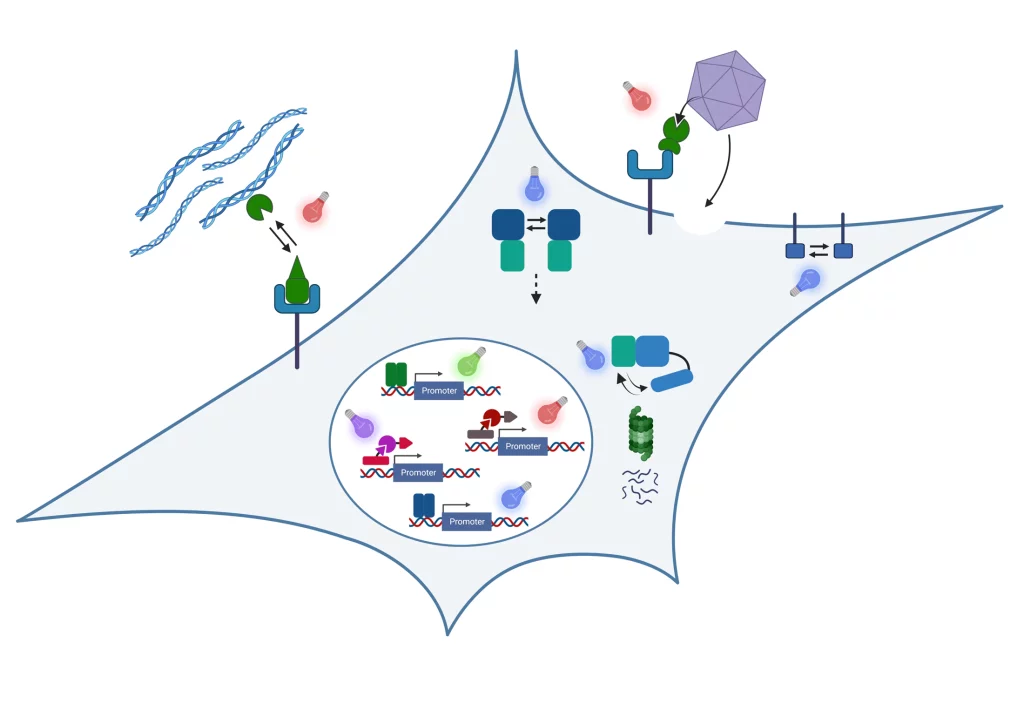
In our research, we engineer nature’s molecular sensing, processing, and actuation machinery in order to precisely control the function and properties of cells and materials. We apply these newly developed technologies in different fields of fundamental and applied research.

Team Members


Research
Stimulus-responsive and Information-processing (living) Materials

We develop and apply stimulus-responsive and information-processing biohybrid polymer materials. To this aim, we functionally couple synthetic biological molecular sensors and switches to polymer materials. By wiring these switches according to topologies inspired by electronic circuits, we engineer materials that perform fundamental computational operations. Examples of our work include:
- We engineered a hydrogel based on a bacteria-derived photoreceptor which allows the light-responsive, fully reversibly tuning of its mechanical properties. We applied this hydrogel as extracellular matrix to analyze the impact of dynamic mechanical environments on transcriptome-wide responses in mesenchymal stem cells or on the migration of T-lymphocytes.
See Hörner et al. Advanced Materials 2019 - We integrated synthetic biological switches with polymer materials into a circuit inspired by an electronic counter. The resulting material system was able to count the number of input light pulses and to release different output as a function of the number of light pulses detected. We applied this system to sequentially release different biocatalysts to drive a two-step biochemical reaction.
See Beyer et al., Advanced Materials 2018 - We developed PenTag, a protein tag for the spontaneous, covalent coupling of proteins to ampicillin-functionalized molecules such as dyes, polymers, or solid supports. Based on this strategy, we engineered and assembled material modules to function as encoder for processing different combinations of biochemical input stimuli.
See Mohsenin et al., Advanced Functional Materials 2024 - By engineering modular protease-based switches that can either be activated or repressed, we develop information-processing biohybrid circuits that process binary biomolecular information according to a circuit inspired by electronic decoders. Such circuits can be applied to process and interpret biochemical sensor information for advanced diagnostic applications.
See Mohsenin et al., Advanced Materials 2024
Molecular optogenetics to control cell fate and function
We develop and apply molecular optogenetic tools to control cell fate and function with unprecedented spatial and temporal precision in a dose-dependent and highly specific manner. To this aim, we engineer plant- and bacteria-derived photoreceptors and functionally couple them to proteins involved in cell signaling and gene expression. Examples of our work include:
- Light-inducible formation of liquid or gel-like transcription factor condensates in mammalian cells and mice. We demonstrate that liquid “transcription factor droplets” show a several-fold higher activity in inducing transgene expression compared to native transcription factors. Further, gel-like transcription factor condensates were shown to correlate with decreased transcriptional activation thus providing a materials-based layer of controlling gene expression.
See Schneider et al., Science Advances 2021 and Fischer et al., Small 2024 - Light-guided adeno-associated viral (AAV) vectors. We engineered a light-responsive tropism into AAVs which allows us to selectively transfer genetic information into single cells or to transduce different cells within one culture with different transgenes.
See Hörner et al., Science Advances 2021
Our group is running www.optobase.org, the most comprehensive database on molecular optogenetics. Have a look and discover the amazing opportunities in controlling biology with light!
Biosensors
We integrate natural and engineered molecular sensors for drugs, metabolites or nucleic acids into suitable readout formats for the fast and sensitive quantification of such substances. Together with collaboration partners, we develop biosensor systems for different application fields:
Open Positions
We are always excited to meet curious and creative scientists passionate about synthetic biology, optogenetics, and engineered living materials. If you would like to shape the future of biobased and living materials with us, we warmly welcome your spontaneous application for a PhD thesis or Postdoc position!
Projects and Partners
We perform collaborative research in materials-oriented synthetic biology within interdisciplinary research consortia
STEADY
Within the ERC Advanced Grant STEADY, we develop concepts for dynamically controlling the properties of engineered living materials by advanced synthetic genetic circuits.
LoopOfFun
We coordinate the European Innovation Council (EIC)-funded consortium LoopOfFun in which we aim at developing a platform for the rapid development of industry-scale, one-step, simple casting-based manufacturing processes for fungal mycelia composites. We jointly work towards this goal with our consortium partners:
- Prof. Roman Jerala, National Institute of Chemistry, Ljubljana, Slovenia
- Dr. Achim Weber, Fraunhofer IGB, Stuttgart, Germany
- Prof. Arnold Driessen, University of Groningen, The Netherlands
- Carlotta Borgato and Jan Boelen, Atelier LUMA, Arles, France
DELIVER
In the project DELIVER funded by the Carl-Zeiss-Foundation, we collaborate towards the data-driven engineering of sustainable living materials. We combine synthetic biology with materials sciences and data-driven approaches to design bio-based composite materials with custom-tailored structural properties for construction applications. Within deliver, we collaborate with the following partners:
- Prof. Thomas Speck, University of Freiburg, Germany
- Dr. Clemens Kreutz, University Hospital Freiburg, Germany
BILLARD
We coordinate the BILLARD project funded by the Federal Ministry of Education and Research (BMBF) within the funding line “Biologization of Technology”, we collaborate with PD Dr. Felicitas Bucher from the Clinic of Ophtamology at the University Hospital Freiburg on the development of novel intraocular drug delivery devices.
CIBSS – Centre for Integrative Biological Signalling Studies
We are member of the Cluster of Excellence CIBSS in which we perform research on novel optogenetic technologies to control signaling reactions in mammalian cells. We mainly collaborate with Prof. Dr. Jens Timmer on the model-based design of synthetic biological switches and networks and with Prof. Dr. Wolfgang Schamel on controlling immunological processes such as T cell activation via optogenetics.
Publications
Thomas, O. S. | Rebmann, B. | Tonn, M. | Schirmeister, I. C. | Wehrle, S. | Becker, J. | Zea Jimenez, G. J. | Hook, S. | Jäger, S. | Klenzendorf, M. | Laskowski, M. | Kaier, A. | Pütz, G. | Zurbriggen, M. D. | Weber, Wilfried | Hörner, M. | Wagner, H. J.
DOI:
Controlling the time and dose of nanoparticulate drug delivery by administration of small molecule drugs holds promise for efficient and safer therapies. This study describes a versatile approach of exploiting antibody-ligand interactions for the design of small molecule-responsive nanocarrier and nanocomposite systems. For this purpose, antibody fragments (scFvs) specific for two distinct small molecule ligands are designed. Subsequently, the surface of nanoparticles (liposomes or adeno-associated viral vectors, AAVs) is modified with these ligands, serving as anchor points for scFv binding. By modifying the scFvs with polymer tails, they can act as a non-covalently bound shielding layer, which is recruited to the anchor points on the nanoparticle surface and prevents interactions with cultured mammalian cells. Administration of an excess of the respective ligand triggers competitive displacement of the shielding layer from the nanoparticle surface and restores nanoparticle-cell interactions. The same principle is applied for developing hydrogel depots that can release integrated AAVs or liposomes in response to small molecule ligands. The liberated nanoparticles subsequently deliver their cargoes to cells. In summary, the utilization of different antibody-ligand interactions, different nanoparticles, and different release systems validates the versatility of the design concept described herein. © 2021 The Authors. Small published by Wiley-VCH GmbH
Zhou, Y. | Kong, D. | Wang, X. | Yu, G. | Wu, X. | Guan, N. | Weber, Wilfried | Ye, H.
DOI:
Optogenetic technologies have transformed our ability to precisely control biological processes in time and space. Yet, current eukaryotic optogenetic systems are limited by large or complex optogenetic modules, long illumination times, low tissue penetration or slow activation and deactivation kinetics. Here, we report a red/far-red light-mediated and miniaturized Δphytochrome A (ΔPhyA)-based photoswitch (REDMAP) system based on the plant photoreceptor PhyA, which rapidly binds the shuttle protein far-red elongated hypocotyl 1 (FHY1) under illumination with 660-nm light with dissociation occurring at 730 nm. We demonstrate multiple applications of REDMAP, including dynamic on/off control of the endogenous Ras/Erk mitogen-activated protein kinase (MAPK) cascade and control of epigenetic remodeling using a REDMAP-mediated CRISPR–nuclease-deactivated Cas9 (CRISPR–dCas9) (REDMAPcas) system in mice. We also demonstrate the utility of REDMAP tools for in vivo applications by activating the expression of transgenes delivered by adeno-associated viruses (AAVs) or incorporated into cells in microcapsules implanted into mice, rats and rabbits illuminated by light-emitting diodes (LEDs). Further, we controlled glucose homeostasis in type 1 diabetic (T1D) mice and rats using REDMAP to trigger insulin expression. REDMAP is a compact and sensitive tool for the precise spatiotemporal control of biological activities in animals with applications in basic biology and potentially therapy. © 2021, The Author(s), under exclusive licence to Springer Nature America, Inc.
Bruch, R. | Johnston, M. | Kling, A. | Mattmüller, T. | Baaske, J. | Partel, S. | Madlener, S. | Weber, Wilfried | Urban, G. A. | Dincer, C.
DOI:
Recently the use of microRNAs (miRNAs) as biomarkers for a multitude of diseases has gained substantial significance for clinical as well as point-of-care diagnostics. Amongst other challenges, however, it holds the central requirement that the concentration of a given miRNA must be evaluated within the context of other factors in order to unambiguously diagnose one specific disease. In terms of the development of diagnostic methods and devices, this implies an inevitable demand for multiplexing in order to be able to gauge the abundance of several components of interest in a patient's sample in parallel. In this study, we design and implement different multiplexed versions of our electrochemical microfluidic biosensor by dividing its channel into subsections, creating four novel chip designs for the amplification-free and simultaneous quantification of up to eight miRNAs on the CRISPR-Biosensor X (‘X’ highlighting the multiplexing aspect of the device). We then use a one-step model assay followed by amperometric readout in combination with a 2-min-stop-flow-protocol to explore the fluidic and mechanical characteristics and limitations of the different versions of the device. The sensor showing the best performance, is subsequently used for the Cas13a-powered proof-of-concept measurement of two miRNAs (miRNA-19b and miRNA-20a) from the miRNA-17–92 cluster, which is dysregulated in the blood of pediatric medulloblastoma patients. Quantification of the latter, alongside simultaneous negative control measurements are accomplished on the same device. We thereby confirm the applicability of our platform to the challenge of amplification-free, parallel detection of multiple nucleic acids. © 2020 Elsevier B.V.
Burgos-Morales, O. | Gueye, M. | Lacombe, L. | Nowak, C. | Schmachtenberg, R. | Hörner, M. | Jerez-Longres, C. | Mohsenin, H. | Wagner, H. J. | Weber, Wilfried
DOI:
Materials in nature have fascinating properties that serve as a continuous source of inspiration for materials scientists. Accordingly, bio-mimetic and bio-inspired approaches have yielded remarkable structural and functional materials for a plethora of applications. Despite these advances, many properties of natural materials remain challenging or yet impossible to incorporate into synthetic materials. Natural materials are produced by living cells, which sense and process environmental cues and conditions by means of signaling and genetic programs, thereby controlling the biosynthesis, remodeling, functionalization, or degradation of the natural material. In this context, synthetic biology offers unique opportunities in materials sciences by providing direct access to the rational engineering of how a cell senses and processes environmental information and translates them into the properties and functions of materials. Here, we identify and review two main directions by which synthetic biology can be harnessed to provide new impulses for the biologization of the materials sciences: first, the engineering of cells to produce precursors for the subsequent synthesis of materials. This includes materials that are otherwise produced from petrochemical resources, but also materials where the bio-produced substances contribute unique properties and functions not existing in traditional materials. Second, engineered living materials that are formed or assembled by cells or in which cells contribute specific functions while remaining an integral part of the living composite material. We finally provide a perspective of future scientific directions of this promising area of research and discuss science policy that would be required to support research and development in this field. © 2021 The Author(s)
Hörner, M. | Weber, Wilfried
DOI:
Available methods for efficient gene transfer into user-selected or even single cells suffer from high invasiveness or the need for complicated equipment. Here, we present a technology for the light-guided transduction of native cell lines and primary cells by adeno-associated viral (AAV) vectors. We demonstrate the spatially resolved transduction of different cells with different genes within one culture and the selective transduction of single cells by local illumination. © 2021, Die Autoren.
Kramer, M. M. | Lataster, L. | Weber, Wilfried | Radziwill, G.
DOI:
Biological signals are sensed by their respective receptors and are transduced and pro-cessed by a sophisticated intracellular signaling network leading to a signal-specific cellular re-sponse. Thereby, the response to the signal depends on the strength, the frequency, and the duration of the stimulus as well as on the subcellular signal progression. Optogenetic tools are based on genetically encoded light-sensing proteins facilitating the precise spatiotemporal control of signal transduction pathways and cell fate decisions in the absence of natural ligands. In this review, we provide an overview of optogenetic approaches connecting light-regulated protein-protein interaction or caging/uncaging events with steering the function of signaling proteins. We briefly discuss the most common optogenetic switches and their mode of action. The main part deals with the engineering and application of optogenetic tools for the control of transmembrane receptors including receptor tyrosine kinases, the T cell receptor and integrins, and their effector proteins. We also ad-dress the hallmarks of optogenetics, the spatial and temporal control of signaling events. © 2021 by the authors. Licensee MDPI, Basel, Switzerland.

Hörner, M. | Jerez-Longres, C. | Hudek, A. | Hook, S. | Yousefi, O. S. | Schamel, W. W. A. | Hörner, C. | Zurbriggen, M. D. | Ye, H. | Wagner, H. J. | Weber, Wilfried
DOI:
Methodologies for the controlled delivery of genetic information into target cells are of utmost importance for genetic engineering in both fundamental and applied research. However, available methods for efficient gene transfer into user-selected or even single cells suffer from low throughput, the need for complicated equipment, high invasiveness, or side effects by off-target viral uptake. Here, we engineer an adeno-associated viral (AAV) vector system that transfers genetic information into native target cells upon illumination with cell-compatible red light. This OptoAAV system allows adjustable and spatially resolved gene transfer down to single-cell resolution and is compatible with different cell lines and primary cells. Moreover, the sequential application of multiple OptoAAVs enables spatially resolved transduction with different transgenes. The approach presented is likely extendable to other classes of viral vectors and is expected to foster advances in basic and applied genetic research. Copyright © 2021 The Authors, some rights reserved.
Schneider, N. | Chatelle, C. V. | Ochoa-Fernandez, R. | Zurbriggen, M. D. | Weber, Wilfried
DOI:
The quest to engineer increasingly complex synthetic gene networks in mammalian and plant cells requires an ever-growing portfolio of orthogonal gene expression systems. To control gene expression, light is of particular interest due to high spatial and temporal resolution, ease of dosage and simplicity of administration, enabling increasingly sophisticated man–machine interfaces. However, the majority of applied optogenetic switches are crowded in the UVB, blue and red/far-red light parts of the optical spectrum, limiting the number of simultaneously applicable stimuli. This problem is even more pertinent in plant cells, in which UV-A/B, blue, and red light-responsive photoreceptors are already expressed endogenously. To alleviate these challenges, we developed a green light responsive gene switch, based on the light-sensitive bacterial transcription factor CarH from Thermus thermophilus and its cognate DNA operator sequence CarO. The switch is characterized by high reversibility, high transgene expression levels, and low leakiness, leading to up to 350-fold induction ratios in mammalian cells. In this chapter, we describe the essential steps to build functional components of the green light-regulated gene switch, followed by detailed protocols to quantify transgene expression over time in mammalian cells. In addition, we expand this protocol with a description of how the optogenetic switch can be implemented in protoplasts of A. thaliana. © 2021, Springer Science+Business Media, LLC, part of Springer Nature.
Wagner, H. J. | Weber, Wilfried | Fussenegger, M.
DOI:
Three recent approvals and over 100 ongoing clinical trials make adeno-associated virus (AAV)-based vectors the leading gene delivery vehicles in gene therapy. Pharmaceutical companies are investing in this small and nonpathogenic gene shuttle to increase the therapeutic portfolios within the coming years. This prospect of marking a new era in gene therapy has fostered both investigations of the fundamental AAV biology as well as engineering studies to enhance delivery vehicles. Driven by the high clinical potential, a new generation of synthetic-biologically engineered AAV vectors is on the rise. Concepts from synthetic biology enable the control and fine-tuning of vector function at different stages of cellular transduction and gene expression. It is anticipated that the emerging field of synthetic-biologically engineered AAV vectors can shape future gene therapeutic approaches and thus the design of tomorrow's gene delivery vectors. This review describes and discusses the recent trends in capsid and vector genome engineering, with particular emphasis on synthetic-biological approaches. © 2021 The Authors. Advanced Science published by Wiley-VCH GmbH