

We engineer cells and materials that communicate and process information through synthetic biology
Our inspiration is the ability of organisms and the materials they are made of to adapt to dynamic environmental conditions. Plants adapt growth to light conditions; bacteria develop resistance against antibiotics or bones get stronger when exercised. The basis for this ability to adapt is a fascinating information processing machinery of the organisms: Environmental conditions are captured by molecular sensors, then the signals are processed and integrated with genetic programs to finally yield a targeted response.
In our research, we engineer nature’s molecular sensing, processing, and actuation machinery in order to precisely control the function and properties of cells and materials. We apply these newly developed technologies in different fields of fundamental and applied research.

Team Members


Research
Stimulus-responsive and Information-processing (living) Materials

We develop and apply stimulus-responsive and information-processing biohybrid polymer materials. To this aim, we functionally couple synthetic biological molecular sensors and switches to polymer materials. By wiring these switches according to topologies inspired by electronic circuits, we engineer materials that perform fundamental computational operations. Examples of our work include:
- We engineered a hydrogel based on a bacteria-derived photoreceptor which allows the light-responsive, fully reversibly tuning of its mechanical properties. We applied this hydrogel as extracellular matrix to analyze the impact of dynamic mechanical environments on transcriptome-wide responses in mesenchymal stem cells or on the migration of T-lymphocytes.
See Hörner et al. Advanced Materials 2019 - We integrated synthetic biological switches with polymer materials into a circuit inspired by an electronic counter. The resulting material system was able to count the number of input light pulses and to release different output as a function of the number of light pulses detected. We applied this system to sequentially release different biocatalysts to drive a two-step biochemical reaction.
See Beyer et al., Advanced Materials 2018 - We developed PenTag, a protein tag for the spontaneous, covalent coupling of proteins to ampicillin-functionalized molecules such as dyes, polymers, or solid supports. Based on this strategy, we engineered and assembled material modules to function as encoder for processing different combinations of biochemical input stimuli.
See Mohsenin et al., Advanced Functional Materials 2024 - By engineering modular protease-based switches that can either be activated or repressed, we develop information-processing biohybrid circuits that process binary biomolecular information according to a circuit inspired by electronic decoders. Such circuits can be applied to process and interpret biochemical sensor information for advanced diagnostic applications.
See Mohsenin et al., Advanced Materials 2024
Molecular optogenetics to control cell fate and function
We develop and apply molecular optogenetic tools to control cell fate and function with unprecedented spatial and temporal precision in a dose-dependent and highly specific manner. To this aim, we engineer plant- and bacteria-derived photoreceptors and functionally couple them to proteins involved in cell signaling and gene expression. Examples of our work include:
- Light-inducible formation of liquid or gel-like transcription factor condensates in mammalian cells and mice. We demonstrate that liquid “transcription factor droplets” show a several-fold higher activity in inducing transgene expression compared to native transcription factors. Further, gel-like transcription factor condensates were shown to correlate with decreased transcriptional activation thus providing a materials-based layer of controlling gene expression.
See Schneider et al., Science Advances 2021 and Fischer et al., Small 2024 - Light-guided adeno-associated viral (AAV) vectors. We engineered a light-responsive tropism into AAVs which allows us to selectively transfer genetic information into single cells or to transduce different cells within one culture with different transgenes.
See Hörner et al., Science Advances 2021
Our group is running www.optobase.org, the most comprehensive database on molecular optogenetics. Have a look and discover the amazing opportunities in controlling biology with light!
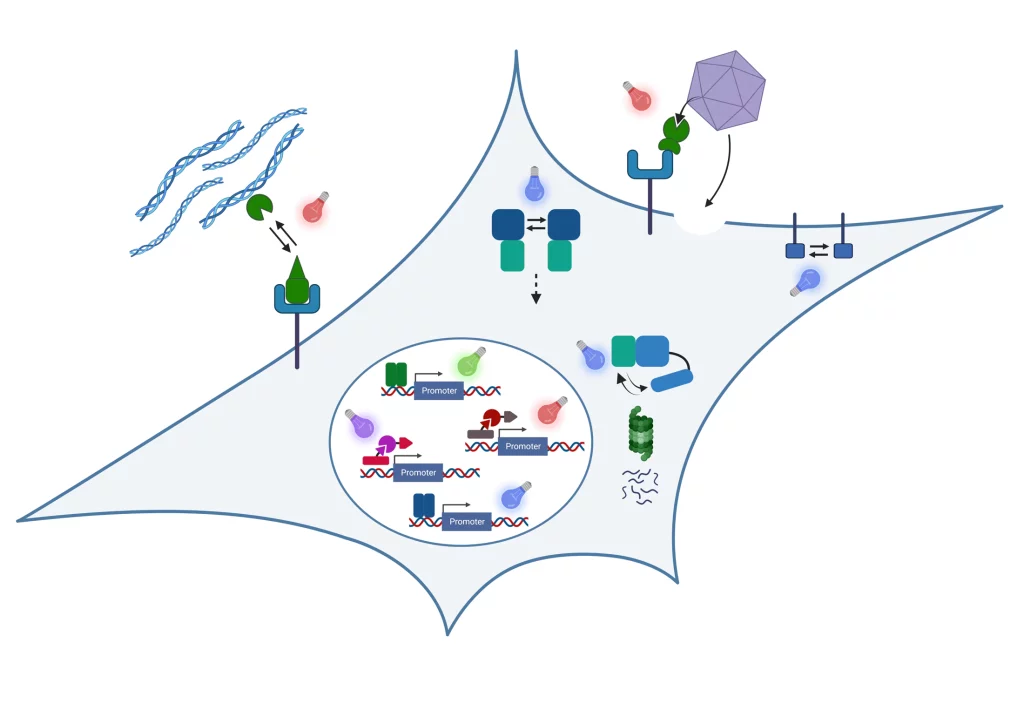
Biosensors
We integrate natural and engineered molecular sensors for drugs, metabolites or nucleic acids into suitable readout formats for the fast and sensitive quantification of such substances. Together with collaboration partners, we develop biosensor systems for different application fields:
Open Positions
We are always excited to meet curious and creative scientists passionate about synthetic biology, optogenetics, and engineered living materials. If you would like to shape the future of biobased and living materials with us, we warmly welcome your spontaneous application for a PhD thesis or Postdoc position!
Projects and Partners
We perform collaborative research in materials-oriented synthetic biology within interdisciplinary research consortia
STEADY
Within the ERC Advanced Grant STEADY, we develop concepts for dynamically controlling the properties of engineered living materials by advanced synthetic genetic circuits.
LoopOfFun
We coordinate the European Innovation Council (EIC)-funded consortium LoopOfFun in which we aim at developing a platform for the rapid development of industry-scale, one-step, simple casting-based manufacturing processes for fungal mycelia composites. We jointly work towards this goal with our consortium partners:
- Prof. Roman Jerala, National Institute of Chemistry, Ljubljana, Slovenia
- Dr. Achim Weber, Fraunhofer IGB, Stuttgart, Germany
- Prof. Arnold Driessen, University of Groningen, The Netherlands
- Carlotta Borgato and Jan Boelen, Atelier LUMA, Arles, France
DELIVER
In the project DELIVER funded by the Carl-Zeiss-Foundation, we collaborate towards the data-driven engineering of sustainable living materials. We combine synthetic biology with materials sciences and data-driven approaches to design bio-based composite materials with custom-tailored structural properties for construction applications. Within deliver, we collaborate with the following partners:
- Prof. Thomas Speck, University of Freiburg, Germany
- Dr. Clemens Kreutz, University Hospital Freiburg, Germany
BILLARD
We coordinate the BILLARD project funded by the Federal Ministry of Education and Research (BMBF) within the funding line “Biologization of Technology”, we collaborate with PD Dr. Felicitas Bucher from the Clinic of Ophtamology at the University Hospital Freiburg on the development of novel intraocular drug delivery devices.
CIBSS – Centre for Integrative Biological Signalling Studies
We are member of the Cluster of Excellence CIBSS in which we perform research on novel optogenetic technologies to control signaling reactions in mammalian cells. We mainly collaborate with Prof. Dr. Jens Timmer on the model-based design of synthetic biological switches and networks and with Prof. Dr. Wolfgang Schamel on controlling immunological processes such as T cell activation via optogenetics.
Publications
Lohse, Stefan | Mink, Jan Niklas | Eckhart, Lea | Hans, Muriel Charlotte | Jusufi, Leuart | Zwick, Anabel | Mohr, Tobias | Bley, Isabelle Ariane | Khalmurzaev, Oybek | Matveev, Vsevolod Borisovich | Loertzer, Philine | Pryalukhin, Alexey | Hartmann, Arndt | Geppert, Carol-Immanuel | Loertzer, Hagen | Wunderlich, Heiko | Lehnhof, Hans-Peter | Naumann, Carsten Maik | Kalthoff, Holger | Junker, Kerstin
DOI:
PeCa is a rare entity with rising incidence rates due to increased infections with human papillomaviruses (HPV). The distinct subtypes of PeCa with an individual pathogenesis demand biomarkers for a precise patient risk assessment regarding disease progression and therapeutic susceptibility. We recently identified promising candidates associated with an HPV-instructed tumor microenvironment (TME) using HPV-positive PeCa cell lines and tissue microarrays (TMA). The capacity of HPV + p63 + PeCa cells to release neutrophil-attracting CXCL-8 provided a molecular link explaining the infiltration of CD15 + myeloid cells in PeCa specimens. The candidate biomarkers HPV, p63, CD15, DKK1, and CD147 linked a tumor-promoting TME with a higher TNM classification reflecting more aggressive and metastasizing cancers. Based on immune-reactive scores (IRS) from TMA staining for these biomarkers, we calculated correlations and conducted association analyses to assess the degree of relationship between all biomarkers. We then conducted Kaplan–Meier survival estimates and Cox regression analyses to delineate the impact on PeCa patient survival. There is a notable predictive potential regarding the survival of patients with biomarker profiles beyond the potency of the individual biomarker. From all candidate biomarkers and biomarker profiles, the combination of CD147 and infiltrating CD15 + cells linked to an active HPV-driven transformation displayed cancer-immune dynamics with dismal prognosis for patients. After deciphering relevant interdependencies, the HPV + CD147 + CD15 + status was the most potent profile predicting metastasis-free survival of PeCa patients. The results of this report underscore the need for analysis of the TME and the development of multi-parameter composite scores that reflect fundamental cancer-immune relationships to tailor therapeutic interventions based on actual cancer immune dynamics.
Valcenko, Alexander | Zwick, Anabel | Schneider, Lissy | Linxweiler, Maximilian | Lohse, Stefan
DOI:
Neutrophils play a crucial role in the tumor microenvironment (TME) of head and neck squamous cell carcinomas (HNSCC) and significantly influence treatment outcomes. Phenotypic and functional properties of neutrophils adapt to the TME with distinct subsets modulating disease progression and therapeutic interventions. Here, we evaluated phenotypic and functional differences of neutrophils derived from HNSCC patients and healthy donors. We observed significant phenotypic differences between neutrophils from healthy donors and HNSCC patient-derived neutrophils. Gender and tumor stage influenced neutrophil phenotypes and their ability to lyse tumor cells through antibody-dependent cell-mediated cytotoxicity (ADCC). Patients with advanced HNSCC and males may benefit less from neutrophil-centered immunotherapy. An engineered IgA2 antibody specific for the epidermal growth factor receptor (EGFR) demonstrated superior efficacy in activating neutrophils for ADCC compared to Panitumumab using healthy and patient-derived neutrophils, underscoring the potential of the IgA isotype as a therapeutic alternative. The distinct behavior and antibody-isotype dependent ADCC competence of CD177+/- neutrophils of healthy but not HNSCC donors warrants further exploration. Our study emphasizes the importance of personalized immunotherapy treatments that consider the characteristics of neutrophils, patient demographics, and the type of antibody to improve ADCC and ultimately enhance treatment outcomes for HNSCC.
Fischer, Alexandra A. M. | Schatz, Larissa | Baaske, Julia | Römer, Winfried | Weber, Wilfried | Thuenauer, Roland
DOI:
Each cell in a multicellular organism permanently adjusts the concentration of its cell
surface proteins. In particular, epithelial cells tightly control the number of carriers,
transporters and cell adhesion proteins at their plasma membrane. However, sensi-
tively measuring the cell surface concentration of a particular protein of interest in
live cells and in real time represents a considerable challenge. Here, we introduce a
novel approach based on split luciferases, which uses one luciferase fragment as a
tag on the protein of interest and the second fragment as a supplement to the extra-
cellular medium. Once the protein of interest arrives at the cell surface, the luciferase
fragments complement and generate luminescence. We compared the performance
of split Gaussia luciferase and split Nanoluciferase by using a system to synchronize
biosynthetic trafficking with conditional aggregation domains. The best results were
achieved with split Nanoluciferase, for which luminescence increased more than
6000-fold upon recombination. Furthermore, we showed that our approach can sep-
arately detect and quantify the arrival of membrane proteins at the apical and baso-
lateral plasma membrane in single polarized epithelial cells by detecting the
luminescence signals with a microscope, thus opening novel avenues for characteriz-
ing the variations in trafficking in individual epithelial cells.
Hörner, Maximilian | Becker, Jan | Bohnert, Rebecca | Banos, Miguel | Jerez-Longres, Carolina | Mühlhäuser, Vanessa | Härrer, Daniel | Wang Wong, Tin | Meier, Matthias | Weber, Wilfried
DOI:
Hydrogels with adjustable mechanical properties have been engineered as matrices for mammalian cells and allow the dynamic, mechano-responsive manipulation of cell fate and function. Recent research yields hydrogels, where biological photoreceptors translated optical signals into a reversible and adjustable change in hydrogel mechanics. While their initial application provides important insights into mechanobiology, broader implementation is limited by a small dynamic range of addressable stiffness. Herein, this limitation is overcome by developing a photoreceptor-based hydrogel with reversibly adjustable stiffness from ≈800 Pa to the sol state. The hydrogel is based on star-shaped polyethylene glycol, functionalized with the red/far-red light photoreceptor phytochrome B (PhyB), or phytochrome-interacting factor 6 (PIF6). Upon illumination with red light, PhyB heterodimerizes with PIF6, thus crosslinking the polymers and resulting in gelation. However, upon illumination with far-red light, the proteins dissociate and trigger a complete gel-to-sol transition. The hydrogel's light-responsive mechanical properties are comprehensively characterized and it is applied as a reversible extracellular matrix for the spatiotemporally controlled deposition of mammalian cells within a microfluidic chip. It is anticipated that this technology will open new avenues for the site- and time-specific positioning of cells and will contribute to overcome spatial restrictions.
Jerez-Longres, Carolina | Gómez-Matos, Marieta | Becker, Jan | Hörner, Maximilian | Wieland, Franz-Georg | Timmer, Jens | Weber, Wilfried
DOI:
Encapsulated cell-based therapies involve the use of genetically-modified cells embedded in a material in order to produce a therapeutic agent in a specific location in the patient's body. This approach has shown great potential in animal model systems for treating diseases such as type I diabetes or cancer, with selected approaches having been tested in clinical trials. Despite the promise shown by encapsulated cell therapy, though, there are safety concerns yet to be addressed, such as the escape of the engineered cells from the encapsulation material and the resulting production of therapeutic agents at uncontrolled sites in the body. For that reason, there is great interest in the implementation of safety switches that protect from those side effects. Here, we develop a material-genetic interface as safety switch for engineered mammalian cells embedded into hydrogels. Our switch allows the therapeutic cells to sense whether they are embedded in the hydrogel by means of a synthetic receptor and signaling cascade that link transgene expression to the presence of an intact embedding material. The system design is highly modular, allowing its flexible adaptation to other cell types and embedding materials. This autonomously acting switch constitutes an advantage over previously described safety switches, which rely on user-triggered signals to modulate activity or survival of the implanted cells. We envision that the concept developed here will advance the safety of cell therapies and facilitate their translation to clinical evaluation.
Molinari, Pamela E. | Krapp, Adriana R. | Weiner, Andrea | Beyer, Hannes M. | Kondadi, Arun Kumar | Blomeier, Tim | López, Melina | Bustos-Sanmamed, Pilar | Tevere, Evelyn | Weber, Wilfried | Reichert, Andreas S. | Calcaterra, Nora B. | Beller, Mathias | Carrillo, Nestor | Zurbriggen, Matias D.
DOI:
NADP(H) is a central metabolic hub providing reducing equivalents to multiple biosynthetic, regulatory and antioxidative pathways in all living organisms. While biosensors are available to determine NADP+ or NADPH levels in vivo, no probe exists to estimate the NADP(H) redox status, a determinant of the cell energy availability. We describe herein the design and characterization of a genetically-encoded ratiometric biosensor, termed NERNST, able to interact with NADP(H) and estimate ENADP(H). NERNST consists of a redox-sensitive green fluorescent protein (roGFP2) fused to an NADPH-thioredoxin reductase C module which selectively monitors NADP(H) redox states via oxido-reduction of the roGFP2 moiety. NERNST is functional in bacterial, plant and animal cells, and organelles such as chloroplasts and mitochondria. Using NERNST, we monitor NADP(H) dynamics during bacterial growth, environmental stresses in plants, metabolic challenges to mammalian cells, and wounding in zebrafish. NERNST estimates the NADP(H) redox poise in living organisms, with various potential applications in biochemical, biotechnological and biomedical research.
Russ, Marissa | Ehret, Anna K. | Hörner, Maximilian | Peschkov, Daniel | Bohnert, Rebecca | Idstein, Vincent | Minguet, Susana | Weber, Wilfried | Lillemeier, Björn F. | Yousefi, O. Sascha | Schamel, Wolfgang W.
DOI:
The kinetics of a ligand-receptor interaction determine the responses of the receptor-expressing cell. One approach to experimentally and reversibly change this kinetics on demand is optogenetics. We have previously developed a system in which the interaction of a modified receptor with an engineered ligand can be controlled by light. In this system the ligand is a soluble Phytochrome B (PhyB) tetramer and the receptor is fused to a mutated PhyB-interacting factor (PIFS). However, often the natural ligand is not soluble, but expressed as a membrane protein on another cell. This allows ligand-receptor interactions in two dimensions. Here, we developed a strategy to generate cells that display PhyB as a membrane-bound protein by expressing the SpyCatcher fused to a transmembrane domain in HEK-293T cells and covalently coupling purified PhyB-SpyTag to these cells. As proof-of-principle, we use Jurkat T cells that express a GFP-PIFS-T cell receptor and show that these cells can be stimulated by the PhyB-coupled HEK-293T cells in a light dependent manner. Thus, we call the PhyB-coupled cells opto-antigen presenting cells (opto-APCs). Our work expands the toolbox of optogenetic technologies, allowing two-dimensional ligand-receptor interactions to be controlled by light.
Su, C. | Rodriguez-Franco, M. | Lace, B. | Nebel, N. | Hernandez-Reyes, C. | Liang, P. | Schulze, E. | Mymrikov, E. V. | Gross, N. M. | Knerr, J. | Wang, H. | Siukstaite, L. | Keller, J. | Libourel, C. | Fischer, A. A. M. | Gabor, K. E. | Mark, E. | Popp, C. | Hunte, C. | Weber, Wilfried | Wendler, P. | Stanislas, T. | Delaux, P. M. | Einsle, O. | Grosse, R. | Römer, W. | Ott, T.
DOI:
In plants, the topological organization of membranes has mainly been attributed to the cell wall and the cytoskeleton. Additionally, few proteins, such as plant-specific remorins have been shown to function as protein and lipid organizers. Root nodule symbiosis requires continuous membrane re-arrangements, with bacteria being finally released from infection threads into membrane-confined symbiosomes. We found that mutations in the symbiosis-specific SYMREM1 gene result in highly disorganized perimicrobial membranes. AlphaFold modelling and biochemical analyses reveal that SYMREM1 oligomerizes into antiparallel dimers and may form a higher-order membrane scaffolding structure. This was experimentally confirmed when expressing this and other remorins in wall-less protoplasts is sufficient where they significantly alter and stabilize de novo membrane topologies ranging from membrane blebs to long membrane tubes with a central actin filament. Reciprocally, mechanically induced membrane indentations were equally stabilized by SYMREM1. Taken together we describe a plant-specific mechanism that allows the stabilization of large-scale membrane conformations independent of the cell wall. © 2023, The Author(s).