

We engineer cells and materials that communicate and process information through synthetic biology
Our inspiration is the ability of organisms and the materials they are made of to adapt to dynamic environmental conditions. Plants adapt growth to light conditions; bacteria develop resistance against antibiotics or bones get stronger when exercised. The basis for this ability to adapt is a fascinating information processing machinery of the organisms: Environmental conditions are captured by molecular sensors, then the signals are processed and integrated with genetic programs to finally yield a targeted response.
In our research, we engineer nature’s molecular sensing, processing, and actuation machinery in order to precisely control the function and properties of cells and materials. We apply these newly developed technologies in different fields of fundamental and applied research.

Team Members


Research
Stimulus-responsive and Information-processing (living) Materials

We develop and apply stimulus-responsive and information-processing biohybrid polymer materials. To this aim, we functionally couple synthetic biological molecular sensors and switches to polymer materials. By wiring these switches according to topologies inspired by electronic circuits, we engineer materials that perform fundamental computational operations. Examples of our work include:
- We engineered a hydrogel based on a bacteria-derived photoreceptor which allows the light-responsive, fully reversibly tuning of its mechanical properties. We applied this hydrogel as extracellular matrix to analyze the impact of dynamic mechanical environments on transcriptome-wide responses in mesenchymal stem cells or on the migration of T-lymphocytes.
See Hörner et al. Advanced Materials 2019 - We integrated synthetic biological switches with polymer materials into a circuit inspired by an electronic counter. The resulting material system was able to count the number of input light pulses and to release different output as a function of the number of light pulses detected. We applied this system to sequentially release different biocatalysts to drive a two-step biochemical reaction.
See Beyer et al., Advanced Materials 2018 - We developed PenTag, a protein tag for the spontaneous, covalent coupling of proteins to ampicillin-functionalized molecules such as dyes, polymers, or solid supports. Based on this strategy, we engineered and assembled material modules to function as encoder for processing different combinations of biochemical input stimuli.
See Mohsenin et al., Advanced Functional Materials 2024 - By engineering modular protease-based switches that can either be activated or repressed, we develop information-processing biohybrid circuits that process binary biomolecular information according to a circuit inspired by electronic decoders. Such circuits can be applied to process and interpret biochemical sensor information for advanced diagnostic applications.
See Mohsenin et al., Advanced Materials 2024
Molecular optogenetics to control cell fate and function
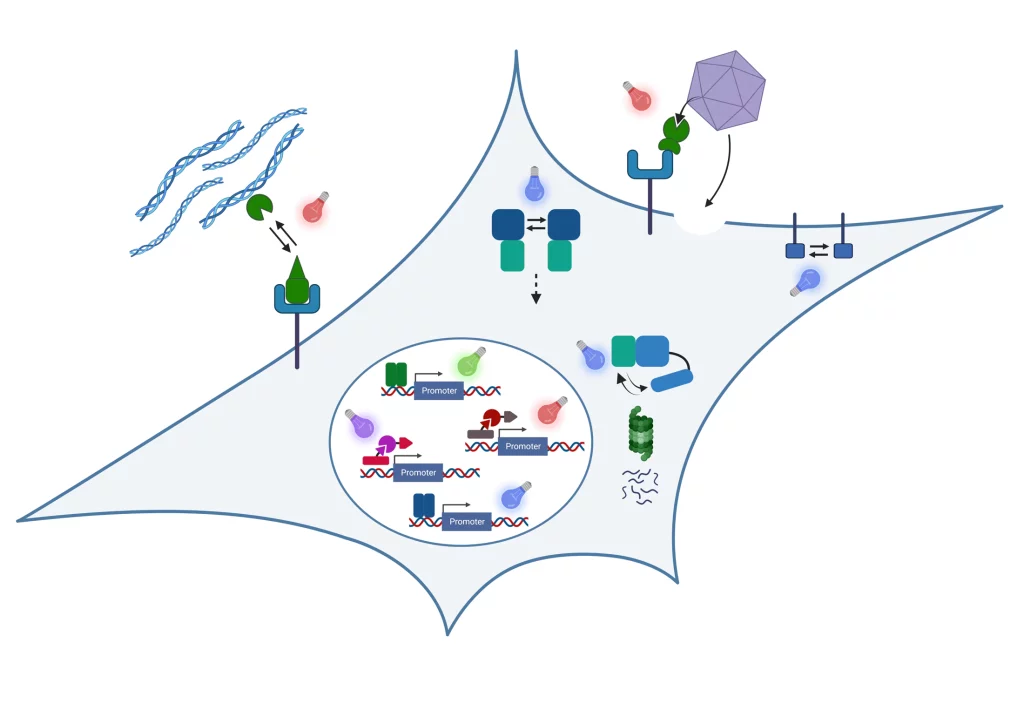
We develop and apply molecular optogenetic tools to control cell fate and function with unprecedented spatial and temporal precision in a dose-dependent and highly specific manner. To this aim, we engineer plant- and bacteria-derived photoreceptors and functionally couple them to proteins involved in cell signaling and gene expression. Examples of our work include:
- Light-inducible formation of liquid or gel-like transcription factor condensates in mammalian cells and mice. We demonstrate that liquid “transcription factor droplets” show a several-fold higher activity in inducing transgene expression compared to native transcription factors. Further, gel-like transcription factor condensates were shown to correlate with decreased transcriptional activation thus providing a materials-based layer of controlling gene expression.
See Schneider et al., Science Advances 2021 and Fischer et al., Small 2024 - Light-guided adeno-associated viral (AAV) vectors. We engineered a light-responsive tropism into AAVs which allows us to selectively transfer genetic information into single cells or to transduce different cells within one culture with different transgenes.
See Hörner et al., Science Advances 2021
Our group is running www.optobase.org, the most comprehensive database on molecular optogenetics. Have a look and discover the amazing opportunities in controlling biology with light!
Biosensors
We integrate natural and engineered molecular sensors for drugs, metabolites or nucleic acids into suitable readout formats for the fast and sensitive quantification of such substances. Together with collaboration partners, we develop biosensor systems for different application fields:
Open Positions
We are always excited to meet curious and creative scientists passionate about synthetic biology, optogenetics, and engineered living materials. If you would like to shape the future of biobased and living materials with us, we warmly welcome your spontaneous application for a PhD thesis or Postdoc position!
Projects and Partners
We perform collaborative research in materials-oriented synthetic biology within interdisciplinary research consortia
STEADY
Within the ERC Advanced Grant STEADY, we develop concepts for dynamically controlling the properties of engineered living materials by advanced synthetic genetic circuits.
LoopOfFun
We coordinate the European Innovation Council (EIC)-funded consortium LoopOfFun in which we aim at developing a platform for the rapid development of industry-scale, one-step, simple casting-based manufacturing processes for fungal mycelia composites. We jointly work towards this goal with our consortium partners:
- Prof. Roman Jerala, National Institute of Chemistry, Ljubljana, Slovenia
- Dr. Achim Weber, Fraunhofer IGB, Stuttgart, Germany
- Prof. Arnold Driessen, University of Groningen, The Netherlands
- Carlotta Borgato and Jan Boelen, Atelier LUMA, Arles, France
DELIVER
In the project DELIVER funded by the Carl-Zeiss-Foundation, we collaborate towards the data-driven engineering of sustainable living materials. We combine synthetic biology with materials sciences and data-driven approaches to design bio-based composite materials with custom-tailored structural properties for construction applications. Within deliver, we collaborate with the following partners:
- Prof. Thomas Speck, University of Freiburg, Germany
- Dr. Clemens Kreutz, University Hospital Freiburg, Germany
BILLARD
We coordinate the BILLARD project funded by the Federal Ministry of Education and Research (BMBF) within the funding line “Biologization of Technology”, we collaborate with PD Dr. Felicitas Bucher from the Clinic of Ophtamology at the University Hospital Freiburg on the development of novel intraocular drug delivery devices.
CIBSS – Centre for Integrative Biological Signalling Studies
We are member of the Cluster of Excellence CIBSS in which we perform research on novel optogenetic technologies to control signaling reactions in mammalian cells. We mainly collaborate with Prof. Dr. Jens Timmer on the model-based design of synthetic biological switches and networks and with Prof. Dr. Wolfgang Schamel on controlling immunological processes such as T cell activation via optogenetics.
Publications
Fischer, Alexandra A. M. | Kramer, Markus M. | Banos, Miguel | Grimm, Merlin M. | Fliegauf, Manfred | Grimbacher, Bodo | Radziwill,Gerald | Rahmann, Sven | Weber, Wilfried
DOI:
Molecular optogenetics allows the control of molecular signaling pathways in response to light. This enables the analysis of the kinetics of signal activation and propagation in a spatially and temporally resolved manner. A key strategy for such control is the light-inducible clustering of signaling molecules, which leads to their activation and subsequent downstream signaling. In this work, an optogenetic approach is developed for inducing graded clustering of different proteins that are fused to eGFP, a widely used protein tag. To this aim, an eGFP-specific nanobody is fused to Cryptochrome 2 variants engineered for different orders of cluster formation. This is exemplified by clustering eGFP-IKKα and eGFP-IKKβ, thereby achieving potent and reversible activation of NF-κB signaling. It is demonstrated that this approach can activate downstream signaling via the endogenous NF-κB pathway and is thereby capable of activating both an NF-κB-responsive reporter construct as well as endogenous NF-κB-responsive target genes as analyzed by RNA sequencing. The generic design of this system is likely transferable to other signaling pathways to analyze the kinetics of signal activation and propagation.
Ostmann, Katharina | Kraegeloh, Annette | Weber, Wilfried
DOI:
Formaldehyde is the smallest existing aldehyde, a highly reactive color less gas at room temperature and ubiquitously present in our atmosphere. Because of its reactivity leading to the crosslinking of macromolecules like proteins, it is widely used in industrial applications, but also in cell biology in order to preserve cells and tissues for further analysis. In this work, we show that formaldehyde releasing solutions commonly used for fixation of cells, can diffuse via the gas phase to the neighboring well and influence signaling processes in the therein cultured cells. To analyze this effect, we utilized a stable reporter cell line for YAP signaling or a gene expression-based reporter for activation of the NF-κB pathway. We could show that next to formaldehyde, also glutaraldehyde and acetaldehyde were able to activate those signaling pathways. Additionally, especially the stable reporter cell line based on YAP signaling can also be used as sensor for bioavailable formaldehyde, being highly sensitive, easy to use, and reversible. The observed impact of formaldehyde on cellular signaling underscores the need for careful planning of experimental protocols and emphasizes the importance of implementing proper controls when utilizing this reagent in cellular signaling analyses.
Schmitt, Franz-Josef | Mehmood, Amna Shah | Tüting, Christian | Phan, Hoang Trong | Reisdorf, Judith | Rieder, Fabian | Golmohamadi, Farzin Ghane | Verma, Rajni | Kastritis, Panagiotis L. | Laufer, Jan
DOI:
The pH dependence of the absorption and (time-resolved) fluorescence of two red-shifted fluorescent proteins, mCardinal and mNeptune, was investigated. Decay-associated spectra were measured following fluorescence excitation at 470 nm in PBS buffer with a pH that ranged from 5.5 to 8.0. The fluorescence of both proteins shows two different decay components. mCardinal exhibits an increase in the long-lived fluorescence component with acidification from 1.34 ns at pH 8.0 to 1.62 ns at pH 5.5. An additional fast decay component with 0.64 ns at pH 8.0 up to 1.1 ns at pH 5.5 was found to be blue-shifted compared to the long-lived component. The fluorescence lifetime of mNeptune is insensitive to pH. DAS of mCardinal were simulated assuming a coupled two-level system to describe the 1S state of the chromophore within two different conformations of the protein. MD simulations were conducted to correlate the experimentally observed pH-induced change in the lifetime in mCardinal with its molecular properties. While the chromophores of both protein variants are stabilized by the same number of hydrogen bonds, it was found that the chromophore in mCardinal exhibits more water contacts compared to mNeptune. In mCardinal, interaction between the chromophore and Glu-145 is reduced as compared to mNeptune, but interaction with Thr-147 which is Ser-147 in mNeptune is stronger in mCardinal. Therefore, the dynamics of the excited-state proton transfer (ESPT) might be different in mCardinal and mNeptune. The pH dependency of ESPT is suggested as a key mechanism for pH sensitivity.
Armbruster, Anja | Ehret, Anna K. | Russ, Marissa | Idstein, Vincent | Klenzendorf, Melissa | Gaspar, Denise | Juraske, Claudia | Yousefi, O. Sascha | Schamel, Wolfang W. | Weber, Wilfried | Hörner, Maximilian
DOI:
Optogenetics is a versatile and powerful tool for the control and analysis of cellular signaling processes. The activation of cellular receptors by light using optogenetic switches usually requires genetic manipulation of cells. However, this considerably limits the application in primary, nonengineered cells, which is crucial for the study of physiological signaling processes and for controlling cell fate and function for therapeutic purposes. To overcome this limitation, we developed a system for the light-dependent extracellular activation of cell surface receptors of nonengineered cells termed OptoREACT (Optogenetic Receptor Activation) based on the light-dependent protein interaction of A. thaliana phytochrome B (PhyB) with PIF6. In the OptoREACT system, a PIF6-coupled antibody fragment binds the T cell receptor (TCR) of Jurkat or primary human T cells, which upon illumination is bound by clustered phytochrome B to induce receptor oligomerization and activation. For clustering of PhyB, we either used tetramerization by streptavidin or immobilized PhyB on the surface of cells to emulate the interaction of a T cell with an antigen-presenting cell. We anticipate that this extracellular optogenetic approach will be applicable for the light-controlled activation of further cell surface receptors in primary, nonengineered cells for versatile applications in fundamental and applied research.
Fischer, Alexandra A. M. | Robertson, Hanah B. | Kong, Deqiang | Grimm, Merlin M. | Grether, Jakob | Groth, Johanna | Baltes, Carsten | Fliegauf, Manfred | Lautenschlaeger, Franziska | Grimbacher, Bodo | Ye, Haifeng | Helms, Volkhard | Weber, Wilfried
DOI:
Phase separation of biomolecules into condensates is a key mechanism in the spatiotemporal organization of biochemical processes in cells. However, the impact of the material properties of biomolecular condensates on important processes, such as the control of gene expression, remains largely elusive. Here, the material properties of optogenetically induced transcription factor condensates are systematically tuned, and probed for their impact on the activation of target promoters. It is demonstrated that transcription factors in rather liquid condensates correlate with increased gene expression levels, whereas stiffer transcription factor condensates correlate with the opposite effect, reduced activation of gene expression. The broad nature of these findings is demonstrated in mammalian cells and mice, as well as by using different synthetic and natural transcription factors. These effects are observed for both transgenic and cell-endogenous promoters. The findings provide a novel materials-based layer in the control of gene expression, which opens novel opportunities in optogenetic engineering and synthetic biology.
Lohse, Stefan | Weber, Wilfried
DOI:
A novel approach for controlling translation initiation in mammalian cells is demonstrated based on the conditional attachment of eukaryotic translation initiation factor-binding proteins to the 3′ UTR of mRNAs via small molecule-, light-, or protein-responsive interactions. The technology overcomes limitations of previously used transcription-based switches and was shown to be functional in managing diabetes or tumor growth in preclinical animal models.
Mohsenin, Hasti | Pacheco, Jennifer | Kemmer, Svenja | Wagner, Hanna J. | Höfflin, Nico | Bergmann, Toquinha | Baumann, Tim | Jerez-Longres, Carolina | Ripp, Alexander | Jork, Nikolaus | Jessen, Henning J. | Fussenegger, Martin | Köhn, Maja | Timmer, Jens | Weber, Wilfried
DOI:
The site-specific and covalent conjugation of proteins on solid supports and in hydrogels is the basis for the synthesis of biohybrid materials offering broad applications. Current methods for conjugating proteins to desired targets are often challenging due to unspecific binding, unstable (noncovalent) coupling, or expensive and difficult-to-synthesize ligand molecules. Here, is presented PenTag, an approach for the bioorthogonal, highly specific, and covalent conjugation of a protein to its ligand for various applications in materials sciences. Penicillin-binding protein 3 (PBP3) is engineered and shows that this protein can be used for the stable and spontaneous conjugation of proteins to dyes, polymers, or solid supports. PenTag as a crosslinking tool is applied for synthesizing stimuli-responsive hydrogels or for the development of a biohybrid material system performing computational operations emulating a 4:2 encoder. Based on this broad applicability and the use of a small, cheap, and easy-to-functionalize ligand and a stable, soluble recombinant protein, is seen PenTag as a versatile approach toward biohybrid material synthesis.

Mohsenin, Hasti | Wagner, Hanna J. | Rosenblatt, Marcus | Kemmer, Svenja | Dreppe, Friedel | Huesgen, Pitter | Timmer, Jens | Weber, Wilfried
DOI:
Synthetic biology applies concepts from electrical engineering and information processing to endow cells with computational functionality. Transferring the underlying molecular components into materials and wiring them according to topologies inspired by electronic circuit boards has yielded materials systems that perform selected computational operations. However, the limited functionality of available building blocks is restricting the implementation of advanced information-processing circuits into materials. Here, a set of protease-based biohybrid modules the bioactivity of which can either be induced or inhibited is engineered. Guided by a quantitative mathematical model and following a design-build-test-learn (DBTL) cycle, the modules are wired according to circuit topologies inspired by electronic signal decoders, a fundamental motif in information processing. A 2-input/4-output binary decoder for the detection of two small molecules in a material framework that can perform regulated outputs in form of distinct protease activities is designed. The here demonstrated smart material system is strongly modular and can be used for biomolecular information processing for example in advanced biosensing or drug delivery applications.
Armbruster, Anja | Mohamed, Asim M.E. | Phan, Hoang Trong | Weber, Wilfried
DOI:
Molecular optogenetics utilizes genetically encoded, light-responsive protein switches to control the function of molecular processes. Over the last two years, there have been notable advances in the development of novel optogenetic switches, their utilization in elucidating intricate signaling pathways, and their progress toward practical applications in biotechnological processes, material sciences, and therapeutic applications. In this review, we discuss these areas, offer insights into recent developments, and contemplate future directions.
Urban, Nadine | Hörner, Maximilian | Weber, Wilfried | Dincer, Can
DOI:
Circumventing the limitations of current bioassays, we introduce a light-controlled assay, OptoAssay, toward wash- and pump-free point-of-care diagnostics. Extending the capabilities of standard bioassays with light-dependent and reversible interaction of optogenetic switches, OptoAssays enable a bidirectional movement of assay components, only by changing the wavelength of light. Demonstrating exceptional versatility, the OptoAssay showcases its efficacy on various substrates, delivering a dynamic bioassay format. The applicability of the OptoAssay is successfully demonstrated by the calibration of a competitive model assay, resulting in a superior limit of detection of 8 pg ml−1, which is beyond those of conventional ELISA tests. In the future, combined with smartphones, OptoAssays could obviate the need for external flow control systems such as pumps or valves and signal readout devices, enabling on-site analysis in resource-limited settings.