

We engineer cells and materials that communicate and process information through synthetic biology
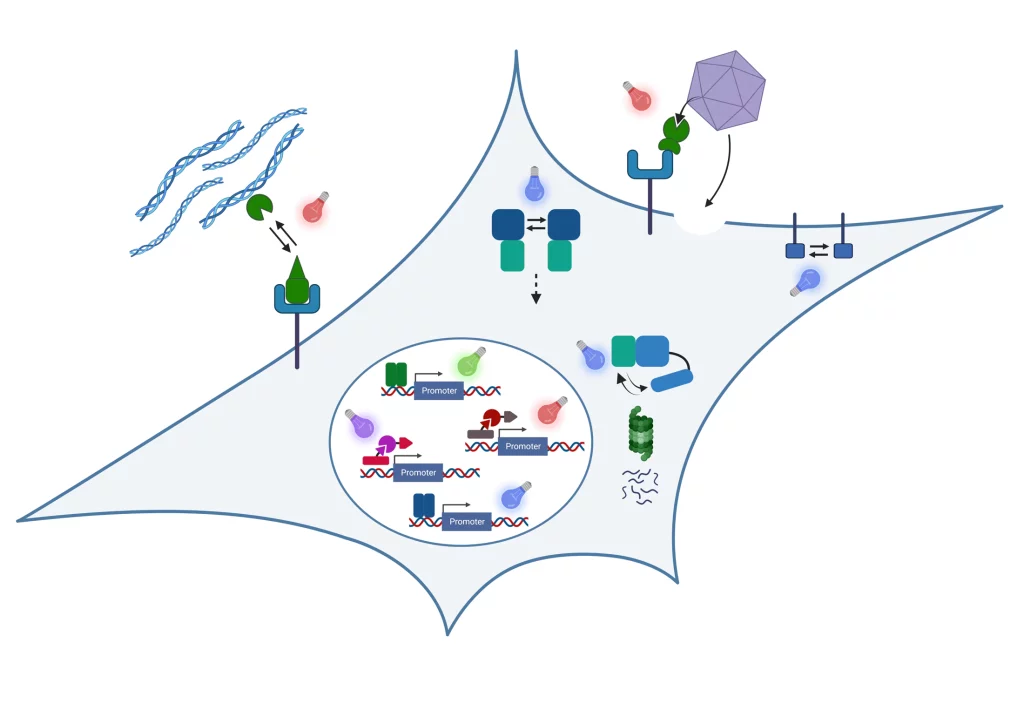
Our inspiration is the ability of organisms and the materials they are made of to adapt to dynamic environmental conditions. Plants adapt growth to light conditions; bacteria develop resistance against antibiotics or bones get stronger when exercised. The basis for this ability to adapt is a fascinating information processing machinery of the organisms: Environmental conditions are captured by molecular sensors, then the signals are processed and integrated with genetic programs to finally yield a targeted response.
In our research, we engineer nature’s molecular sensing, processing, and actuation machinery in order to precisely control the function and properties of cells and materials. We apply these newly developed technologies in different fields of fundamental and applied research.

Team Members


Research
Stimulus-responsive and Information-processing (living) Materials

We develop and apply stimulus-responsive and information-processing biohybrid polymer materials. To this aim, we functionally couple synthetic biological molecular sensors and switches to polymer materials. By wiring these switches according to topologies inspired by electronic circuits, we engineer materials that perform fundamental computational operations. Examples of our work include:
- We engineered a hydrogel based on a bacteria-derived photoreceptor which allows the light-responsive, fully reversibly tuning of its mechanical properties. We applied this hydrogel as extracellular matrix to analyze the impact of dynamic mechanical environments on transcriptome-wide responses in mesenchymal stem cells or on the migration of T-lymphocytes.
See Hörner et al. Advanced Materials 2019 - We integrated synthetic biological switches with polymer materials into a circuit inspired by an electronic counter. The resulting material system was able to count the number of input light pulses and to release different output as a function of the number of light pulses detected. We applied this system to sequentially release different biocatalysts to drive a two-step biochemical reaction.
See Beyer et al., Advanced Materials 2018 - We developed PenTag, a protein tag for the spontaneous, covalent coupling of proteins to ampicillin-functionalized molecules such as dyes, polymers, or solid supports. Based on this strategy, we engineered and assembled material modules to function as encoder for processing different combinations of biochemical input stimuli.
See Mohsenin et al., Advanced Functional Materials 2024 - By engineering modular protease-based switches that can either be activated or repressed, we develop information-processing biohybrid circuits that process binary biomolecular information according to a circuit inspired by electronic decoders. Such circuits can be applied to process and interpret biochemical sensor information for advanced diagnostic applications.
See Mohsenin et al., Advanced Materials 2024
Molecular optogenetics to control cell fate and function
We develop and apply molecular optogenetic tools to control cell fate and function with unprecedented spatial and temporal precision in a dose-dependent and highly specific manner. To this aim, we engineer plant- and bacteria-derived photoreceptors and functionally couple them to proteins involved in cell signaling and gene expression. Examples of our work include:
- Light-inducible formation of liquid or gel-like transcription factor condensates in mammalian cells and mice. We demonstrate that liquid “transcription factor droplets” show a several-fold higher activity in inducing transgene expression compared to native transcription factors. Further, gel-like transcription factor condensates were shown to correlate with decreased transcriptional activation thus providing a materials-based layer of controlling gene expression.
See Schneider et al., Science Advances 2021 and Fischer et al., Small 2024 - Light-guided adeno-associated viral (AAV) vectors. We engineered a light-responsive tropism into AAVs which allows us to selectively transfer genetic information into single cells or to transduce different cells within one culture with different transgenes.
See Hörner et al., Science Advances 2021
Our group is running www.optobase.org, the most comprehensive database on molecular optogenetics. Have a look and discover the amazing opportunities in controlling biology with light!
Biosensors
We integrate natural and engineered molecular sensors for drugs, metabolites or nucleic acids into suitable readout formats for the fast and sensitive quantification of such substances. Together with collaboration partners, we develop biosensor systems for different application fields:
Open Positions
We are always excited to meet curious and creative scientists passionate about synthetic biology, optogenetics, and engineered living materials. If you would like to shape the future of biobased and living materials with us, we warmly welcome your spontaneous application for a PhD thesis or Postdoc position!
Projects and Partners
We perform collaborative research in materials-oriented synthetic biology within interdisciplinary research consortia
STEADY
Within the ERC Advanced Grant STEADY, we develop concepts for dynamically controlling the properties of engineered living materials by advanced synthetic genetic circuits.
LoopOfFun
We coordinate the European Innovation Council (EIC)-funded consortium LoopOfFun in which we aim at developing a platform for the rapid development of industry-scale, one-step, simple casting-based manufacturing processes for fungal mycelia composites. We jointly work towards this goal with our consortium partners:
- Prof. Roman Jerala, National Institute of Chemistry, Ljubljana, Slovenia
- Dr. Achim Weber, Fraunhofer IGB, Stuttgart, Germany
- Prof. Arnold Driessen, University of Groningen, The Netherlands
- Carlotta Borgato and Jan Boelen, Atelier LUMA, Arles, France
DELIVER
In the project DELIVER funded by the Carl-Zeiss-Foundation, we collaborate towards the data-driven engineering of sustainable living materials. We combine synthetic biology with materials sciences and data-driven approaches to design bio-based composite materials with custom-tailored structural properties for construction applications. Within deliver, we collaborate with the following partners:
- Prof. Thomas Speck, University of Freiburg, Germany
- Dr. Clemens Kreutz, University Hospital Freiburg, Germany
BILLARD
We coordinate the BILLARD project funded by the Federal Ministry of Education and Research (BMBF) within the funding line “Biologization of Technology”, we collaborate with PD Dr. Felicitas Bucher from the Clinic of Ophtamology at the University Hospital Freiburg on the development of novel intraocular drug delivery devices.
CIBSS – Centre for Integrative Biological Signalling Studies
We are member of the Cluster of Excellence CIBSS in which we perform research on novel optogenetic technologies to control signaling reactions in mammalian cells. We mainly collaborate with Prof. Dr. Jens Timmer on the model-based design of synthetic biological switches and networks and with Prof. Dr. Wolfgang Schamel on controlling immunological processes such as T cell activation via optogenetics.
Publications
Weber, Wilfried | Fussenegger, M.
DOI:
The design and construction of synthetic gene circuits with complex spatiotemporal dynamics was pioneered in bacteria, but it took almost a decade until synthetic biologists were able to construct genetic circuits with complex spatiotemporal dynamics in mammalian cells. This review highlights the most recent advances in mammalian synthetic biology, and it describes metabolite, hormone, and light-triggered genetic switches as well as the design and construction of synthetic networks that feature tunable oscillations. We conclude by discussing not only the current limitations but also possible ways to transform the construction of synthetic mammalian systems from an art into a predictive engineering discipline. © 2010 Elsevier Ltd.
Christen, E. H. | Karlsson, M. | Kämpf, M. M. | Weber, C. C. | Fussenegger, M. | Weber, Wilfried
DOI:
Inducer-dependent prokaryotic transcriptional repressor proteins that originally evolved to orchestrate the transcriptome with intracellular and extracellular metabolite pools, have become universal tools in synthetic biology, drug discovery, diagnostics and functional genomics. Production of the repressor proteins is often limited due to inhibiting effects on the production host and requires iterative process optimization for each individual repressor. At the example of the Streptomyces pristinaespiralis-derived streptogramin-dependent repressor PIP, the expression of which was shown to inhibit growth of Escherichia coli BL21*, we demonstrate that the addition of the PIP-specific streptogramin antibiotic pristinamycin I neutralizes the growth-inhibiting effect and results in >100-fold increased PIP titers. The yield of PIP was further increased 2.5-fold by the engineering of a new E. coli host suitable for the production of growth-inhibiting proteins encoded by an unfavorable codon usage. PIP produced in the presence of pristinamycin I was purified and was shown to retain the antibiotic-dependent binding to its operator pir as demonstrated by a fluorescence resonance energy transfer (FRET)-based approach. At the example of the macrolide-, tetracycline- and arsenic-dependent repressors MphR(A), TetR and ArsR, we further demonstrate that the production yields can be increased 2- to 3-fold by the addition of the cognate inducer molecules erythromycin, tetracycline and As3+, respectively. Therefore, the addition of inducer molecules specific to the target repressor protein seems to be a general strategy to increase the yield of this interesting protein class. © 2009 Elsevier Inc. All rights reserved.
Gitzinger, M. | Kemmer, C. | El-Baba, M. D. | Weber, Wilfried | Fussenegger, M.
DOI:
Adjustable control of therapeutic transgenes in engineered cell implants after transdermal and topical delivery of nontoxic trigger molecules would increase convenience, patient compliance, and elimination of hepatic first-pass effect in future therapies. Pseudomonas putida DOT-T1E has evolved the flavonoid-triggered TtgR operon, which controls expression of a multisubstrate-specific efflux pump (TtgABC) to resist plant-derived defense metabolites in its rhizosphere habitat. Taking advantage of the TtgR operon, we have engineered a hybrid P. putida-mammalian genetic unit responsive to phloretin. This flavonoid is contained in apples, and, as such, or as dietary supplement, regularly consumed by humans. The engineered mammalian phloretin-adjustable control element (PEACE) enabled adjustable and reversible transgene expression in different mammalian cell lines and primary cells. Due to the short half-life of phloretin in culture, PEACE could also be used to program expression of difficult-to-produce protein therapeutics during standard bioreactor operation. When formulated in skin lotions and applied to the skin of mice harboring transgenic cell implants, phloretin was able to fine-tune target genes and adjust heterologous protein levels in the bloodstream of treated mice. PEACE-controlled target gene expression could foster advances in biopharmaceutical manufacturing as well as gene- and cell-based therapies.
Weber, Wilfried | Fussenegger, M.
DOI:
Synthetic biology, the science of engineering complex biological systems with novel functions, is increasingly fascinating researchers across disciplines who gather to design functional biological assemblies in a rational and systematic manner. Although initial success stories were based on reprogramming prokaryotic and lower eukaryotic cells, the design of synthetic mammalian gene circuits is becoming increasingly popular because it promises to foster novel therapeutic opportunities in the not-so-distant future. Here, we discuss the latest generation of mammalian synthetic biology devices assembled to form complex synthetic gene networks, such as regulatory cascades, logic evaluators, hysteretic circuits, epigenetic toggle switches, time-keeping components, drug discovery tools, and "cell phone" units. We further highlight how such circuits could be interconnected to achieve higher-order control networks such as synthetic hormone-like communication systems in animals or synthetic ecosystems with dynamic interspecies crosstalk. © 2009 Elsevier Ltd. All rights reserved.
Weber, Wilfried | Fussenegger, M.
DOI:
The emergence of synthetic biology is holding great hopes for providing solutions to the unmet needs of humankind. This review article describes how synthetic biology can deliver on this promise in the field of drug discovery by providing novel opportunities throughout the entire drug discovery process. Synthetic biology tools enable disease mechanisms and target identification to be elucidated and also provide avenues to discover small chemotherapeutic molecules or design novel biopharmaceuticals. Furthermore, synthetic biologists can design cost-effective microbial production processes for complex natural products, which could help overcome global drug shortages. These impressive advances have been achieved in only a few years, and are an indicator for the potential of synthetic biology. © 2009 Elsevier Ltd. All rights reserved.
Weber, Wilfried | Lienhart, C. | Daoud-El Baba, M. | Fussenegger, M.
DOI:
Adjustable and reversible transgene expression systems enabling precise control of metabolic pathways and tunable production of specific target proteins have been essential for conditional reprogramming of mammalian cells to achieve progress in basic and applied bioengineering disciplines. Most of the currently available transgene control modalities have been designed to be responsive to clinically licensed pharmacologically active drugs which were expected to prevail in future clinical trials yet raised concerns about side effects when administered long term at subclinical doses. We have chosen vitamin H, also known as biotin, to control target gene transcription in mammalian cells in a potentially side effect-free manner. BirA, the Escherichia coli repressor of the biotin biosynthesis operon, was fused to the Herpes simplex transactivation domain to generate a biotin-dependent transactivator (BIT), which, in the presence of biotin, binds and activates chimeric target promoters (PBIT) harboring BirA-specific operator sites 5′ of a minimal promoter. Biotin-inducible transgene expression was functional in a variety of rodent, monkey and human cell lines, showed excellent adjustability and reversibility in transgenic Chinese hamster ovary cell lines, provided precise product gene control in standard bioreactor cultures and enabled dose-dependent vitamin H control of a human glycoprotein in mice. The combination of a side effect-free inducer, precise and reversible transcription tunability and broad functionality in different cell types as well as in entire animals represents a unique asset for the use of biotin-inducible transgene control in future gene therapy, tissue engineering and biopharmaceutical manufacturing scenarios. © 2009 Elsevier Inc. All rights reserved.
Weber, Wilfried | Lienhart, C. | Daoud-El Baba, M. | Grass, R. N. | Kohler, T. | Müller, R. | Stark, W. J. | Fussenegger, M.
DOI:
Targeted delivery of therapeutic transgenes into specific cells remains a highly relevant challenge for tissue engineering and future gene-based therapies. We have designed streptavidin-pseudotyped lentiviral particles which upon coupling with biotinylated magnetic carbon-coated cobalt nanoparticles could be guided by magnetic fields to site-specifically transduce desired target cells in culture as well as in mice. Magnetic patterns projected onto monolayer cultures were replicated by fluorescent cells following targeted transduction by magnetic lentiviral particles engineered for constitutive expression of the green fluorescent protein (GFP). Even after intravenous injection into mice magnetic GFP-transgenic lentiviral particles could be guided to a preferred transduction site in the animal using a magnetic field. Magnet-guided transgene delivery producing desired patterns of transduced cell populations may enable the design of defined tissue topologies and provide site-specific transduction of therapeutic transgenes for cell-specific interventions in future gene and cancer therapies. © 2009 Elsevier B.V. All rights reserved.
Weber, Wilfried | Luzi, S. | Karlsson, M. | Fussenegger, M.
DOI:
The release of volatile ethylene and acetaldehyde characterizes the metabolic state and quality of fruit. We have designed and implemented a hybrid dual-channel catalytic-biological sensor system, which is able to quantify both volatiles in situ. This sensor system consists of a mammalian cell line engineered for constitutive expression of an Aspergillus nidulans-derived biosensor which triggers quantitative reporter gene expression in the presence of volatile acetaldehyde. Ethylene, oxidized to acetaldehyde using a Wacker-based process, can be quantified by the same transgenic sensor cell line. Differential profiling of reporter gene transcription by the sensor system revealed the relative concentrations of both volatile metabolites and enabled correct assessment of fruit quality as shown for fresh, old and rotten apples. Functional combination of catalytic processes with biosensor technology is able to precisely capture the metabolic state of food and may foster novel insight into biochemical food quality assessment as well as the design of synthetic control circuits detecting and preventing food spoilage. © 2009 Elsevier B.V. All rights reserved.
Weber, Wilfried | Luzi, S. | Karlsson, M. | Sanchez-Bustamante, C. D. | Frey, U. | Hierlemann, A. | Fussenegger, M.
DOI:
Electric signal processing has evolved to manage rapid information transfer in neuronal networks and muscular contraction in multicellular organisms and controls the most sophisticated man-built devices. Using a synthetic biology approach to assemble electronic parts with genetic control units engineered into mammalian cells, we designed an electric power-adjustable transcription control circuit able to integrate the intensity of a direct current over time, to translate the amplitude or frequency of an alternating current into an adjustable genetic readout or to modulate the beating frequency of primary heart cells. Successful miniaturization of the electro-genetic devices may pave the way for the design of novel hybrid electro-genetic implants assembled from electronic and genetic parts. © 2009 The Author(s).
Weber, Wilfried | Schuetz, M. | Dénervaud, N. | Fussenegger, M.
DOI:
Functionally well-characterized modular transcription units represent the genetic repertoire for the design of synthetic gene networks operating inside individual mammalian cells. Interconnection of specialized cells to multicellular assemblies that could execute complex computational functions requires synthetic signaling systems, which process and synchronize metabolic information between mammalian cells. In this study we have designed a metabolite-controlled inter-cellular signaling device consisting of a human sender cell line stably engineered for constitutive expression of the human liver-type arginase and a transgenic receiver cell line harboring a synthetic circuit, which produced a human glycoprotein in response to l-arginine levels in the culture medium. Quantitative characterization of the system components enabled precise prediction of l-arginine degradation and product gene expression kinetics and showed that two independent transgenic cell lines could functionally inter-operate to form a metabolite-controlled device which is able to precisely time desired target gene expression. Synthetic gene circuits modulating the transfer of metabolic information from a sender to a receiver cell line may enable the design of synthetic hormone systems supporting communication across multicellular assemblies. © The Royal Society of Chemistry 2009.