

We engineer cells and materials that communicate and process information through synthetic biology
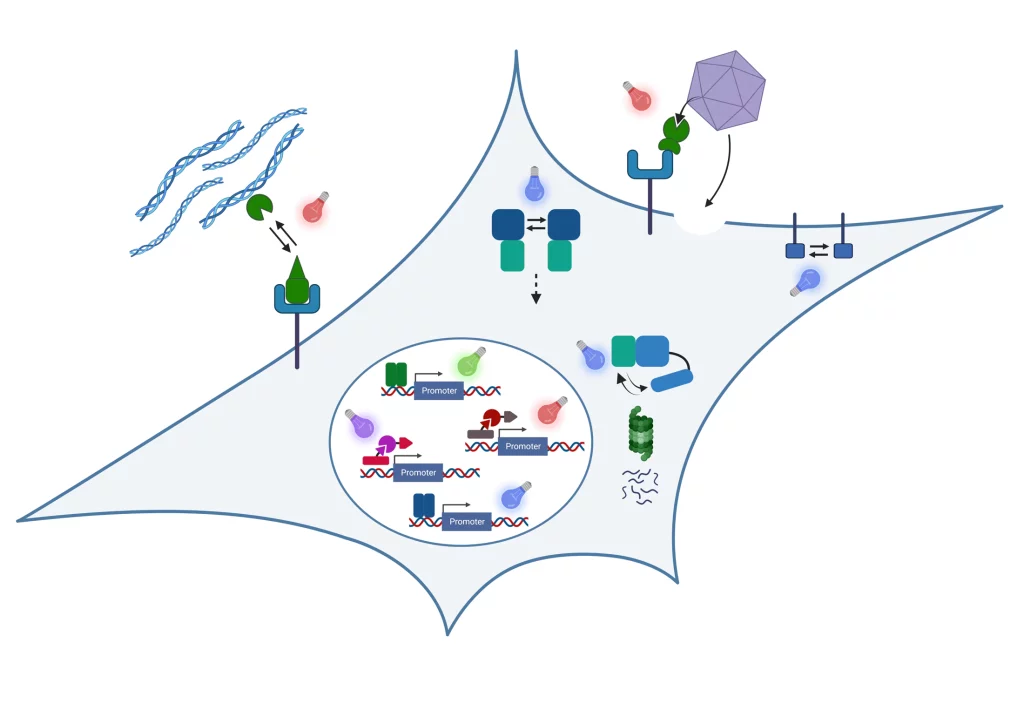
Our inspiration is the ability of organisms and the materials they are made of to adapt to dynamic environmental conditions. Plants adapt growth to light conditions; bacteria develop resistance against antibiotics or bones get stronger when exercised. The basis for this ability to adapt is a fascinating information processing machinery of the organisms: Environmental conditions are captured by molecular sensors, then the signals are processed and integrated with genetic programs to finally yield a targeted response.
In our research, we engineer nature’s molecular sensing, processing, and actuation machinery in order to precisely control the function and properties of cells and materials. We apply these newly developed technologies in different fields of fundamental and applied research.

Team Members


Research
Stimulus-responsive and Information-processing (living) Materials

We develop and apply stimulus-responsive and information-processing biohybrid polymer materials. To this aim, we functionally couple synthetic biological molecular sensors and switches to polymer materials. By wiring these switches according to topologies inspired by electronic circuits, we engineer materials that perform fundamental computational operations. Examples of our work include:
- We engineered a hydrogel based on a bacteria-derived photoreceptor which allows the light-responsive, fully reversibly tuning of its mechanical properties. We applied this hydrogel as extracellular matrix to analyze the impact of dynamic mechanical environments on transcriptome-wide responses in mesenchymal stem cells or on the migration of T-lymphocytes.
See Hörner et al. Advanced Materials 2019 - We integrated synthetic biological switches with polymer materials into a circuit inspired by an electronic counter. The resulting material system was able to count the number of input light pulses and to release different output as a function of the number of light pulses detected. We applied this system to sequentially release different biocatalysts to drive a two-step biochemical reaction.
See Beyer et al., Advanced Materials 2018 - We developed PenTag, a protein tag for the spontaneous, covalent coupling of proteins to ampicillin-functionalized molecules such as dyes, polymers, or solid supports. Based on this strategy, we engineered and assembled material modules to function as encoder for processing different combinations of biochemical input stimuli.
See Mohsenin et al., Advanced Functional Materials 2024 - By engineering modular protease-based switches that can either be activated or repressed, we develop information-processing biohybrid circuits that process binary biomolecular information according to a circuit inspired by electronic decoders. Such circuits can be applied to process and interpret biochemical sensor information for advanced diagnostic applications.
See Mohsenin et al., Advanced Materials 2024
Molecular optogenetics to control cell fate and function
We develop and apply molecular optogenetic tools to control cell fate and function with unprecedented spatial and temporal precision in a dose-dependent and highly specific manner. To this aim, we engineer plant- and bacteria-derived photoreceptors and functionally couple them to proteins involved in cell signaling and gene expression. Examples of our work include:
- Light-inducible formation of liquid or gel-like transcription factor condensates in mammalian cells and mice. We demonstrate that liquid “transcription factor droplets” show a several-fold higher activity in inducing transgene expression compared to native transcription factors. Further, gel-like transcription factor condensates were shown to correlate with decreased transcriptional activation thus providing a materials-based layer of controlling gene expression.
See Schneider et al., Science Advances 2021 and Fischer et al., Small 2024 - Light-guided adeno-associated viral (AAV) vectors. We engineered a light-responsive tropism into AAVs which allows us to selectively transfer genetic information into single cells or to transduce different cells within one culture with different transgenes.
See Hörner et al., Science Advances 2021
Our group is running www.optobase.org, the most comprehensive database on molecular optogenetics. Have a look and discover the amazing opportunities in controlling biology with light!
Biosensors
We integrate natural and engineered molecular sensors for drugs, metabolites or nucleic acids into suitable readout formats for the fast and sensitive quantification of such substances. Together with collaboration partners, we develop biosensor systems for different application fields:
Open Positions
We are always excited to meet curious and creative scientists passionate about synthetic biology, optogenetics, and engineered living materials. If you would like to shape the future of biobased and living materials with us, we warmly welcome your spontaneous application for a PhD thesis or Postdoc position!
Projects and Partners
We perform collaborative research in materials-oriented synthetic biology within interdisciplinary research consortia
STEADY
Within the ERC Advanced Grant STEADY, we develop concepts for dynamically controlling the properties of engineered living materials by advanced synthetic genetic circuits.
LoopOfFun
We coordinate the European Innovation Council (EIC)-funded consortium LoopOfFun in which we aim at developing a platform for the rapid development of industry-scale, one-step, simple casting-based manufacturing processes for fungal mycelia composites. We jointly work towards this goal with our consortium partners:
- Prof. Roman Jerala, National Institute of Chemistry, Ljubljana, Slovenia
- Dr. Achim Weber, Fraunhofer IGB, Stuttgart, Germany
- Prof. Arnold Driessen, University of Groningen, The Netherlands
- Carlotta Borgato and Jan Boelen, Atelier LUMA, Arles, France
DELIVER
In the project DELIVER funded by the Carl-Zeiss-Foundation, we collaborate towards the data-driven engineering of sustainable living materials. We combine synthetic biology with materials sciences and data-driven approaches to design bio-based composite materials with custom-tailored structural properties for construction applications. Within deliver, we collaborate with the following partners:
- Prof. Thomas Speck, University of Freiburg, Germany
- Dr. Clemens Kreutz, University Hospital Freiburg, Germany
BILLARD
We coordinate the BILLARD project funded by the Federal Ministry of Education and Research (BMBF) within the funding line “Biologization of Technology”, we collaborate with PD Dr. Felicitas Bucher from the Clinic of Ophtamology at the University Hospital Freiburg on the development of novel intraocular drug delivery devices.
CIBSS – Centre for Integrative Biological Signalling Studies
We are member of the Cluster of Excellence CIBSS in which we perform research on novel optogenetic technologies to control signaling reactions in mammalian cells. We mainly collaborate with Prof. Dr. Jens Timmer on the model-based design of synthetic biological switches and networks and with Prof. Dr. Wolfgang Schamel on controlling immunological processes such as T cell activation via optogenetics.
Publications
Karlsson, M. | Weber, Wilfried | Fussenegger, M.
DOI:
Advances in the development of molecular tools for the inducible control of transcription, translation, and protein degradation are the basis for the rapidly emerging design and construction of synthetic gene networks in mammalian cells. In this chapter, we describe such tools and how they can be integrated into a synthetic gene network with desired functionality. The network design and construction process is illustrated in the form of a detailed protocol for the implementation of a logic NOR gate based on an inducible promoter combined with an inducible protein degradation system. © 2012 Springer Science+Business Media, LLC.
Weber, Wilfried | Fussenegger, M.
DOI:
Synthetic biology aims to create functional devices, systems and organisms with novel and useful functions on the basis of catalogued and standardized biological building blocks. Although they were initially constructed to elucidate the dynamics of simple processes, designed devices now contribute to the understanding of disease mechanisms, provide novel diagnostic tools, enable economic production of therapeutics and allow the design of novel strategies for the treatment of cancer, immune diseases and metabolic disorders, such as diabetes and gout, as well as a range of infectious diseases. In this Review, we cover the impact and potential of synthetic biology for biomedical applications. © 2011 Macmillan Publishers Limited. All rights reserved.
Zurbriggen, M. D. | Moor, A. | Weber, Wilfried
DOI:
The recent implementation of various high-throughput biochemical and bioanalytical platforms for the study of biological systems has resulted in a wealth of experimental information that systems biology integrates into models and functional descriptions of organisms. The fast tempo of systems biology development is currently bringing in a revolution in the understanding of cell networks by providing with a holistic comprehension of cellular components and their interaction dynamics. This thorough description of biological systems has laid the grounds for the development of synthetic biology, a discipline applying basic principles of engineering for the rational assembly of biological modules into higher order complex biological systems with desired properties. Despite the success of this new field for the generation of biotechnological tools, it has not been yet widely applied to plant systems. This review aims at describing the current status of systems biology, its contribution to our understanding of plant metabolism, expression and regulatory networks and how synthetic biology approaches could benefit utilising plant and bacterial 'omics' as a source for the design and development of biological modules for the improvement of plant stress tolerance and crop production, among other applications. The article further describes synthetic biology strategies currently being applied to plant metabolic engineering, development of signalling pathways and synthetic organelles, and the potential of this new field for the understanding of plant cellular functioning and the generation of plant biotechnological tools. © 2012 Elsevier B.V..
Christen, E. H. | Karlsson, M. | Kämpf, M. M. | Schoenmakers, R. | Gübeli, R. J. | Wischhusen, H. M. | Friedrich, C. | Fussenegger, M. | Weber, Wilfried
DOI:
Interactive materials that specifically respond to environmental stimuli hold high promise as energy-autonomous sensors and actuators in biomedicine, analytics or microsystems engineering. However, the implementation of materials specifically responsive to a given small molecule has so far been hampered by a lack of generically applicable stimulus sensors. In this study, a novel and likely general strategy for the synthesis of biohybrid materials with desired stimulus specificity is established. The strategy is based on allosterically regulated DNA-binding proteins, a conserved protein family that has evolved in prokaryotes to sense and respond to most diverse molecules in order to enable bacterial survival in a changing environment. The novel hydrogel design concept is demonstrated with the example of single-chain TetR, a protein that binds the tetO DNA motif and dissociates thereof in the presence of the antibiotic tetracycline. Therefore, linear polyacrylamide is crosslinked via the TetR/tetO interaction to a biohybrid material that can subsequently be dissolved by tetracycline in a dose-dependent manner. This drug-induced dissolution is applied for the adjustable release of the cytokine interleukin 4 in a tetracycline-dependent manner. The design concept developed in this study might serve as a blueprint for the synthesis of biohybrid materials responsive to drugs, metabolites or toxins by replacing TetR/tetO with another protein/DNA pair showing the desired stimulus specificity. A biohybrid hydrogel is synthesized for the drug-inducible release of biopharmaceuticals. The hydrogel consists of linear polyacrylamide crosslinked by the interaction of the tetracycline repressor scTetR with its target DNA sequence tetO. Addition of tetracycline dissociates the protein-DNA interaction and triggers the release of a previously embedded payload protein. Copyright © 2011 WILEY-VCH Verlag GmbH & Co. KGaA, Weinheim.
Karlsson, M. | Weber, Wilfried | Fussenegger, M.
DOI:
Inducible expression systems represent the founding technology for the emergence of synthetic biology in mammalian cells. The core molecules in these systems are bacterial regulator proteins that bind to or dissociate from a cognate DNA operator sequence in response to an exogenous stimulus like a small-molecule inducer. In this chapter, we describe a generic protocol of how bacterial regulator proteins can be applied to the design, construction, and optimization of an inducible expression system in mammalian cells. By choosing regulator proteins with an appropriate small-molecule inducer, this protocol provides a straightforward approach for establishing biosensors, cell-to-cell communication systems, or tools to control gene expression in vivo. © 2011 Elsevier Inc. All rights reserved.
Weber, Wilfried | Fussenegger, M.
DOI:
The rapid development of synthetic biology is a paradigm of how the molecular diversity of naturally occurring gene control components can be used to design synthetic control devices and gene networks that provide precisely programmed transgene expression dynamics in space and time. Here we offer an overview on recent advances in the modular design of trigger-inducible mammalian expression devices that are either responsive by exogenous stimuli such as chemicals and physical cues or controlled by endogenous metabolites driving prosthetic circuits to treat metabolic disorders in a self-sufficient manner. Compatible genetic switches can also be assembled to synthetic gene networks that show highly complex expression dynamics such as temporally resolved band-detect functions or oscillating transgene expression profiles. The ongoing metagenomic discovery and characterization of the unexplored sequence space is constantly increasing the molecular diversity in fundamental control components that fuels the further development of synthetic biology. © 2011 Elsevier Ltd.
Weber, Wilfried | Fussenegger, M.
DOI:
Synthetic quorum-sensing systems in mammalian cells has enabled the implementation of time- and distance-dependent bioprocesses, as well as the design of synthetic ecosystems emulating clinically important host–parasite interactions. In this chapter, we provide a detailed protocol of the design of a mammalian cell-to-cell signaling device and its integration into a mammalian quorum-sensing system for cell density-induced expression product genes. Cell-to-cell signaling is based on a sender cell, metabolically engineered for expression of alcohol dehydrogenase converting ethanol into acetaldehyde, and a receiver cell line for the dose-dependent translation of the acetaldehyde concentration into transgene expression by an acetaldehyde-responsive promoter. This protocol can be adapted easily to various cell types and transgenes for the design of versatile mammalian cell-based quorum-sensing systems. © 2011, Springer Science+Business Media, LLC.
Wend, S. | Weber, Wilfried
DOI:
Synthetic Biology aims at the design and construction of biologic systems with desired features by applying a modular strategy. This approach was used to investigate the interaction of multiple organisms in synthetic ecosystems.
Kämpf, M. M. | Christen, E. H. | Ehrbar, M. | Baba, M. D. E. | Hamri, G. C. E. | Fussenegger, M. | Weber, Wilfried
DOI:
Gene therapy scientists have developed expression systems for therapeutic transgenes within patients, which must be seamlessly integrated into the patient's physiology by developing sophisticated control mechanisms to titrate expression levels of the transgenes into the therapeutic window. However, despite these efforts, gene-based medicine still faces security concerns related to the administration of the therapeutic transgene vector. Here, molecular tools developed for therapeutic transgene expression can readily be transferred to materials science to design a humanized drug depot that can be implanted into mice and enables the trigger-inducible release of a therapeutic protein in response to a small-molecule inducer. The drug depot is constructed by embedding the vascular endothelial growth factor (VEGF121) as model therapeutic protein into a hydrogel consisting of linear Polyacrylamide crosslinked with a homodimeric variant of the human FKbinding protein 12 (F M), originally developed for gene therapeutic applications, as well as with dimethylsuberimidate. Administrating increasing concentrations of the inducer molecule FK506 triggers the dissociation of FM thereby loosening the hydrogel structure and releasing the VEGF121 payload in a dose-adjustable manner. Subcutaneous implantation of the drug depot into mice and subsequent administration of the inducer by injection or by oral intake triggers the release of VEGF121 as monitored in the mouse serum. This study is the first demonstration of a stimuli-responsive hydrogel that can be used in mammals to release a therapeutic protein on demand by the application of a small-molecule stimulus. This trigger-inducible release is a starting point for the further development of externally controlled drug depots for patient-compliant administration of biopharmaceuticals. © 2010 WILEY-VCH Verlag GmbH & Co. KGaA, Weinheim.
Kämpf, M. M. | Weber, Wilfried
DOI:
Synthetic biology as the discipline of reconstructing natural and designing novel biological systems is gaining increasing impact in signaling science. This review article provides insight into synthetic approaches for analyzing and synthesizing signaling processes starting with strategies into how natural and pathological signaling pathways can be reconstructed in an evolutionary distant host to study their topology and function while avoiding interference with the original host background. In the second part we integrate synthetic strategies in the rewiring of signaling systems at the nucleic acid and protein level to reprogram cellular functions for biotechnological applications. The last part focuses on synthetic inter-cell and inter-species signaling devices and their integration into synthetic ecosystems to study fundamental mechanisms governing the co-existence of species. We finally address current bottlenecks in the (re-)design of signaling pathways and discuss future directions in signaling-related synthetic biology. © 2010 The Royal Society of Chemistry.