

We engineer cells and materials that communicate and process information through synthetic biology
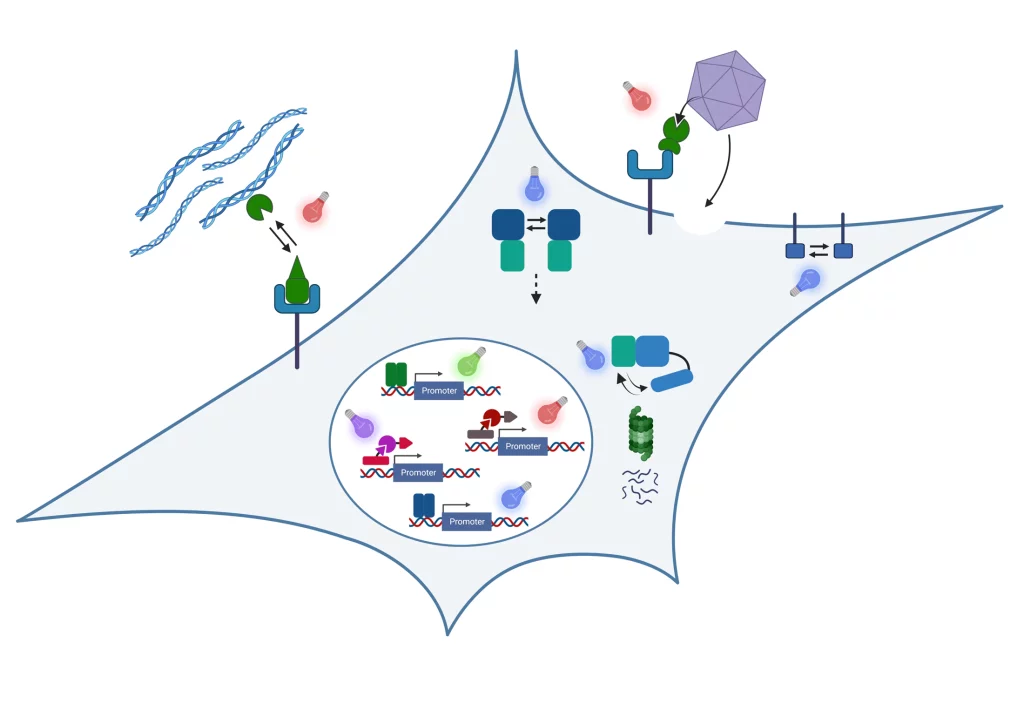
Our inspiration is the ability of organisms and the materials they are made of to adapt to dynamic environmental conditions. Plants adapt growth to light conditions; bacteria develop resistance against antibiotics or bones get stronger when exercised. The basis for this ability to adapt is a fascinating information processing machinery of the organisms: Environmental conditions are captured by molecular sensors, then the signals are processed and integrated with genetic programs to finally yield a targeted response.
In our research, we engineer nature’s molecular sensing, processing, and actuation machinery in order to precisely control the function and properties of cells and materials. We apply these newly developed technologies in different fields of fundamental and applied research.

Team Members


Research
Stimulus-responsive and Information-processing (living) Materials

We develop and apply stimulus-responsive and information-processing biohybrid polymer materials. To this aim, we functionally couple synthetic biological molecular sensors and switches to polymer materials. By wiring these switches according to topologies inspired by electronic circuits, we engineer materials that perform fundamental computational operations. Examples of our work include:
- We engineered a hydrogel based on a bacteria-derived photoreceptor which allows the light-responsive, fully reversibly tuning of its mechanical properties. We applied this hydrogel as extracellular matrix to analyze the impact of dynamic mechanical environments on transcriptome-wide responses in mesenchymal stem cells or on the migration of T-lymphocytes.
See Hörner et al. Advanced Materials 2019 - We integrated synthetic biological switches with polymer materials into a circuit inspired by an electronic counter. The resulting material system was able to count the number of input light pulses and to release different output as a function of the number of light pulses detected. We applied this system to sequentially release different biocatalysts to drive a two-step biochemical reaction.
See Beyer et al., Advanced Materials 2018 - We developed PenTag, a protein tag for the spontaneous, covalent coupling of proteins to ampicillin-functionalized molecules such as dyes, polymers, or solid supports. Based on this strategy, we engineered and assembled material modules to function as encoder for processing different combinations of biochemical input stimuli.
See Mohsenin et al., Advanced Functional Materials 2024 - By engineering modular protease-based switches that can either be activated or repressed, we develop information-processing biohybrid circuits that process binary biomolecular information according to a circuit inspired by electronic decoders. Such circuits can be applied to process and interpret biochemical sensor information for advanced diagnostic applications.
See Mohsenin et al., Advanced Materials 2024
Molecular optogenetics to control cell fate and function
We develop and apply molecular optogenetic tools to control cell fate and function with unprecedented spatial and temporal precision in a dose-dependent and highly specific manner. To this aim, we engineer plant- and bacteria-derived photoreceptors and functionally couple them to proteins involved in cell signaling and gene expression. Examples of our work include:
- Light-inducible formation of liquid or gel-like transcription factor condensates in mammalian cells and mice. We demonstrate that liquid “transcription factor droplets” show a several-fold higher activity in inducing transgene expression compared to native transcription factors. Further, gel-like transcription factor condensates were shown to correlate with decreased transcriptional activation thus providing a materials-based layer of controlling gene expression.
See Schneider et al., Science Advances 2021 and Fischer et al., Small 2024 - Light-guided adeno-associated viral (AAV) vectors. We engineered a light-responsive tropism into AAVs which allows us to selectively transfer genetic information into single cells or to transduce different cells within one culture with different transgenes.
See Hörner et al., Science Advances 2021
Our group is running www.optobase.org, the most comprehensive database on molecular optogenetics. Have a look and discover the amazing opportunities in controlling biology with light!
Biosensors
We integrate natural and engineered molecular sensors for drugs, metabolites or nucleic acids into suitable readout formats for the fast and sensitive quantification of such substances. Together with collaboration partners, we develop biosensor systems for different application fields:
Open Positions
We are always excited to meet curious and creative scientists passionate about synthetic biology, optogenetics, and engineered living materials. If you would like to shape the future of biobased and living materials with us, we warmly welcome your spontaneous application for a PhD thesis or Postdoc position!
Projects and Partners
We perform collaborative research in materials-oriented synthetic biology within interdisciplinary research consortia
STEADY
Within the ERC Advanced Grant STEADY, we develop concepts for dynamically controlling the properties of engineered living materials by advanced synthetic genetic circuits.
LoopOfFun
We coordinate the European Innovation Council (EIC)-funded consortium LoopOfFun in which we aim at developing a platform for the rapid development of industry-scale, one-step, simple casting-based manufacturing processes for fungal mycelia composites. We jointly work towards this goal with our consortium partners:
- Prof. Roman Jerala, National Institute of Chemistry, Ljubljana, Slovenia
- Dr. Achim Weber, Fraunhofer IGB, Stuttgart, Germany
- Prof. Arnold Driessen, University of Groningen, The Netherlands
- Carlotta Borgato and Jan Boelen, Atelier LUMA, Arles, France
DELIVER
In the project DELIVER funded by the Carl-Zeiss-Foundation, we collaborate towards the data-driven engineering of sustainable living materials. We combine synthetic biology with materials sciences and data-driven approaches to design bio-based composite materials with custom-tailored structural properties for construction applications. Within deliver, we collaborate with the following partners:
- Prof. Thomas Speck, University of Freiburg, Germany
- Dr. Clemens Kreutz, University Hospital Freiburg, Germany
BILLARD
We coordinate the BILLARD project funded by the Federal Ministry of Education and Research (BMBF) within the funding line “Biologization of Technology”, we collaborate with PD Dr. Felicitas Bucher from the Clinic of Ophtamology at the University Hospital Freiburg on the development of novel intraocular drug delivery devices.
CIBSS – Centre for Integrative Biological Signalling Studies
We are member of the Cluster of Excellence CIBSS in which we perform research on novel optogenetic technologies to control signaling reactions in mammalian cells. We mainly collaborate with Prof. Dr. Jens Timmer on the model-based design of synthetic biological switches and networks and with Prof. Dr. Wolfgang Schamel on controlling immunological processes such as T cell activation via optogenetics.
Publications
Karlsson, M. | Rebmann, B. | Lienemann, P. S. | Sprossmann, N. | Ehrbar, M. | Radziwill, G. | Weber, Wilfried
DOI:
The precise manipulation of growth factor signaling is central to the progress of tissue engineering. Methods for direct time-resolved activation of signaling pathways through controlled receptor dimerization have been reported; however, these suffer from the risks associated with gene transfer. Here we present an alternative gene transfer-free approach in the form of a protein switch featuring pharmacologically controlled ON-OFF regulation of growth factor activity. The reversible operation of the switch enables stimulation of target processes within a defined period of time. The protein switch provides a means for both studying and manipulating signaling processes, and is thus believed to be a valuable tool for basic research as well as tissue engineering and biomedical applications.
Menzel, A. | Gübeli, R. J. | Güder, F. | Weber, Wilfried | Zacharias, M.
DOI:
Detecting drug-target interactions in real-time is a powerful approach for drug discovery and analytics. We show here for the first time the ultra fast electrical real-time detection and quantification of antibiotics using a novel biohybrid nanosensor. The biomolecular sensing is performed on ultralong (mm range) high aspect ratio nanowall (50 nm width) surfaces functionalized with operator DNA tetO which is specifically bound by the sensor protein TetR. This sensor protein is released from the operator DNA in a dose dependent manner by exposing the device functionalized with this bound DNA-protein complex to tetracycline antibiotics. As a result, the electrical conductance is accordingly modulated by these surface net charge changes. The switching mechanism of sensor proteins attached at the functionalized surfaces and releasing them again by antibiotics is demonstrated. With the here presented device the detection limit is below the limits of prevailing detection methods. Moreover, the study is extended to detect antibiotic residues in spiked organic milk from cows far below the maximum residual level of the European Union. In spiked milk samples a detection limit for tetracycline concentrations in the 100 fM level was achieved. The nanowall devices are fabricated by atomic layer deposition-based spacer lithography on full wafer scale which is a simple approach capable for mass production. © 2013 The Royal Society of Chemistry.
Müller, K. | Engesser, R. | Metzger, S. | Schulz, S. | Kämpf, M. M. | Busacker, M. | Steinberg, T. | Tomakidi, P. | Ehrbar, M. | Nagy, F. | Timmer, J. | Zubriggen, M. D. | Weber, Wilfried
DOI:
Growth and differentiation of multicellular systems is orchestrated by spatially restricted gene expression programs in specialized subpopulations. The targeted manipulation of such processes by synthetic tools with high-spatiotemporal resolution could, therefore, enable a deepened understanding of developmental processes and open new opportunities in tissue engineering. Here, we describe the first red/far-red light-triggered gene switch for mammalian cells for achieving gene expression control in time and space. We show that the system can reversibly be toggled between stable on-and off-states using short light pulses at 660 or 740 nm. Red light-induced gene expression was shown to correlate with the applied photon number and was compatible with different mammalian cell lines, including human primary cells. The light-induced expression kinetics were quantitatively analyzed by a mathematical model. We apply the system for the spatially controlled engineering of angiogenesis in chicken embryos. The system's performance combined with cell-and tissue-compatible regulating red light will enable unprecedented spatiotemporally controlled molecular interventions in mammalian cells, tissues and organisms. © 2013 The Author(s).
Müller, K. | Engesser, R. | Schulz, S. | Steinberg, T. | Tomakidi, P. | Weber, C. C. | Ulm, R. | Timmer, J. | Zurbriggen, M. D. | Weber, Wilfried
DOI:
The emergence and future of mammalian synthetic biology depends on technologies for orchestrating and custom tailoring complementary gene expression and signaling processes in a predictable manner. Here, we demonstrate for the first time multi-chromatic expression control in mammalian cells by differentially inducing up to three genes in a single cell culture in response to light of different wavelengths. To this end, we developed an ultraviolet B (UVB)-inducible expression system by designing a UVB-responsive split transcription factor based on the Arabidopsis thaliana UVB receptor UVR8 and the WD40 domain of COP1. The system allowed high (up to 800-fold) UVB-induced gene expression in human, monkey, hamster and mouse cells. Based on a quantitative model, we determined critical system parameters. By combining this UVB-responsive system with blue and red light-inducible gene control technology, we demonstrate multi-chromatic multi-gene control by differentially expressing three genes in a single cell culture in mammalian cells, and we apply this system for the multi-chromatic control of angiogenic signaling processes. This portfolio of optogenetic tools enables the design and implementation of synthetic biological networks showing unmatched spatiotemporal precision for future research and biomedical applications. © 2013 The Author(s) 2013. Published by Oxford University Press.
Müller, K. | Engesser, R. | Timmer, J. | Zurbriggen, M. D. | Nagy, F. | Weber, Wilfried
DOI:
The chromophore 3-Z phycocyanobilin (PCB, (2R,3Z)-8,12-bis(2-carboxyethyl)-18-ethyl-3-ethylidene-2,7,13,17-tetramethyl-2,3-dihydrobilin-1,19(21H,24H)-dione) mediates red and far-red light perception in natural and synthetic biological systems. Here we describe a PCB synthesis strategy in mammalian cells. We optimize the production by co-localizing the biocatalysts to the substrate source, by coordinating the availability of the biocatalysts and by reducing the degradation of the reaction product. We show that the resulting PCB levels of 2 μM are sufficient to sustain the functionality of red light-responsive optogenetic tools suitable for the light-inducible control of gene expression in mammalian cells. © 2013 The Royal Society of Chemistry.
Müller, K. | Weber, Wilfried
DOI:
Light is fundamental to life on earth. Therefore, nature has evolved a multitude of photoreceptors that sense light across all kingdoms. This natural resource provides synthetic biology with a vast pool of light-sensing components with distinct spectral properties that can be harnessed to engineer novel optogenetic tools. These devices enable control over gene expression, cell morphology and signaling pathways with superior spatiotemporal resolution and are maturing towards elaborate applications in basic research, in the production of biopharmaceuticals and in biomedicine. This article provides a summary of the recent advances in optogenetics that use light for the precise control of biological functions in mammalian cells. © 2013 The Royal Society of Chemistry.
Wend, S. | Dal Bosco, C. | Kämpf, M. M. | Ren, F. | Palme, K. | Weber, Wilfried | Dovzhenko, A. | Zurbriggen, M. D.
DOI:
Time-resolved quantitative analysis of auxin-mediated processes in plant cells is as of yet limited. By applying a synergistic mammalian and plant synthetic biology approach, we have developed a novel ratiometric luminescent biosensor with wide applicability in the study of auxin metabolism, transport, and signalling. The sensitivity and kinetic properties of our genetically encoded biosensor open new perspectives for the analysis of highly complex auxin dynamics in plant growth and development.
Bacchus, W. | Lang, M. | El-Baba, M. D. | Weber, Wilfried | Stelling, J. | Fussenegger, M.
DOI:
The design of synthetic biology-inspired control devices enabling entire mammalian cells to receive, process and transfer metabolic information and so communicate with each other via synthetic multichannel networks may provide new insight into the organization of multicellular organisms and future clinical interventions. Here we describe communication networks that orchestrate behavior in individual mammalian cells in response to cell-to-cell metabolic signals. We engineered sender, processor and receiver cells that interact with each other in ways that resemble natural intercellular communication networks such as multistep information processing cascades, feed-forward-based signaling loops, and two-way communication. The engineered two-way communication devices mimicking natural control systems in the development of vertebrate extremities and vasculature was used to program temporal permeability in vascular endothelial cell layers. These synthetic multicellular communication systems may inspire future therapies or tissue engineering strategies. © 2012 Nature America, Inc. All rights reserved.
Christen, E. H. | Gübeli, R. J. | Kaufmann, B. | Merkel, L. | Schoenmakers, R. | Budisa, N. | Fussenegger, M. | Weber, Wilfried | Wiltschi, B.
DOI:
The Cu(i)-catalyzed cycloaddition of terminal azides and alkynes (click chemistry) represents a highly specific reaction for the functionalization of biomolecules with chemical moieties such as dyes or polymer matrices. In this study we evaluate the use of bicinchoninic acid (BCA) as a ligand for Cu(i) under physiological reaction conditions. We demonstrate that the BCA-Cu(i)-complex represents an efficient catalyst for the conjugation of fluorophores or biotin to alkyne- or azide-functionalized proteins resulting in increased or at least equal reaction yields compared to commonly used catalysts like Cu(i) in complex with TBTA (tris[(1-benzyl-1H-1,2,3-triazol-4-yl)methyl] amine) or BPAA (bathophenanthroline disulfonic acid). The stabilization of Cu(i) with BCA represents a new strategy for achieving highly efficient bioconjugation reactions under physiological conditions in many application fields. © 2012 The Royal Society of Chemistry.