

We engineer cells and materials that communicate and process information through synthetic biology
Our inspiration is the ability of organisms and the materials they are made of to adapt to dynamic environmental conditions. Plants adapt growth to light conditions; bacteria develop resistance against antibiotics or bones get stronger when exercised. The basis for this ability to adapt is a fascinating information processing machinery of the organisms: Environmental conditions are captured by molecular sensors, then the signals are processed and integrated with genetic programs to finally yield a targeted response.
In our research, we engineer nature’s molecular sensing, processing, and actuation machinery in order to precisely control the function and properties of cells and materials. We apply these newly developed technologies in different fields of fundamental and applied research.

Team Members


Research
Stimulus-responsive and Information-processing (living) Materials

We develop and apply stimulus-responsive and information-processing biohybrid polymer materials. To this aim, we functionally couple synthetic biological molecular sensors and switches to polymer materials. By wiring these switches according to topologies inspired by electronic circuits, we engineer materials that perform fundamental computational operations. Examples of our work include:
- We engineered a hydrogel based on a bacteria-derived photoreceptor which allows the light-responsive, fully reversibly tuning of its mechanical properties. We applied this hydrogel as extracellular matrix to analyze the impact of dynamic mechanical environments on transcriptome-wide responses in mesenchymal stem cells or on the migration of T-lymphocytes.
See Hörner et al. Advanced Materials 2019 - We integrated synthetic biological switches with polymer materials into a circuit inspired by an electronic counter. The resulting material system was able to count the number of input light pulses and to release different output as a function of the number of light pulses detected. We applied this system to sequentially release different biocatalysts to drive a two-step biochemical reaction.
See Beyer et al., Advanced Materials 2018 - We developed PenTag, a protein tag for the spontaneous, covalent coupling of proteins to ampicillin-functionalized molecules such as dyes, polymers, or solid supports. Based on this strategy, we engineered and assembled material modules to function as encoder for processing different combinations of biochemical input stimuli.
See Mohsenin et al., Advanced Functional Materials 2024 - By engineering modular protease-based switches that can either be activated or repressed, we develop information-processing biohybrid circuits that process binary biomolecular information according to a circuit inspired by electronic decoders. Such circuits can be applied to process and interpret biochemical sensor information for advanced diagnostic applications.
See Mohsenin et al., Advanced Materials 2024
Molecular optogenetics to control cell fate and function
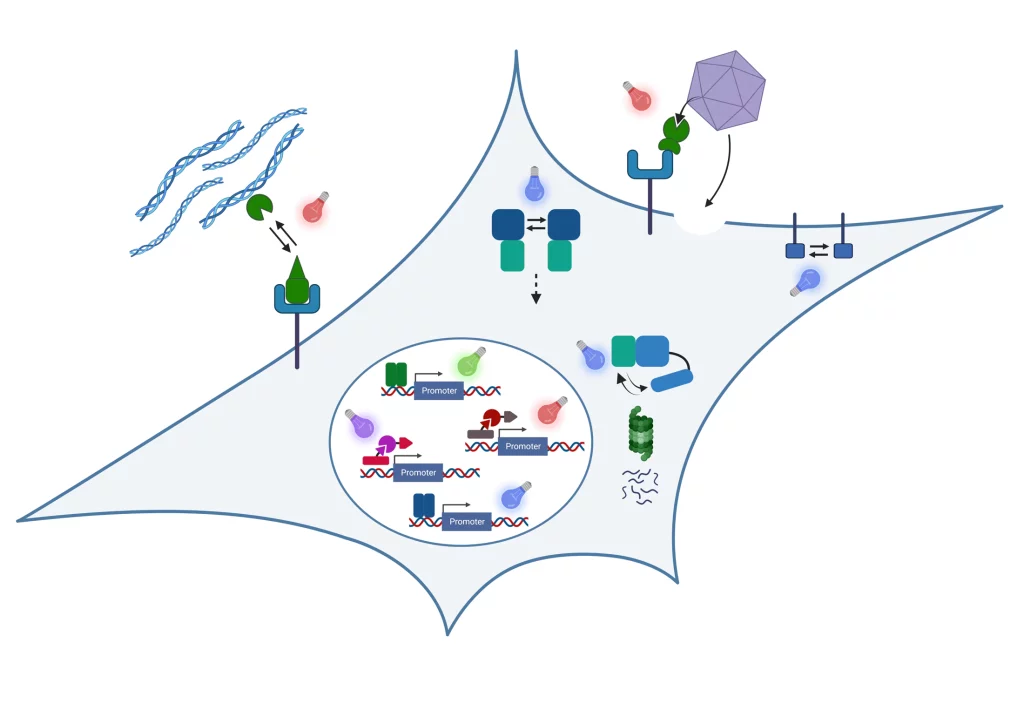
We develop and apply molecular optogenetic tools to control cell fate and function with unprecedented spatial and temporal precision in a dose-dependent and highly specific manner. To this aim, we engineer plant- and bacteria-derived photoreceptors and functionally couple them to proteins involved in cell signaling and gene expression. Examples of our work include:
- Light-inducible formation of liquid or gel-like transcription factor condensates in mammalian cells and mice. We demonstrate that liquid “transcription factor droplets” show a several-fold higher activity in inducing transgene expression compared to native transcription factors. Further, gel-like transcription factor condensates were shown to correlate with decreased transcriptional activation thus providing a materials-based layer of controlling gene expression.
See Schneider et al., Science Advances 2021 and Fischer et al., Small 2024 - Light-guided adeno-associated viral (AAV) vectors. We engineered a light-responsive tropism into AAVs which allows us to selectively transfer genetic information into single cells or to transduce different cells within one culture with different transgenes.
See Hörner et al., Science Advances 2021
Our group is running www.optobase.org, the most comprehensive database on molecular optogenetics. Have a look and discover the amazing opportunities in controlling biology with light!
Biosensors
We integrate natural and engineered molecular sensors for drugs, metabolites or nucleic acids into suitable readout formats for the fast and sensitive quantification of such substances. Together with collaboration partners, we develop biosensor systems for different application fields:
Open Positions
We are always excited to meet curious and creative scientists passionate about synthetic biology, optogenetics, and engineered living materials. If you would like to shape the future of biobased and living materials with us, we warmly welcome your spontaneous application for a PhD thesis or Postdoc position!
Projects and Partners
We perform collaborative research in materials-oriented synthetic biology within interdisciplinary research consortia
STEADY
Within the ERC Advanced Grant STEADY, we develop concepts for dynamically controlling the properties of engineered living materials by advanced synthetic genetic circuits.
LoopOfFun
We coordinate the European Innovation Council (EIC)-funded consortium LoopOfFun in which we aim at developing a platform for the rapid development of industry-scale, one-step, simple casting-based manufacturing processes for fungal mycelia composites. We jointly work towards this goal with our consortium partners:
- Prof. Roman Jerala, National Institute of Chemistry, Ljubljana, Slovenia
- Dr. Achim Weber, Fraunhofer IGB, Stuttgart, Germany
- Prof. Arnold Driessen, University of Groningen, The Netherlands
- Carlotta Borgato and Jan Boelen, Atelier LUMA, Arles, France
DELIVER
In the project DELIVER funded by the Carl-Zeiss-Foundation, we collaborate towards the data-driven engineering of sustainable living materials. We combine synthetic biology with materials sciences and data-driven approaches to design bio-based composite materials with custom-tailored structural properties for construction applications. Within deliver, we collaborate with the following partners:
- Prof. Thomas Speck, University of Freiburg, Germany
- Dr. Clemens Kreutz, University Hospital Freiburg, Germany
BILLARD
We coordinate the BILLARD project funded by the Federal Ministry of Education and Research (BMBF) within the funding line “Biologization of Technology”, we collaborate with PD Dr. Felicitas Bucher from the Clinic of Ophtamology at the University Hospital Freiburg on the development of novel intraocular drug delivery devices.
CIBSS – Centre for Integrative Biological Signalling Studies
We are member of the Cluster of Excellence CIBSS in which we perform research on novel optogenetic technologies to control signaling reactions in mammalian cells. We mainly collaborate with Prof. Dr. Jens Timmer on the model-based design of synthetic biological switches and networks and with Prof. Dr. Wolfgang Schamel on controlling immunological processes such as T cell activation via optogenetics.
Publications
Bacchus, W. | Weber, Wilfried | Fussenegger, M.
DOI:
Prokaryotic transcriptional regulatory elements are widely utilized building blocks for constructing regulatory genetic circuits adapted for mammalian cells and have found their way into a broad range of biotechnological applications. Prokaryotic transcriptional repressors, fused to eukaryotic transactivation or repression domains, compose the transcription factor, which binds and adjusts transcription from chimeric promoters containing the repressor-specific operator sequence. Escherichia coli and Chlamydia trachomatis share common features in the regulatory mechanism of the biosynthesis of l-tryptophan. The repressor protein TrpR of C. trachomatis regulates the trpRBA operon and the TrpR of E. coli regulates the trpEDCBA operon, both requiring l-tryptophan as a co-repressor. Fusion of these bacterial repressors to the VP16 transactivation domain of Herpes simplex virus creates synthetic transactivators that could bind and activate chimeric promoters, assembled by placing repressor-specific operator modules adjacent to a minimal promoter, in an l-tryptophan-adjustable manner. Combinations of different transactivator and promoter variants from the same or different bacterial species resulted in a multitude of regulatory systems where l-tryptophan regulation properties, background noise, and maximal gene expression levels were significantly diverse. Different l-tryptophan analogues showed diverse regulatory capacity depending on the promoter/transactivator combination. We believe the systems approach to rationally choose promoters, transactivators and inducer molecules, to obtain desired and predefined genetic expression dynamics and control profiles, will significantly advance the design of new regulatory circuits as well as improving already existing ones. © 2012 Elsevier Inc.
Geraths, C. | Daoud-El Baba, M. | Charpin-El Hamri, G. | Weber, Wilfried
DOI:
Functional biomaterials that detect and correct pathological parameters hold high promises for biomedical application. In this study we describe a biohybrid hydrogel that detects elevated concentrations of uric acid and responds by dissolution and the release of uric acid-degrading urate oxidase. This material was synthesized by incorporating PEG-stabilized urate oxidase into a polyacrylamide hydrogel that was crosslinked by the uric acid-sensitive interaction between the uric acid transcription factor HucR and its operator hucO. We characterize the uric acid responsiveness of the material and demonstrate that it can effectively be applied to counteract flares of uric acid in a mouse model. This approach might be a first step towards a biomedical device autonomously managing uric acid burst associated to gouty arthritis and the tumor lysis syndrome. © 2013 Elsevier B.V. All rights reserved.
Geraths, C. | Eichstädter, L. | Gübeli, R. J. | Christen, E. H. | Friedrich, C. | Weber, Wilfried
DOI:
Hydrogels provide a highly favorable matrix for immobilizing growth factors, enzymes or cells for biomedical applications like tissue engineering, drug delivery or the treatment of metabolic diseases. In this study we describe the synthesis and characterization of a hydrogel able to degrade l-ornithine, a metabolite that is highly elevated in congenital hyperornithinemia. The hydrogel was synthesized by embedding the l-ornithine-degrading enzymes l-ornithine aminotransferase (OAT) and l-ornithine decarboxylase (ODC) into a polymer network. The network was formed from linear polyacrylamide crosslinked by heterodimers of ODC and ornithine decarboxylase antizyme (OAz). The resulting hydrogel was shown to be stable under physiological conditions and to efficiently degrade l-ornithine. The hydrogel-stabilizing ODC-OAz interactions could subsequently be dissociated by the addition of antizyme inhibitor (AzI) which resulted in the inducible dissolution of the hydrogel. This l-ornithine-degrading hydrogel that can efficiently be eliminated when its functionality is no longer required might represent a first step towards an enzyme substitution approach against hyperornithinemia. © 2012 Elsevier B.V.
Gübeli, R. J. | Burger, K. | Weber, Wilfried
DOI:
The synthetic reconstruction of natural gene networks and the de novo design of artificial genetic circuits provide new insights into the cell's regulatory mechanisms and will open new opportunities for drug discovery and intelligent therapeutic schemes. We will present how modular synthetic biology tools like repressors, promoters and enzymes can be assembled into complex systems in order to discover small molecules to shut off antibiotic resistance in tubercle bacteria and to design self-sufficient therapeutic networks. The transfer of these synthetic biological modules to the materials science field enables the construction of novel drug-inducible biohybrid materials for biomedical applications. © 2012 Elsevier Inc.
Gübeli, R. J. | Hövermann, D. | Seitz, H. | Rebmann, B. | Schoenmakers, R. G. | Ehrbar, M. | Charpin-El Hamri, G. | Daoud-El Baba, M. | Werner, M. | Müller, M. | Weber, Wilfried
DOI:
Remote-controlled drug depots represent a highly valuable tool for the timely controlled administration of pharmaceuticals in a patient compliant manner. Here, the first pharmacologically controlled material that allows for the scheduled induction of a medical response in mice is described. To this aim, a novel, humanized biohybrid material that releases its cargo in response to a small-molecule stimulus licensed for human use is developed. The functionality of the material in mice is demonstrated by the remote-controlled delivery of a vaccine against the oncogenic human papillomavirus type 16. It is shown that the biohybrid depot-mediated immunoprotection is equivalent to the classical multi-injection-based vaccination. These results indicate that this material can be used as a universal remote-controlled vehicle for the patient-compliant delivery of vaccines and pharmaceuticals. A pharmacologically controlled hydrogel depot is presented allowing for the scheduled induction of a medical response in vivo. The vaccine-loaded hydrogel depot is administered to mice. At the desired point in time, the vaccine can be released from the depot by the oral administration of the stimulus molecule fluorescein resulting in protective immunization. © 2013 WILEY-VCH Verlag GmbH & Co. KGaA, Weinheim.
Gübeli, R. J. | Laird, D. | Ehrbar, M. | Ritter, B. S. | Steinberg, T. | Tomakidi, P. | Weber, Wilfried
DOI:
Biohybrid materials combining synthetic polymers with biological components are highly suited for tissue engineering in order to emulate the behavior of natural materials such as the extracellular matrix (ECM). In order to allow for an optimal cell-material interplay, the physical and biological parameters of the artificial matrix need to be dynamically remodeled during cultivation. Current tissue engineering concepts are mainly based on passive remodeling mechanisms including the degradation of the hydrogel and the release of incorporated biomolecules and therefore do not enable external adjustment of cultivation conditions. We present a novel hydrogel material that is able to serve as a cell growth matrix, whose degradation and presentation of cell-interacting biomolecules can be externally controlled by the addition of a pharmacological substance. The hydrogel is based on branched polyethylene glycol that is covalently decorated with the aminocoumarin-antibiotic switchable gyrase B protein conferring stimulus-responsive degradation. ECM properties were conferred to the hydrogels with cell attachment motifs and a general approach for the incorporation and inducible release of therapeutic biomolecules. This smart biohybrid material has the potential to serve as a next-generation tissue engineering device which allows for dynamic external adjustment of the physical and biological parameters, resulting in optimally controlled tissue formation. © 2013 Acta Materialia Inc. Published by Elsevier Ltd. All rights reserved.
Gübeli, R. J. | Schöneweis, K. | Huzly, D. | Ehrbar, M. | Charpin-El Hamri, G. | El-Baba, M. D. | Urban, S. | Weber, Wilfried
DOI:
The simplification of current vaccine administration regimes is of crucial interest in order to further sustain and expand the high impact of vaccines for public health. Most vaccines including the vaccine against hepatitis B need several doses to achieve protective immunization. In order to reduce the amount of repetitive injections, depot-based approaches represent a promising strategy. We present the application of novobiocin-sensitive biohybrid hydrogels as a depot for the pharmacologically controlled release of a vaccine against hepatitis B. Upon subcutaneous implantation of the vaccine depot into mice, we were able to release the vaccine by the oral administration of the stimulus molecule novobiocin resulting in successful immunization of the mice. This material-based vaccination regime holds high promises to replace classical vaccine injections conducted by medical personnel by the simple oral uptake of the stimulus thereby solving a major obstacle in increasing hepatitis B vaccination coverage.
Hotz, N. | Wilcke, L. | Weber, Wilfried
DOI:
A key feature of any living system is the ability to sense and react to the environmental stimuli. The biochemical characterization of the underlying biological sensors combined with advances in polymer chemistry has enabled the development of stimulus-sensitive biohybrid materials that translate most diverse chemical and biological input into a precise change in material properties. In this review article, we first describe synthesis strategies of how biological and chemical polymers can functionally be interconnected. We then provide a comprehensive overview of how the different properties of biological sensor molecules such as competitive target binding and allosteric modulation can be harnessed to develop responsive materials with applications in tissue engineering and drug delivery. Stimulus-sensing biohybrid materials have attracted significant interest as smart materials with applications especially in the biomedical field. Such materials harnessing unique properties of chemical and biological polymers are engineered to translate molecular stimuli into precisely defined mechanical material properties. This article gives an overview of how biological polymers can be used to control material properties and on their applications. © 2013 WILEY-VCH Verlag GmbH & Co. KGaA, Weinheim.
Juillot, S. | Weber, Wilfried
Karlsson, M. | Lienemann, P. S. | Sprossmann, N. | Heilmann, K. | Brummer, T. | Lutolf, M. P. | Ehrbar, M. | Weber, Wilfried
DOI:
The caging of small molecules has revolutionized biological research by providing a means to regulate a wide range of processes. Here we report on a generic pharmacological method to cage proteins in a similar fashion. The present approach is of value in both fundamental and applied research, e.g. in tissue engineering. © 2013 The Royal Society of Chemistry.