

We engineer cells and materials that communicate and process information through synthetic biology
Our inspiration is the ability of organisms and the materials they are made of to adapt to dynamic environmental conditions. Plants adapt growth to light conditions; bacteria develop resistance against antibiotics or bones get stronger when exercised. The basis for this ability to adapt is a fascinating information processing machinery of the organisms: Environmental conditions are captured by molecular sensors, then the signals are processed and integrated with genetic programs to finally yield a targeted response.
In our research, we engineer nature’s molecular sensing, processing, and actuation machinery in order to precisely control the function and properties of cells and materials. We apply these newly developed technologies in different fields of fundamental and applied research.

Team Members


Research
Stimulus-responsive and Information-processing (living) Materials

We develop and apply stimulus-responsive and information-processing biohybrid polymer materials. To this aim, we functionally couple synthetic biological molecular sensors and switches to polymer materials. By wiring these switches according to topologies inspired by electronic circuits, we engineer materials that perform fundamental computational operations. Examples of our work include:
- We engineered a hydrogel based on a bacteria-derived photoreceptor which allows the light-responsive, fully reversibly tuning of its mechanical properties. We applied this hydrogel as extracellular matrix to analyze the impact of dynamic mechanical environments on transcriptome-wide responses in mesenchymal stem cells or on the migration of T-lymphocytes.
See Hörner et al. Advanced Materials 2019 - We integrated synthetic biological switches with polymer materials into a circuit inspired by an electronic counter. The resulting material system was able to count the number of input light pulses and to release different output as a function of the number of light pulses detected. We applied this system to sequentially release different biocatalysts to drive a two-step biochemical reaction.
See Beyer et al., Advanced Materials 2018 - We developed PenTag, a protein tag for the spontaneous, covalent coupling of proteins to ampicillin-functionalized molecules such as dyes, polymers, or solid supports. Based on this strategy, we engineered and assembled material modules to function as encoder for processing different combinations of biochemical input stimuli.
See Mohsenin et al., Advanced Functional Materials 2024 - By engineering modular protease-based switches that can either be activated or repressed, we develop information-processing biohybrid circuits that process binary biomolecular information according to a circuit inspired by electronic decoders. Such circuits can be applied to process and interpret biochemical sensor information for advanced diagnostic applications.
See Mohsenin et al., Advanced Materials 2024
Molecular optogenetics to control cell fate and function
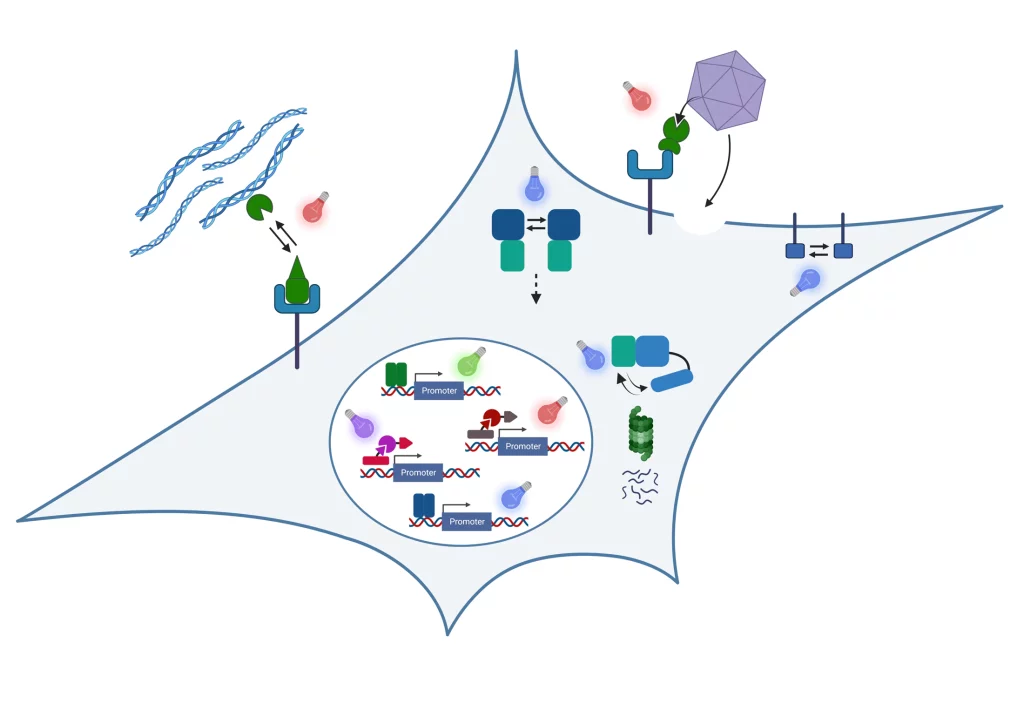
We develop and apply molecular optogenetic tools to control cell fate and function with unprecedented spatial and temporal precision in a dose-dependent and highly specific manner. To this aim, we engineer plant- and bacteria-derived photoreceptors and functionally couple them to proteins involved in cell signaling and gene expression. Examples of our work include:
- Light-inducible formation of liquid or gel-like transcription factor condensates in mammalian cells and mice. We demonstrate that liquid “transcription factor droplets” show a several-fold higher activity in inducing transgene expression compared to native transcription factors. Further, gel-like transcription factor condensates were shown to correlate with decreased transcriptional activation thus providing a materials-based layer of controlling gene expression.
See Schneider et al., Science Advances 2021 and Fischer et al., Small 2024 - Light-guided adeno-associated viral (AAV) vectors. We engineered a light-responsive tropism into AAVs which allows us to selectively transfer genetic information into single cells or to transduce different cells within one culture with different transgenes.
See Hörner et al., Science Advances 2021
Our group is running www.optobase.org, the most comprehensive database on molecular optogenetics. Have a look and discover the amazing opportunities in controlling biology with light!
Biosensors
We integrate natural and engineered molecular sensors for drugs, metabolites or nucleic acids into suitable readout formats for the fast and sensitive quantification of such substances. Together with collaboration partners, we develop biosensor systems for different application fields:
Open Positions
We are always excited to meet curious and creative scientists passionate about synthetic biology, optogenetics, and engineered living materials. If you would like to shape the future of biobased and living materials with us, we warmly welcome your spontaneous application for a PhD thesis or Postdoc position!
Projects and Partners
We perform collaborative research in materials-oriented synthetic biology within interdisciplinary research consortia
STEADY
Within the ERC Advanced Grant STEADY, we develop concepts for dynamically controlling the properties of engineered living materials by advanced synthetic genetic circuits.
LoopOfFun
We coordinate the European Innovation Council (EIC)-funded consortium LoopOfFun in which we aim at developing a platform for the rapid development of industry-scale, one-step, simple casting-based manufacturing processes for fungal mycelia composites. We jointly work towards this goal with our consortium partners:
- Prof. Roman Jerala, National Institute of Chemistry, Ljubljana, Slovenia
- Dr. Achim Weber, Fraunhofer IGB, Stuttgart, Germany
- Prof. Arnold Driessen, University of Groningen, The Netherlands
- Carlotta Borgato and Jan Boelen, Atelier LUMA, Arles, France
DELIVER
In the project DELIVER funded by the Carl-Zeiss-Foundation, we collaborate towards the data-driven engineering of sustainable living materials. We combine synthetic biology with materials sciences and data-driven approaches to design bio-based composite materials with custom-tailored structural properties for construction applications. Within deliver, we collaborate with the following partners:
- Prof. Thomas Speck, University of Freiburg, Germany
- Dr. Clemens Kreutz, University Hospital Freiburg, Germany
BILLARD
We coordinate the BILLARD project funded by the Federal Ministry of Education and Research (BMBF) within the funding line “Biologization of Technology”, we collaborate with PD Dr. Felicitas Bucher from the Clinic of Ophtamology at the University Hospital Freiburg on the development of novel intraocular drug delivery devices.
CIBSS – Centre for Integrative Biological Signalling Studies
We are member of the Cluster of Excellence CIBSS in which we perform research on novel optogenetic technologies to control signaling reactions in mammalian cells. We mainly collaborate with Prof. Dr. Jens Timmer on the model-based design of synthetic biological switches and networks and with Prof. Dr. Wolfgang Schamel on controlling immunological processes such as T cell activation via optogenetics.
Publications
Müller, K. | Naumann, S. | Weber, Wilfried | Zurbriggen, M. D.
DOI:
Molecular switches that are controlled by chemicals have evolved as central research instruments in mammalian cell biology. However, these tools are limited in terms of their spatiotemporal resolution due to freely diffusing inducers. These limitations have recently been addressed by the development of optogenetic, genetically encoded, and light-responsive tools that can be controlled with the unprecedented spatiotemporal precision of light. In this article, we first provide a brief overview of currently available optogenetic tools that have been designed to control diverse cellular processes. Then, we focus on recent developments in light-controlled gene expression technologies and provide the reader with a guideline for choosing the most suitable gene expression system. © 2015 by De Gruyter.
Müller, K. | Zurbriggen, M. D. | Weber, Wilfried
DOI:
The rapid development of mammalian optogenetics has produced an expanding number of gene switches that can be controlled with the unprecedented spatiotemporal resolution of light. However, in the "pre-optogenetic" era many networks, cell lines and transgenic organisms have been engineered that rely on chemically-inducible transgene expression systems but would benefit from the advantages of the traceless inducer light. To open the possibility for the effortless upgrade of such systems from chemical inducers to light, we capitalized on the specific Med25VBD inhibitor of the VP16/VP64 transactivation domain. In a first step, we demonstrated the efficiency and selectivity of Med25VBD in the inhibition of VP16/VP64-based transgene expression systems. Then, we fused the inhibitor to the blue light-responsive B-LID degron and optimized the performance of this construct with regard to the number of Med25VBD repeats. This approach resulted in an optogenetic upgrade of the popular Tet-OFF (TetR-VP64, tetO7-PhCMVmin) system that allows tunable, blue light-inducible transgene expression in HEK-293T cells. © 2015 Wiley Periodicals, Inc..
Agne, M. | Blank, I. | Emhardt, A. J. | Gäbelein, C. G. | Gawlas, F. | Gillich, N. | Gonschorek, P. | Juretschke, T. J. | Krämer, S. D. | Louis, N. | Müller, A. | Rudorf, A. | Schäfer, L. M. | Scheidmann, M. C. | Schmunk, L. J. | Schwenk, P. M. | Stammnitz, M. R. | Warmer, P. M. | Weber, Wilfried | Fischer, A. | Kaufmann, B. | Wagner, H. J. | Radziwill, G.
DOI:
The ability to control mammalian genes in a synergistic mode using synthetic transcription factors is highly desirable in fields of tissue engineering, stem cell reprogramming and fundamental research. In this study, we developed a standardized toolkit utilizing an engineered CRISPR/Cas9 system that enables customizable gene regulation in mammalian cells. The RNA-guided dCas9 protein was implemented as a programmable transcriptional activator or repressor device, including targeting of endogenous loci. For facile assembly of single or multiple CRISPR RNAs, our toolkit comprises a modular RNAimer plasmid, which encodes the required noncoding RNA components. © 2014 American Chemical Society.
Hörner, M. | Kaufmann, B. | Cotugno, G. | Wiedtke, E. | Büning, H. | Grimm, D. | Weber, Wilfried
DOI:
Chemically triggered molecular switches for controlling the fate and function of biological systems are fundamental to the emergence of synthetic biology and the development of biomedical applications. We here present the first chemically triggered switch for controlling the infectivity of adeno-associated viral (AAV) vectors. © 2014 The Royal Society of Chemistry.
Hövermann, D. | Rossow, T. | Gübeli, R. J. | Seiffert, S. | Weber, Wilfried
DOI:
Biohybrid hydrogels that change their mechanical properties in response to pharmacological cues hold high promises as externally controlled drug depots for biomedical applications. In this study, we devise a generically applicable method for the synthesis of micrometer-scale, injection-ready biohybrid materials. We use droplet-based microfluidics to generate monodisperse pre-microgel fluid droplets, wherein which we react fluorescein-modified 8-arm poly(ethylene glycol) with a thiol-functionalized humanized anti-fluorescein single chain antibody fragment and vinylsulfonefunctionalized 8-arm poly(ethylene glycol), resulting in the formation of stable, narrowly dispersed supramolecular microgels (30 and 150μm diameter). We demonstrate that the addition of free fluorescein to these microgels results in a weakening of their hydrogel structure, eventually leading to its disintegration. This method of formation of pharmacologically responsive biohybrid hydrogels in an injection-ready formulation is a pioneering example of a general approach for the synthesis of biohybrid hydrogel-based drug depots for biomedical applications. © 2014 WILEY-VCH Verlag GmbH & Co. KGaA, Weinheim.
Ketterer, S. | Hövermann, D. | Guebeli, R. J. | Bartels-Burgahn, F. | Riewe, D. | Altmann, T. | Zurbriggen, M. D. | Junker, B. | Weber, Wilfried | Meier, M.
DOI:
Steadily growing demands for identification and quantification of cellular metabolites in higher throughput have brought a need for new analytical technologies. Here, we developed a synthetic biological sensor system for quantifying metabolites from biological cell samples. For this, bacterial transcription factors were exploited, which bind to or dissociate from regulatory DNA elements in response to physiological changes in the cellular metabolite concentration range. Representatively, the bacterial pyruvate dehydrogenase (PdhR), trehalose (TreR), and l-arginine (ArgR) repressor proteins were functionalized to detect pyruvate, trehalose-6-phosphate (T6P), and arginine concentration in solution. For each transcription factor the mutual binding behavior between metabolite and DNA, their working range, and othogonality were determined. High-throughput, parallel processing, and automation were achieved through integration of the metabolic sensor system on a microfluidic large-scale integration (mLSI) chip platform. To demonstrate the functionality of the integrated metabolic sensor system, we measured diurnal concentration changes of pyruvate and the plant signaling molecule T6P within cell etxracts of Arabidopsis thaliana rosettes. The transcription factor sensor system is of generic nature and extendable on the microfluidic chip. (Figure Presented). © 2014 American Chemical Society.
Müller, K. | Siegel, D. | Rodriguez Jahnke, F. | Gerrer, K. | Wend, S. | Decker, E. L. | Reski, R. | Weber, Wilfried | Zurbriggen, M. D.
DOI:
On command control of gene expression in time and space is required for the comprehensive analysis of key plant cellular processes. Even though some chemical inducible systems showing satisfactory induction features have been developed, they are inherently limited in terms of spatiotemporal resolution and may be associated with toxic effects. We describe here the first synthetic light-inducible system for the targeted control of gene expression in plants. For this purpose, we applied an interdisciplinary synthetic biology approach comprising mammalian and plant cell systems to customize and optimize a split transcription factor based on the plant photoreceptor phytochrome B and one of its interacting factors (PIF6). Implementation of the system in transient assays in tobacco protoplasts resulted in strong (95-fold) induction in red light (660 nm) and could be instantaneously returned to the OFF state by subsequent illumination with far-red light (740 nm). Capitalizing on this toggle switch-like characteristic, we demonstrate that the system can be kept in the OFF state in the presence of 740 nm-supplemented white light, opening up perspectives for future application of the system in whole plants. Finally we demonstrate the system's applicability in basic research, by the light-controlled tuning of auxin signalling networks in N. tabacum protoplasts, as well as its biotechnological potential for the chemical-inducer free production of therapeutic proteins in the moss P. patens. This journal is © the Partner Organisations 2014.
Müller, K. | Zurbriggen, M. D. | Weber, Wilfried
DOI:
Light-triggered gene expression systems offer an unprecedented spatiotemporal resolution that cannot be achieved with classical chemically inducible genetic tools. Here we describe a protocol for red light-responsive gene expression in mammalian cells. This system can be toggled between stable ON and OFF states by short pulses of red and far-red light, respectively. In the protocol, CHO-K1 cells are transfected to allow red light-inducible expression of the secreted alkaline phosphatase (SEAP) reporter, and gene expression is tuned by illumination with light of increasing wavelengths. As a starting point for elaborate red light-responsive gene expression, we outline the reversible activation of gene expression and describe how a spatial pattern can be 'printed' on a monolayer of cells by using a photomask. The core protocol requires only 4 d from seeding of the cells to reporter quantification, and other than light-emitting diode (LED) illumination boxes no elaborate equipment is required. © 2014 Nature America, Inc.
Tomakidi, P. | Schulz, S. | Proksch, S. | Weber, Wilfried | Steinberg, T.
DOI:
Mechanobiology is a scientific interface discipline emerging from engineering and biology. With regard to tissue-regenerative cell-based strategies, mechanobiological concepts, including biomechanics as a target for cell and human mesenchymal stem cell behaviour, are on the march. Based on the periodontium as a paradigm, this mini-review discusses the key role of focal-adhesion kinase (FAK) in mechanobiology, since it is involved in mediating the transformation of environmental biomechanical signals into cell behavioural responses via mechanotransducing signalling cascades. These processes enable cells to adjust quickly to environmental cues, whereas adjustment itself relies on the specific intramolecular phosphorylation of FAK tyrosine residues and the multiple interactions of FAK with distinct partners. Furthermore, interaction-triggered mechanotransducing pathways govern the dynamics of focal adhesion sites and cell behaviour. Facets of behaviour not only include cell spreading and motility, but also proliferation, differentiation and apoptosis. In translational terms, identified and characterized biomechanical parameters can be incorporated into innovative concepts of cell- and tissue-tailored clinically applied biomaterials controlling cell behaviour as desired.
Wend, S. | Wagner, H. J. | Muller, K. | Zurbriggen, M. D. | Weber, Wilfried | Radziwill, G.
DOI:
Light-dependent dimerization is the basis for recently developed noninvasive optogenetic tools. Here we present a novel tool combining optogenetics with the control of protein kinase activity to investigate signal transduction pathways. Mediated by Arabidopsis thaliana photoreceptor cryptochrome 2, we activated the protein kinase C-RAF by blue light-dependent dimerization, allowing for decoupling from upstream signaling events induced by surface receptors. The activation by light is fast, reversible, and not only time but also dose dependent as monitored by phosphorylation of ERK1/2. Additionally, light-activated C-RAF controls serum response factor-mediated gene expression. Light-induced heterodimerization of C-RAF with a kinase-dead mutant of B-RAF demonstrates the enhancing role of B-RAF as a scaffold for C-RAF activity, which leads to the paradoxical activation of C-RAF found in human cancers. This optogenetic tool enables reversible control of protein kinase activity in signal duration and strength. These properties can help to shed light onto downstream signaling processes of protein kinases in living cells. © 2013 American Chemical Society.