

We engineer cells and materials that communicate and process information through synthetic biology
Our inspiration is the ability of organisms and the materials they are made of to adapt to dynamic environmental conditions. Plants adapt growth to light conditions; bacteria develop resistance against antibiotics or bones get stronger when exercised. The basis for this ability to adapt is a fascinating information processing machinery of the organisms: Environmental conditions are captured by molecular sensors, then the signals are processed and integrated with genetic programs to finally yield a targeted response.
In our research, we engineer nature’s molecular sensing, processing, and actuation machinery in order to precisely control the function and properties of cells and materials. We apply these newly developed technologies in different fields of fundamental and applied research.

Team Members


Research
Stimulus-responsive and Information-processing (living) Materials

We develop and apply stimulus-responsive and information-processing biohybrid polymer materials. To this aim, we functionally couple synthetic biological molecular sensors and switches to polymer materials. By wiring these switches according to topologies inspired by electronic circuits, we engineer materials that perform fundamental computational operations. Examples of our work include:
- We engineered a hydrogel based on a bacteria-derived photoreceptor which allows the light-responsive, fully reversibly tuning of its mechanical properties. We applied this hydrogel as extracellular matrix to analyze the impact of dynamic mechanical environments on transcriptome-wide responses in mesenchymal stem cells or on the migration of T-lymphocytes.
See Hörner et al. Advanced Materials 2019 - We integrated synthetic biological switches with polymer materials into a circuit inspired by an electronic counter. The resulting material system was able to count the number of input light pulses and to release different output as a function of the number of light pulses detected. We applied this system to sequentially release different biocatalysts to drive a two-step biochemical reaction.
See Beyer et al., Advanced Materials 2018 - We developed PenTag, a protein tag for the spontaneous, covalent coupling of proteins to ampicillin-functionalized molecules such as dyes, polymers, or solid supports. Based on this strategy, we engineered and assembled material modules to function as encoder for processing different combinations of biochemical input stimuli.
See Mohsenin et al., Advanced Functional Materials 2024 - By engineering modular protease-based switches that can either be activated or repressed, we develop information-processing biohybrid circuits that process binary biomolecular information according to a circuit inspired by electronic decoders. Such circuits can be applied to process and interpret biochemical sensor information for advanced diagnostic applications.
See Mohsenin et al., Advanced Materials 2024
Molecular optogenetics to control cell fate and function
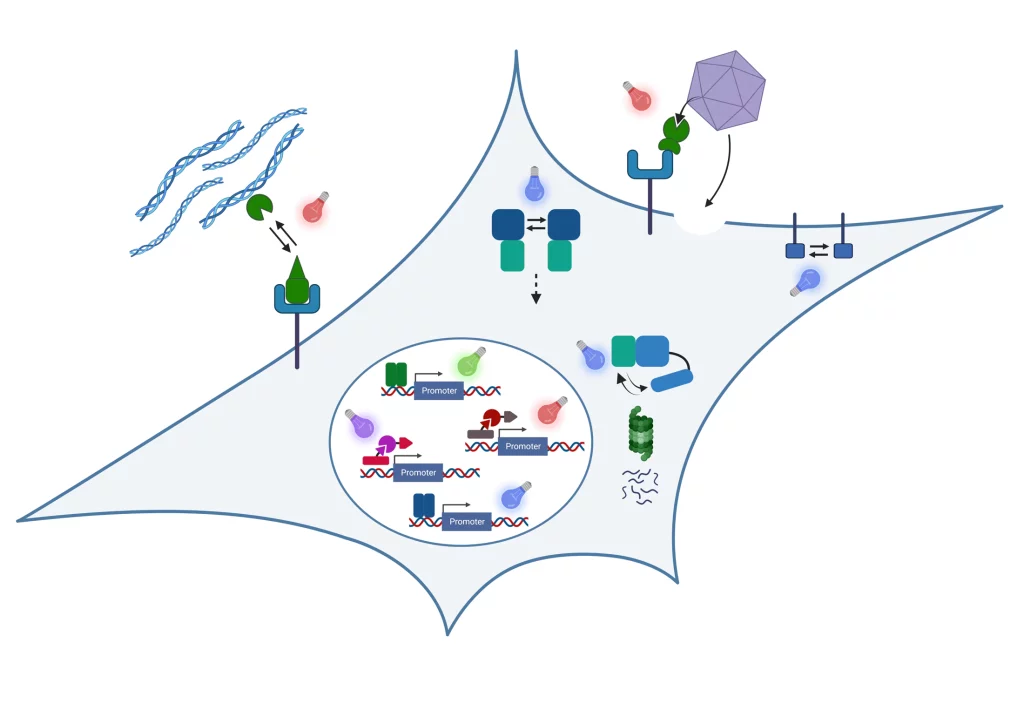
We develop and apply molecular optogenetic tools to control cell fate and function with unprecedented spatial and temporal precision in a dose-dependent and highly specific manner. To this aim, we engineer plant- and bacteria-derived photoreceptors and functionally couple them to proteins involved in cell signaling and gene expression. Examples of our work include:
- Light-inducible formation of liquid or gel-like transcription factor condensates in mammalian cells and mice. We demonstrate that liquid “transcription factor droplets” show a several-fold higher activity in inducing transgene expression compared to native transcription factors. Further, gel-like transcription factor condensates were shown to correlate with decreased transcriptional activation thus providing a materials-based layer of controlling gene expression.
See Schneider et al., Science Advances 2021 and Fischer et al., Small 2024 - Light-guided adeno-associated viral (AAV) vectors. We engineered a light-responsive tropism into AAVs which allows us to selectively transfer genetic information into single cells or to transduce different cells within one culture with different transgenes.
See Hörner et al., Science Advances 2021
Our group is running www.optobase.org, the most comprehensive database on molecular optogenetics. Have a look and discover the amazing opportunities in controlling biology with light!
Biosensors
We integrate natural and engineered molecular sensors for drugs, metabolites or nucleic acids into suitable readout formats for the fast and sensitive quantification of such substances. Together with collaboration partners, we develop biosensor systems for different application fields:
Open Positions
We are always excited to meet curious and creative scientists passionate about synthetic biology, optogenetics, and engineered living materials. If you would like to shape the future of biobased and living materials with us, we warmly welcome your spontaneous application for a PhD thesis or Postdoc position!
Projects and Partners
We perform collaborative research in materials-oriented synthetic biology within interdisciplinary research consortia
STEADY
Within the ERC Advanced Grant STEADY, we develop concepts for dynamically controlling the properties of engineered living materials by advanced synthetic genetic circuits.
LoopOfFun
We coordinate the European Innovation Council (EIC)-funded consortium LoopOfFun in which we aim at developing a platform for the rapid development of industry-scale, one-step, simple casting-based manufacturing processes for fungal mycelia composites. We jointly work towards this goal with our consortium partners:
- Prof. Roman Jerala, National Institute of Chemistry, Ljubljana, Slovenia
- Dr. Achim Weber, Fraunhofer IGB, Stuttgart, Germany
- Prof. Arnold Driessen, University of Groningen, The Netherlands
- Carlotta Borgato and Jan Boelen, Atelier LUMA, Arles, France
DELIVER
In the project DELIVER funded by the Carl-Zeiss-Foundation, we collaborate towards the data-driven engineering of sustainable living materials. We combine synthetic biology with materials sciences and data-driven approaches to design bio-based composite materials with custom-tailored structural properties for construction applications. Within deliver, we collaborate with the following partners:
- Prof. Thomas Speck, University of Freiburg, Germany
- Dr. Clemens Kreutz, University Hospital Freiburg, Germany
BILLARD
We coordinate the BILLARD project funded by the Federal Ministry of Education and Research (BMBF) within the funding line “Biologization of Technology”, we collaborate with PD Dr. Felicitas Bucher from the Clinic of Ophtamology at the University Hospital Freiburg on the development of novel intraocular drug delivery devices.
CIBSS – Centre for Integrative Biological Signalling Studies
We are member of the Cluster of Excellence CIBSS in which we perform research on novel optogenetic technologies to control signaling reactions in mammalian cells. We mainly collaborate with Prof. Dr. Jens Timmer on the model-based design of synthetic biological switches and networks and with Prof. Dr. Wolfgang Schamel on controlling immunological processes such as T cell activation via optogenetics.
Publications
Middleton, A. M. | Dal Bosco, C. | Chlap, P. | Bensch, R. | Harz, H. | Ren, F. | Bergmann, S. | Wend, S. | Weber, Wilfried | Hayashi, K. I. | Zurbriggen, M. D. | Uhl, R. | Ronneberger, O. | Palme, K. | Fleck, C. | Dovzhenko, A.
DOI:
In plants, the phytohormone auxin acts as a master regulator of developmental processes and environmental responses. The best characterized process in the auxin regulatory network occurs at the subcellular scale, wherein auxin mediates signal transduction into transcriptional programs by triggering the degradation of Aux/IAA transcriptional repressor proteins in the nucleus. However, whether and how auxin movement between the nucleus and the surrounding compartments is regulated remain elusive. Using a fluorescent auxin analog, we show that its diffusion into the nucleus is restricted. By combining mathematical modeling with time course assays on auxin-mediated nuclear signaling and quantitative phenotyping in single plant cell systems, we show that ER-to-nucleus auxin flux represents a major subcellular pathway to directly control nuclear auxin levels. Our findings propose that the homeostatically regulated auxin pool in the ER and ER-to-nucleus auxin fluxes underpin auxin-mediated downstream responses in plant cells. Middleton et al. study how the plant phytohormone auxin enters the nucleus by using quantitative phenotyping in single plant cell systems and bespoke mathematical models that relate controlled perturbations to experimentally measurable responses. Their findings show that auxin predominantly enters the nucleus via the endoplasmic reticulum. © 2018 The Authors
Schneider, N. | Gäbelein, C. | Wiener, J. | Georgiev, T. | Gobet, N. | Weber, Wilfried | Meier, M.
DOI:
We here present a method that combines genetic code expansion with CRISPR/Cas9 genome engineering to label endogenously expressed proteins with high spatiotemporal resolution. The method exploits the use of an orthogonal tRNA/tRNA synthetase pair in conjugation with noncanonical amino acids to create stop codon read through events. To demonstrate the functionality of the method, we pulse labeled endogenous β-actin and tumor protein p53 with a minimally invasive HA tag at their C-termini. Targeting the protein label with a proximity ligation assay plus real time imaging facilitates seamless quantification of the protein synthesis rate and spatial localization at the single cell level. The presented approach does not interfere with any physiological control of cellular expression, nor did we observe any perturbation of endogenous protein functions. © 2018 American Chemical Society.
Wagner, H. J. | Engesser, R. | Ermes, K. | Geraths, C. | Timmer, J. | Weber, Wilfried
DOI:
The translation of engineering designs to materials sciences by means of synthetic biological tools represents a novel concept for the development of information-processing materials systems. Here, we provide data on the mathematical model-guided implementation of a biomaterials-based positive feedback loop for the detection of proteolytic activities. Furthermore, we present data on an extended system design for the detection of the antibiotic novobiocin. This work is related to the research article “Synthetic biology-inspired design of signal-amplifying materials systems” (Wagner et al., 2018) [1]. © 2018 The Authors
Wagner, H. J. | Wehrle, S. | Weiss, E. | Cavallari, M. | Weber, Wilfried
DOI:
Nanobodies, the smallest possible antibody format, have become of considerable interest for biotechnological and immunotherapeutic applications. They show excellent robustness, are non-immunogenic in humans, and can easily be engineered and produced in prokaryotic hosts. Traditionally, nanobodies are selected from camelid immune libraries involving the maintenance and treatment of animals. Recent advances have involved the generation of nanobodies from naïve or synthetic libraries. However, such approaches demand large library sizes and sophisticated selection procedures. Here, we propose an alternative, two-step approach for the design and generation of nanobodies. In a first step, complementarity-determining regions (CDRs) are grafted from conventional antibody formats onto nanobody frameworks, generating weak antigen binders. In a second step, the weak binders serve as templates to design focused synthetic phage libraries for affinity maturation. We validated this approach by grafting toxin-and hapten-specific CDRs onto frameworks derived from variable domains of camelid heavy-chain-only antibodies (VHH). We then affinity matured the hapten binder via panning of a synthetic phage library. We suggest that this strategy can complement existing immune, naïve, and synthetic library based methods, requiring neither animal experiments, nor large libraries, nor sophisticated selection protocols. © 2018 by the authors. Licensee MDPI, Basel, Switzerland.
Bruch, R. | Chatelle, C. | Kling, A. | Rebmann, B. | Wirth, S. | Schumann, S. | Weber, Wilfried | Dincer, C. | Urban, G.
DOI:
An appropriate antibiotherapy is crucial for the safety and recovery of patients. Depending on the clinical conditions of patients, the required dose to effectively eradicate an infection may vary. An inadequate dosing not only reduces the efficacy of the antibiotic, but also promotes the emergence of antimicrobial resistances. Therefore, a personalized therapy is of great interest for improved patients' outcome and will reduce in long-term the prevalence of multidrug-resistances. In this context, on-site monitoring of the antibiotic blood concentration is fundamental to facilitate an individual adjustment of the antibiotherapy. Herein, we present a bioinspired approach for the bedside monitoring of free accessible ß-lactam antibiotics, including penicillins (piperacillin) and cephalosporins (cefuroxime and cefazolin) in untreated plasma samples. The introduced system combines a disposable microfluidic chip with a naturally occurring penicillin-binding protein, resulting in a high-performance platform, capable of gauging very low antibiotic concentrations (less than 6 ng ml-1) from only 1 μl of serum. The system's applicability to a personalized antibiotherapy was successfully demonstrated by monitoring the pharmacokinetics of patients, treated with ß-lactam antibiotics, undergoing surgery. © 2017 The Author(s).
Fischer, A. | Weber, Wilfried | Warscheid, B. | Radziwill, G.
DOI:
Scaffold proteins are hubs for the coordination of intracellular signaling networks. The scaffold protein CNK1 promotes several signal transduction pathway. Here we demonstrate that sterile motif alpha (SAM) domain-dependent oligomerization of CNK1 stimulates CNK1-mediated signaling in growth factor-stimulated cells. We identified Ser22 located within the SAM domain as AKT-dependent phosphorylation site triggering CNK1 oligomerization. Oligomeric CNK1 increased the affinity for active AKT indicating a positive AKT feedback mechanism. A CNK1 mutant lacking the SAM domain and the phosphorylation-defective mutant CNK1S22A antagonizes oligomerization and prevents CNK1-driven cell proliferation and matrix metalloproteinase 14 promoter activation. The phosphomimetic mutant CNK1S22D constitutively oligomerizes and stimulates CNK1 downstream signaling. Searching the COSMIC database revealed Ser22 as putative target for oncogenic activation of CNK1. Like the phosphomimetic mutant CNK1S22D, the oncogenic mutant CNK1S22F forms clusters in serum-starved cells comparable to clusters of CNK1 in growth factor-stimulated cells. CNK1 clusters induced by activating Ser22 mutants correlate with enhanced cell invasion and binding to and activation of ADP ribosylation factor 1 associated with tumor formation. Mutational analysis indicate that EGF-triggered phosphorylation of Thr8 within the SAM domain prevents AKT binding and antagonizes CNK1-mediated AKT signaling. Our findings reveal SAM domain-dependent oligomerization by AKT as switch for CNK1 activation. © 2016 Elsevier B.V.
Hörner, M. | Müller, K. | Weber, Wilfried
DOI:
Recent advances in the development of light-inducible transgene expression systems have overcome many inherent drawbacks of conventional chemically regulated systems. The latest generation of those light-regulated systems that are specifically responsive to different wavelengths allows spatiotemporal control of gene expression in a so far unprecedented manner. In this chapter, we first describe the available light-inducible gene expression systems compatible with mammalian cells and explain their underlying mechanisms. Afterward, we give a detailed protocol for the implementation of a UVB light-inducible expression system in mammalian cells. © 2017, Springer Science+Business Media LLC.
Jakob, M. H. | Dong, B. | Gutsch, S. | Chatelle, C. | Krishnaraja, A. | Weber, Wilfried | Zacharias, M.
DOI:
Novel tin oxide field-effect-transistors (SnO2 NW-FET) for pH and protein detection applicable in the healthcare sector are reported. With a SnO2 NW-FET the proof-of-concept of a bio-sensing device is demonstrated using the carrier transport control of the FET channel by a (bio-) liquid modulated gate. Ultra-thin Al2O3 fabricated by a low temperature atomic layer deposition (ALD) process represents a sensitive layer to H+ ions safeguarding the nanowire at the same time. Successful pH sensitivity is demonstrated for pH ranging from 3 to 10. For protein detection, the SnO2 NW-FET is functionalized with a receptor molecule which specifically interacts with the protein of interest to be detected. The feasibility of this approach is demonstrated via the detection of a biotinylated protein using a NW-FET functionalized with streptavidin. An immediate label-free electronic read-out of the signal is shown. The well-established Enzyme-Linked Immunosorbent Assay (ELISA) method is used to determine the optimal experimental procedure which would enable molecular binding events to occur while being compatible with a final label-free electronic read-out on a NW-FET. Integration of the bottom-up fabricated SnO2 NW-FET pH- and biosensor into a microfluidic system (lab-on-a-chip) allows the automated analysis of small volumes in the 400 μl range as would be desired in portable on-site point-of-care (POC) devices for medical diagnosis. © 2017 IOP Publishing Ltd.
Jakob, M. H. | Gutsch, S. | Chatelle, C. | Krishnaraja, A. | Fahlteich, J. | Weber, Wilfried | Zacharias, M.
DOI:
Flexible and transparent zinc oxide (ZnO) thin film field-effect transistors (TF-FET) for the use as small volume potentiometric pH sensors are developed. Low temperature atomic layer deposition (ALD) is used for the fabrication of the metal oxides ZnO and aluminum dioxide (Al2O3). Changing the deposition temperature of the ZnO from 150 to 100 °C allowed a significant increase in resistivity by four orders of magnitude. Hence, adjusting the controlled low carrier concentration for the field-effect based sensor is demonstrated. ZnO TF-FET pH sensors fabricated on silicon/silicon dioxide (Si/SiO2) substrates are compared with sensors based on flexible and transparent polyethylene naphthalate (PEN) foil substrates. Comparison of both types of pH sensors showed successful pH sensitivity for pH ranging from 5 to 10 in both cases. © 2017 WILEY-VCH Verlag GmbH & Co. KGaA, Weinheim
Kolar, K. | Weber, Wilfried
DOI:
Precise spatial and temporal control of cellular processes is in life sciences a highly sought-after capability. In the recent years, this goal has become progressively achievable through the field of optogenetics, which utilizes light as a non-invasive means to control genetically encoded light-responsive proteins. The latest optogenetic systems, such as those for control of subcellular localization or cellular decision-making and tissue morphogenesis provide us with insights to gain a deeper understanding of the cellular inner workings. Besides, they hold a potential for further development into biomedical applications, from in vitro optogenetics-assisted drug candidate screenings to light-controlled gene therapy and tissue engineering. © 2017 Elsevier Ltd