

The Research Group Bioprogrammable Materials explores a young multidisciplinary field combining synthetic biology and biomaterials. It focuses on the development of materials with genetically programmed functionalities capable of biosensing, stimuli-responsive long-term drug release, and manipulation of cell behavior. Synthetic biology tools are used to program proteins and microbes to perform smart and beneficial functions. These engineered biological entities are then incorporated in appropriately developed polymeric matrices, resulting in composite materials with highly versatile functionalities, a wide range of tunability, and in situ controllability.
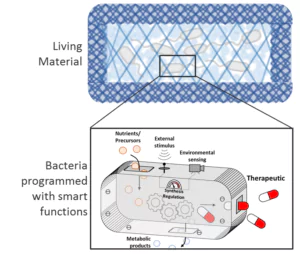
Figure: Bacterias are programmed with smart functions for applications e.g. in biosensing and drug delivery.

Staff


Research
In the Bioprogrammable Materials group, we combine genetically-programmed living organisms like bacteria with polymeric matrices like hydrogels to generate smart composite materials called engineered living materials (ELMs). Our ELMs are designed for a range of biomedical applications, such as biosensing and drug-delivery through innovations in both the living and non-living components:
Stimuli-responsive drug-secretion in bacteria
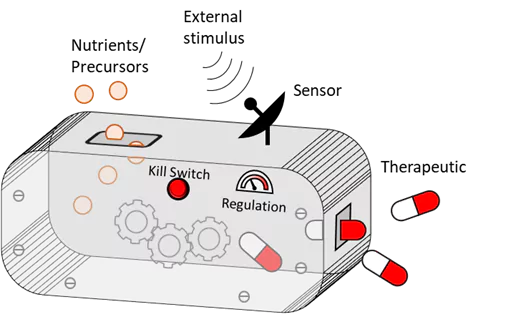
Bacteria are an integral part of the body’s microbiome, with several native and probiotic species imparting natural health benefits to humans. Bacteria are also used extensively in the pharmaceutical industry as biofactories to produce a variety of drugs. Our research merges these two features by engineering medically relevant bacteria like E. coli, Lactobacilli and Corynebacterium to produce and secrete therapeutic molecules directly in the body where they are needed. Since the bacteria naturally thrive within the body, long-term drug release can be sustained. We engineer the bacteria to produce and release anti-microbial, anti-inflammatory and regenerative drugs in the form of peptides, proteins and enzymatically synthesized biomolecules to treat chronic diseases.
Due to variabilities in patient profiles and disease progressions, it is highly desirable to personalize and customize the activity of these therapeutic bacteria in order to ensure their effectiveness. For this, we are developing genetic modules which allow external stimuli to “switch on” drug release. Stimuli like light, heat and small molecules allow remote-control over the bacteria, and stimuli like disease biomarkers will enable autoregulation of bacterial activity in response to disease progression. Stimuli-responsive genetic modules are also being developed as an additional layer of biosafety, to ensure that bacteria do not survive outside their intended implant environment. While many of the genetic modules we use were developed for E. coli, we are also endowing probiotic bacteria like lactobacilli and Corynebacterium with similar functions – a challenge which promises significant rewards by expanding the range of ELM-ready organisms and functions.
Recent publications:
- Dhakane, P.; Tadimarri, V. S.; Sankaran, S. Light-Regulated pro-Angiogenic Engineered Living Materials. bioRxiv – https://doi.org/10.1101/2022.10.28.514190.
- Dey, S.; Asensio, M. B.; Kuttae, S. B.; Sankaran, S. Novel Genetic Modules Encoding High-Level Antibiotic-Free Protein Expression in Probiotic Lactobacilli. bioRxiv – https://doi.org/10.1101/2022.08.04.502766.
Hydrogels for bacterial encapsulation and tools to understand bacterial behavior in confinement
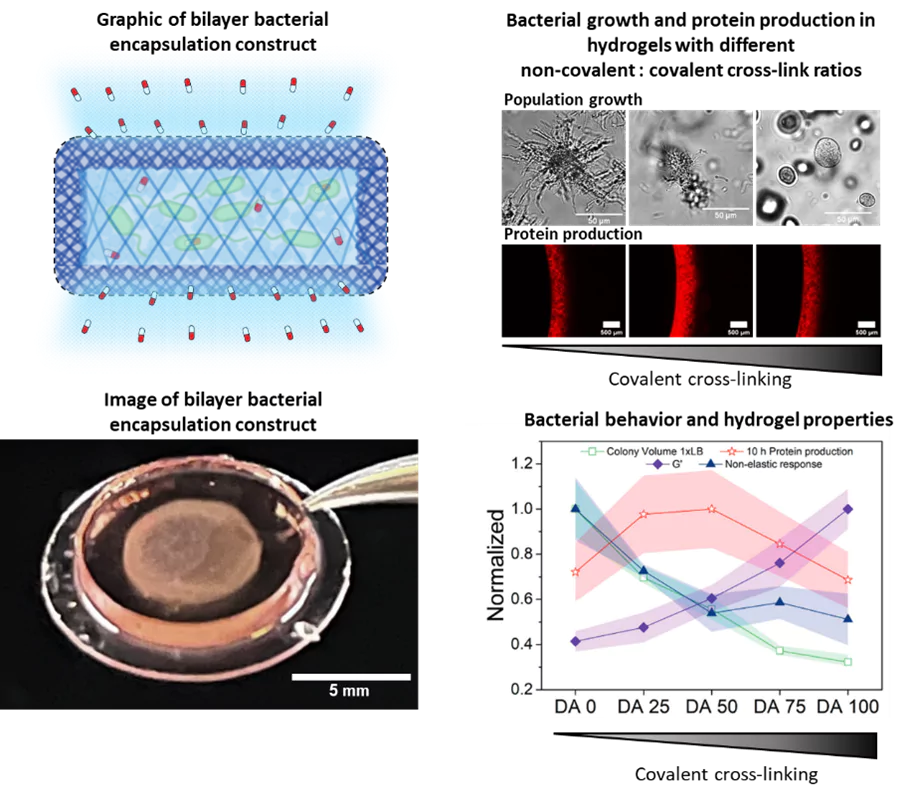
For the therapeutic bacteria to treat a disease, they need to colonize the disease site and establish a population big enough to provide effective drug doses. In collaboration with the Dynamic Biomaterials group, we are developing hydrogel matrices that provide conducive environments for the bacteria to grow and function. These hydrogels are designed to mechanically control the size of the contained bacterial population while maximizing their functionality. The hydrogel network allows diffusion of nutrients, metabolites and drugs in and out of the matrix, while preventing bacterial escape and providing protection from immune cells. The material component therefore provides an added level of biosafety for the use of genetically modified bacteria within the body.
As part of this research, we have identified that certain mechanical properties of the hydrogels influence growth and metabolism of the bacteria within, similar to how it occurs in natural biofilms. This, in turn, affects the performance of the bacteria in terms of stimuli-responsiveness and drug production. Thus, we are studying bacterial behavior confined in hydrogels, whole mechanical properties can be tuned. Thereby, we are unravelling the interplay between collective bacterial behavior and mechanical forces surrounding them. Apart from this enabling us to optimize the performance of our engineered living materials, it also serves as an artificial biofilm platform to gain fundamental insights into potential behavior of bacteria within different domains of natural biofilms. We use microscopy, biochemical and genetic assays to determine growth and metabolic behavior of the bacteria over time.
Recent publications:
Bhusari, S.; Sankaran, S.; del Campo, A. Regulating Bacterial Behavior within Hydrogels of Tunable Viscoelasticity. Advanced Science 2022, 9 (17), 2106026. https://doi.org/10.1002/advs.202106026.
Bhusari, S.; Kim, J.; Polizzi, K.; Sankaran, S.; Campo, A. del. Encapsulation of Bacteria in Bilayer Pluronic Thin Film Hydrogels: A Safe Format for Engineered Living Materials. bioRxiv – https://doi.org/10.1101/2022.09.29.510162.
Collaborations:
These research endeavors are also part of multiple collaborations within two consortia – (i) Leibniz Science Campus on Living Therapeutic Materials (LSC LifeMat) and (ii) Collective Research Center on Physical modeling of non-equilibrium processes in biological systems (CRC 1027).
Finanzierung:



Publications
Tadimarri, Varun S. | Blanch-Asensio, Marc | Deshpande, Ketaki | Baumann, Jonas | Baumann, Carole | Müller, Rolf | Trujillo, Sara | Sankaran, Shrikrishnan
DOI:
Engineered living materials (ELMs) made of bacteria in hydrogels have shown considerable promise for therapeutic applications through controlled and sustained release of complex biopharmaceuticals at low costs and with reduced wastage. While most therapeutic ELMs use E. coli due to its large genetic toolbox, most live biotherapeutic bacteria in development are lactic acid bacteria due to native health benefits they offer. Among these, lactobacilli form the largest family of probiotics with therapeutic potential in almost all sites of the body with a microbiome. A major factor limiting the use of lactobacilli in ELMs is their limited genetic toolbox. This study expands on recent work to expand the genetic programmability of probiotic Lactiplantibacillus plantarum WCFS1 for protein secretion and encapsulate it in a simple, cost-effective, and biocompatible core–shell alginate bead to develop an ELM. The controlled release of recombinant proteins is demonstrated, even up to 14 days from this ELM, thereby terming it PEARL – Protein Eluting Alginate with Recombinant Lactobacilli. Notably, lactobacillus encapsulation offered benefits like bacterial containment, protein release profile stabilization, and metabolite-induced cytotoxicity prevention. These findings demonstrate the mutual benefits of combining recombinant lactobacilli with alginate for the controlled and sustained release of proteins.
Dupont, L. | Tadimarri, Varun S. | Buret, R. | Sankaran, Shrikrishnan | Picton, L. | Jonas, A.M. | Glinel, K.
DOI:
Engineered living materials (ELMs) rely on the ability to control cell behavior in material systems. ELMs containing bacteria secreting beneficial molecules are being developed for therapeutic purposes. Using commensal strains embedded in physically cross-linked agarose hydrogels, we systematically investigate how gel rigidity and initial bacterial density affect the morphology of bacterial colonies and their secretory function. Although often considered independently, these parameters jointly define the microscale environment experienced by embedded cells, influencing nutrient access, mechanical interactions, and potential cell-to-cell communication. We show that matrix rigidity effectively tunes aggregate morphology, modulating their shape and compactness, without compromising bacterial growth or secretion. In parallel, initial bacterial density determines the biomass accumulation dynamics and spatial distribution of aggregates, which in turn influence the onset and temporal profile of secretory activity, without altering its final magnitude. This decoupling between structural organization and secretory output opens new possibilities for engineering ELMs with tailored architectures and prolonged secretory and release activity.
Chatterjee, Anwesha | Meier, Stefanie S.M. | Trujillo, Sara | Möglich, Andreas | Sankaran, Shrikrishnan
DOI:
Impaired angiogenesis is a central barrier in the treatment of chronic and deep tissue wounds, preventing progression through the normal healing cascade. While the combination of near infrared (NIR) photobiomodulation and pro-angiogenic growth factors has shown synergistic therapeutic benefit, the clinical translation of growth factor therapy is hindered by high cost, instability, and the need for localized dosing to avoid aberrant vasculature. Peptidomimetics such as the VEGF-derived QK peptide offer a more stable and predictable alternative, but still require a means for localized, tunable presentation. Here, we establish an engineered living material-based delivery system that responds to clinically relevant NIR light to produce and release a QK-Fusion protein directly at the target site. The probiotic Escherichia coli Nissle 1917 was engineered with an 800 nm-responsive optogenetic circuit and encapsulated within an optimized alginate core–shell hydrogel that ensures biocontainment while allowing controlled outward diffusion of the secreted peptide. The released peptide remains non-cytotoxic, capable of binding extracellular matrix analogs, and promotes angiogenesis in endothelial cultures and the chick chorioallantoic membrane assay. We thus establish a strategy for developing engineered living materials toward remote-controlled angiogenic stimulation.
Ye, Zirui | Chatterjee, Anwesha | Sankaran, Shrikrishnan
DOI:
In engineered living materials (ELMs) made of genetically engineered bacteria embedded in polymeric matrices, it is desirable for the bacteria to remain contained for biosafety and reliable performance. Such ELMs are being explored for a variety of applications, including smart drug delivery, in which the material also needs to allow protein release. Achieving this balance requires materials that simultaneously support cell viability, prevent bacterial escape, and permit controlled molecular diffusion. Here, we systematically dissect how alginate cross-linking chemistry, buffer composition, and secondary network reinforcement shape the performance of core–shell beads encapsulating Escherichia coli Nissle 1917 engineered to secrete a model protein. We identify a 4 h Ca2+ cross-linking window as the upper limit that maintains robust core viability and week-long confinement. For improved confinement, additional cross-linking strategies, including glutaraldehyde, polyethylenimine, and tannic acid, were tested and found to enhance the shell’s barrier properties to prevent leakage for up to 15 days but also negatively impacted protein release. Finally, replacing Ca2+ with Ba2+ as the cross-linking divalent cation yields the most effective solution, producing beads with exceptional long-term bacterial confinement capability (>20 days) while allowing for comparable protein secretion levels to Ca2+ controls. Together, these results establish a a materials-centric design framework for fabricating alginate-based ELMs that achieve durable confinement without compromising functional protein output and highlight barium-alginate shells as a promising platform for fabricating ELMs toward therapeutic applications.
Van Tente, Ilke | Blanch-Asensio, Marc | Eilers, Tom | Vandenheuvel, Dieter | Lebeer, Sarah | Sankaran, Shrikrishnan | Spacova, Irina
DOI:
Lacticaseibacillus rhamnosus strains are widely recognized for their probiotic potential and relevance in urogenital and gut health. However, their genetic tractability and genetic tools remain limited, hindering functional microbiome research and synthetic biology applications. In this study, we expanded the genetic toolbox for the widely used probiotic strains, L. rhamnosus GR-1 and L. rhamnosus GG, by implementing direct plasmid cloning and testing of a set of genetic elements earlier validated in Lactiplantibacillus plantarum. Among five constitutive promoters (PtlpA, Ptec, Pcpg, P48 and P23), PtlpA showed strong promoter activity in L. rhamnosus GR-1. We further characterized this promoter's functionality by incorporating a repressor and assessing its native thermo-responsiveness and stability over time, enhancing its potential for industrial applications. Using these tools, we engineered L. rhamnosus GR-1 with constitutive fluorescence of mCherry, mScarlet3 and sfGFP. The functionality of these fluorescent L. rhamnosus GR-1 strains was shown in a proof-of-concept growth competition experiment with a fluorescent pathogenic Staphylococcus aureus strain. These constitutively fluorescent L. rhamnosus strains, along with the expanded genetic toolkit, offer valuable resources for studying functional properties, such as adhesion, microbe–microbe and host–microbe interactions, and advancing Lactobacillaceae as a chassis for synthetic biology.
Desai, Krupansh K. | Sankaran, Shrikrishnan | Del Campo, Aránzazu | Trujillo, Sara
DOI:
Engineered living materials (ELMs), which usually comprise bacteria, fungi, or animal cells entrapped in polymeric matrices, offer limitless possibilities in fields like drug delivery or biosensing. Determining the conditions that sustain ELM performance while ensuring compatibility with ELM hosts is essential before testing them in vivo. This is critical to reduce animal experimentation and can be achieved through in vitro investigations. Currently, there are no standards that ensure ELM compatibility with host tissues. Towards this goal, we designed a 96-well plate-based screening method to streamline ELM growth across culture conditions and determine their compatibility potential in vitro. We showed proliferation of three bacterial species encapsulated in hydrogels over time and screened six different cell culture media. We fabricated ELMs in bilayer and monolayer formats and tracked bacterial leakage as a measure of ELM biocontainment. After screening, an appropriate medium was selected that sustained growth of an ELM, and it was used to study cytocompatibility in vitro. ELM cytotoxicity on murine fibroblasts and human monocytes was studied by adding ELM supernatants and measuring cell membrane integrity and live/dead staining, respectively, proving ELM cytocompatibility. Our work illustrates a simple setup to streamline the screening of compatible environmental conditions of ELMs with the host.
Khazem, Ali | Schmachtenberg, Rosanne | Weiand, Anke | Sankaran, Shrikrishnan | Weber, Wilfried
DOI:
Living therapeutic and diagnostic materials based on engineered microorganisms are emerging as a novel approach with the perspective of providing patient-tailored, sustainable, and cost-effective healthcare solutions. In this review, we focus on recent advances in using genetically or chemically engineered microorganisms as living diagnostics, therapeutics, and as a means of prevention for various diseases. We also highlight the applications of living therapeutics for acute and chronic diseases, and the role of micro/macro-encapsulation of the engineered microorganisms. We further showcase the current success of engineered living therapeutics in clinical trials and discuss challenges and future trends in the field.
Tadimarri, Varun Sai | Tyagi, Tanya Amit | Duong, Cao Nguyen | Rasheed, Sari | Müller, Rolf | Sankaran, Shrikrishnan
DOI:
Encapsulation of microbes in natural or synthetic matrices is a key aspect of engineered living materials, although the influence of such confinement on microbial behavior is poorly understood. A few recent studies have shown that the spatial confinement and mechanical properties of the encapsulating material significantly influence microbial behavior, including growth, metabolism, and gene expression. However, comparative studies within different bacterial species under identical confinement conditions are limited. In this study, Gram-negative Escherichia coli Nissle 1917 and Gram-positive Lactiplantibacillus plantarum WCFS1 were encapsulated in hydrogel matrices, and their growth, metabolic activity, and recombinant gene expression were examined under varying degrees of hydrogel stiffness, achieved by adjusting the polymer concentration and chemical cross-linking. Both bacteria grow from single cells into confined colonies, but more interestingly, in E. coli gels, mechanical properties influenced colony growth, size, and morphology, whereas this did not occur in L. plantarum gels. However, with both bacteria, increased matrix stiffness led to higher levels of recombinant protein production within the colonies. By measuring metabolic heat from the bacterial gels using the isothermal microcalorimetry technique, it was inferred that E. coli adapts to the mechanical restrictions through multiple metabolic transitions and is significantly affected by the different hydrogel properties. Contrastingly, both of these aspects were not observed with L. plantarum. These results revealed that despite both bacteria being gut-adapted probiotics with similar geometries, mechanical confinement affects them considerably differently. The weaker influence of matrix stiffness on L. plantarum is attributed to its slower growth and thicker cell wall, possibly enabling the generation of higher turgor pressures to overcome restrictive forces under confinement. By providing fundamental insights into the interplay between mechanical forces and bacterial physiology, this work advances our understanding of how matrix properties shape bacterial behavior. The implications of these findings will aid the design of engineered living materials for therapeutic applications.
Deshpande, Ketaki | Tadimarri, Varun S. | Ramirez-Rangel, Juliette | Sankaran, Shrikrishnan | Trujillo, Sara
DOI:
Living therapeutics are attractive candidates to tackle the limitations of classically delivered therapeutic peptides, which are often poorly stable and require cost-intensive modifications. Their functional assessment is limited to animal experiments, which increase the complexity to evaluate the dynamic nature of these systems. Therefore, we developed an in vitro model of endotoxemia using macrophages to assess early-stage anti-inflammatory Living therapeutics. We refined the model based on three anti-inflammatory peptides (KCF-18, I6P7, and α-MSH) and identified suitable therapeutic concentrations and treatment durations. We applied the model to Lactiplantibacillus plantarum TF103, a probiotic engineered to secrete these peptides. The model revealed that Living therapeutics enhanced the effects of the peptides, requiring lower amounts of anti-inflammatory effects. This points to potential synergistic effects between peptides and bacteria. The model presented here allows the investigation of dynamic regimes, which could be useful in the development of complex systems such as the ones encountered in Living therapeutics.
Blanch-Asensio, Marc | Tadimarri, Varun S. | Martinez, Roberto | Singh Dahiya, Gurvinder | Duong, Cao Nguyen | Lale, Rahmi | Sankaran, Shrikrishnan
DOI:
Living microbial therapeutics promise precise, programmable interventions at disease sites, yet most demonstrations of on demand drug release still rely on Escherichia coli, whose rich genetic toolkit is unmatched among probiotics. In particular, genetic parts to regulate in situ protein production are severely lacking in non-model probiotic bacteria like lactobacilli. Here, we equip the probiotic Lactiplantibacillus plantarum with high-performance genetic switches and show how material encapsulation can further enhance their behavior. By integrating cumate or vanillate-responsive operators and repressors with the strongest constitutive promoter in L. plantarum (Ptec), we generated two switches that support micromolar range induction. In rapidly growing culture conditions, acidification-associated leakiness of the switch was observed, which could compromise their applicability for precise on-demand delivery of drugs. Furthermore, such leakiness also limits the duration for which these engineered probiotics can be reliably used. By restricting growth through mild temperature or nutrient limitation, acidification and leakiness were suppressed. Strikingly, immobilizing the engineered cells in core-shell alginate beads (Protein Eluting Alginate with Recombinant Lactobacilli, PEARLs) almost eliminated leakiness, enabling day-scale, reversible control of intracellular reporters and secreted enzymes. This leakiness suppression persisted when two strains carrying orthogonal switches were co-encapsulated and even after miniaturization to submillimeter beads. These results expand the genetic toolbox of probiotic L. plantarum, demonstrate the synergy between genetic circuit design and material encapsulation, and advance lactobacilli toward stimuli-responsive therapeutic platforms.