

The program division “Structure Formation” investigates how molecules, polymers and colloidal particles join to form materials. It studies fundamental processes of structure formation and applies them to prepare new materials from liquid precursors.
We study how the properties of composite and hybrid materials depend on their microstructures and how to change them. To this end, we systematically vary size, geometry, chemical composition, and arrangement of the materials’ constituents. We observe how microstructure and interfaces form and affect material properties to create transparent conductive layers of metal nanoparticles for electronics, composites of conductive polymers with optically active particles for sensors and supraparticles that contain optically active nanoparticles, for example. We see particles as the basis of future “active nanocomposites” that can interface with electronics and change their properties whenever required.

Team Members


Cooperation
INM Fellowship project with Prof. Nico Voelcker, Monash University in Melbourne
The aim of this project is to establish a collaboration for Responsive Release Materials that will focus and enhance the collaboration between the Leibniz Institute for New Materials (INM) and the Melbourne Centre for Nanofabrication (MCN) in Australia.
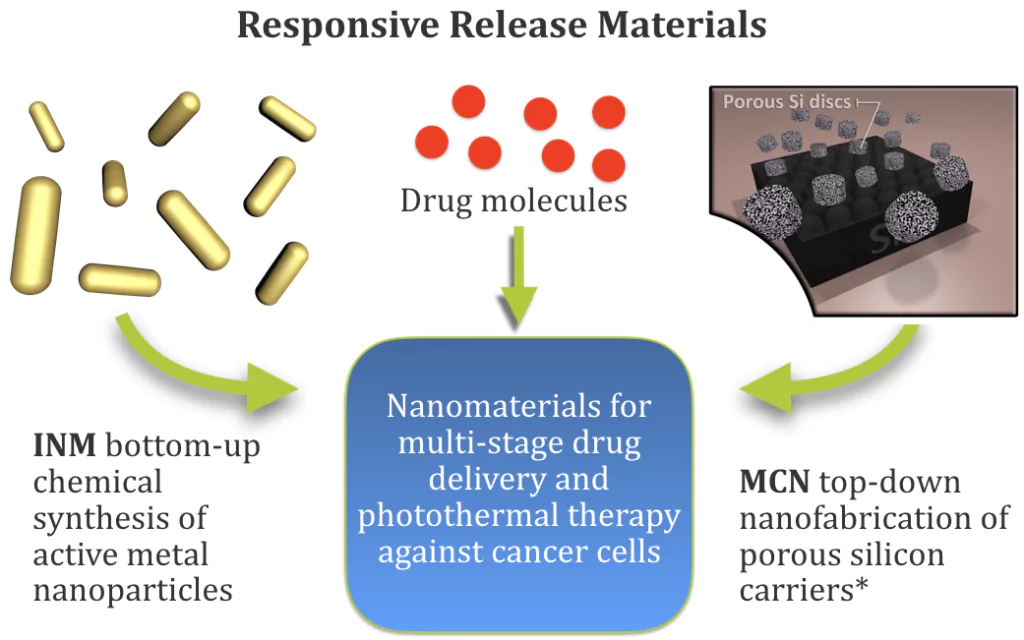
Nanomaterials can enhance the delivery of therapeutics to diseased tissues or cells, for example if their size and shape are suitable for cell internalization, or via their large specific surface area. Here, we combine this principle with the ability of gold nanoparticles to be heated at a distance with electromagnetic radiation. The resulting heat can be exploited to kill pathogens or cancer cells, or make them more susceptible to conventional drug treatment. Gold nanoparticles will be integrated into larger porous silicon particles in order to design multi-stage drug delivery platforms. The program leverages complementary expertise in bottom-up materials synthesis at the INM and cutting-edge nanofabrication techniques available at the Melbourne Centre for Nanofabrication.
Current Projects
3D-ConAn: Quantitative analysis of 3D conductive network structure in composites
3D-ConAn: Quantitative analysis of 3D conductive network structure in composites
In this project, we fabricate stretchable, conductive polymer composites (CPCs) based on silver particles. The particles are dispersed in an elastomer matrix. Above the percolation threshold, the material becomes conductive as a long-range network is formed. We analyse the 3D structure of the network by Focused Ion Beam – Scanning Electron Microscopy (FIB-SEM) tomography and correlate microscopic network metrics with macroscopic conductivity of the material. Furthermore, electromechanical tensile/compression tests are performed, and the network structure is correlated with material’s dynamic behaviour. As a model material we use spherical silver particles in a polydimethylsiloxane (PDMS) matrix.

SensIC: Stretchable electronic materials for product-integrated printed sensors
Makara Lay & Thomas Kister: SensIC
In this project, INM develops new materials for printable temperature sensors and their mechanically flexible connection. Inks and pastes for inkjet and screen-printing technologies are prepared based on mixtures of molecular, nanoscale, and microscale components that form functional structures and require little or no sintering. The molecular nature of the internal interfaces is studied and modified in order to enable reliable performance upon mechanical cycling. Close collaboration with the partners Continental and KIT guarantees the compatibility of the materials with suitable processing. In addition, INM investigates encapsulation materials that add security and unalterable device identification in collaboration with the partner Polysecure.

AdRecBat: Recyclability-by-Design for Lithium Ion Batteries
Bettina Zimmer & Qijun Xie: AdRecBat
In light of the growing demand for lithium-ion batteries and limited supply of key raw materials, there is an urgent need for efficient and sustainable recycling. In traditional (indirect) recycling, battery modules are thermally disintegrated or shredded before being processed pyro- or hydrometallurgically. This requires a lot of energy and/or chemicals, and some compounds (e. g. cathodic active material) and elements (e. g. lithium in the case of pyrometallurgy) cannot be recovered.
In AdRecBat (additive-based ‘design for recycling’ of lithium-ion batteries), we develop a recycling process for direct recovery of active materials: Battery components will not be destroyed but separated from each other with the aid of trigger additives. The latter will be designed and integrated such that
- they cause debonding through external stimuli (e. g. temperature, pH) at three key interfaces: (1) sealing seam of the pouch cell, (2) interface current collector foil-electrode and (3) interface active material-binder.
- good battery performance and safety are ensured.
We collaborate with the Fraunhofer Institute for Silicate Research in Würzburg (ISC) and the Friedrich-Alexander-Universität in Erlangen (FAU). At the INM, we prepare and investigate the effect of trigger additives (e. g. blowing agents, surfactants) for interfaces (2) and (3).

StableInK: Stabilization mechanisms of non-polar metal nanoparticles
Tobias Knapp – StableInK: Stabilization mechanisms of nonpolar metal colloids with thin organic shells
Metal colloids such as gold nanoparticles can be used as building blocks for a variety of applications (such as printable electronics or sensor technology). The main problem is the low stability of the inks, which causes the particles to precipitate during storage (agglomeration). The project will investigate the interactions between the different components of the dispersion (core, shell, solvent) to understand the underlying stabilization mechanisms. The project will develop model systems for the colloidal stability of non-polar nanoparticle dispersions.

LT-PhotoInk: Nanoparticle inks for easily sintering printed electronics
Gisela Heppe – LT-PhotoInk: Ag nanoparticle inks for photonic sintering of inkjet-printed structures on substrates with low thermal resistance
The aim of the project is to develop materials for electronics that can be printed by inkjet on more temperature-sensitive but therefore more cost-effective substrates. This also brings into focus carrier materials that are flexible or transparent, thus opening new areas of application. This is achieved by a photo-sintering process that can be carried out at low temperatures, which requires a special ink-jet ink which consists of silver nanoparticles. To achieve photo-sintering of the ink at low temperatures, the particle surface must be coated with suitable ligands, among other things. Under the chosen sintering conditions, this leads to a destabilization of the dispersion, allowing as many conductive contact paths as possible to be formed between the silver nanoparticles. In addition, nanoparticles of specific shapes and sizes are combined to optimize energy absorption in the sintering process. The aim is to achieve the conductivity of pure silver with the conductor paths printed in this way.

/ Inkjet printed electronics on temperature sensitive materials e.g. paper

Flexible Elektronics
CompoAge: Ageing mechanisms of polyurethane nanocomposites
PU-composites
Nanoparticles influence the physical and the chemical properties of composite materials. In this project the influence of the amount of nanoparticles on the ageing behavior of polyurethane-based composites shall be investigated. Therefore, a polyurethane-based material is modified with different amounts of silica nanoparticles (0-30 wt.%). Because the dispersion of the silica nanoparticles within the matrix influences the material properties, ultramicrotome sections of the silica modified composites are prepared and the dispersion of the nanoparticles in the matrix is investigated by Transmission Electron Microscopy (TEM). To simulate the ageing, the silica modified composites are stored in a KOH-solution (20% ) at ambient temperature. Afterwards the influence of amount of silica nanoparticles is investigated by measuring the mechanical properties (determination of tensile strength and Young’s modulus by tensile tests and determination of microhardness) as well as the thermomechanical properties (determination of glass transmission temperature – Tg and Young’s modulus by Dynamic Mechanical Analyses – DMA and Differential Scanning Calorimetry – DSC) of the modified composites. Possible chemical changes are detected by IR-spectroscopy.
PALS: Plasmonically activated Living Materials
Selim Basaran – Infrared-activable Engineered Living Materials
Engineered Living materials (ELMs) are a type of advanced material that incorporates engineered living organisms (responsive function) into the material matrix (scaffold function). These materials are designed to exhibit biological functionality such as responsiveness to environmental stimuli to produce e.g. proteins or drugs.
We integrate gold nanorods in ELMs to design IR-sensitive Engineered Living Materials with biomedical applicable structures that can rapidly reach 39°C-44°C by plasmonic NIR light stimulation to induce protein or antibiotic production. The temperature profile is controlled by combination of IR thermography and thermocouples. The protein and drug production are quantified as a function of plasmonic stimulation by gold nanorods via ex situ fluorescence microscopy and ESI-MS.

BROADCAST: Stretchable conductors for dielectric actuators in soft robots
Lingyu Liu– Biomimetic robots autonomously driven by dielectric elastomers
Compared to traditional robots, soft robots are usually composed of soft stimuli–responsive materials, which make them have good adaptability and compliance and can interact with the environment. The soft stimuli–responsive materials commonly used in soft robots include dielectric elastomers (DEs), and multi-functional DEs with bio-inspired control strategies can achieve autonomous peristalsis, locomotion, and similar behavior. Nowadays, the improvement in soft robots is hampered by a lack of materials for such circuits and missing rules for design. In this project, we collaborate with soft robotic engineers to investigate novel, autonomously running electro-mechanical soft conductive materials for driving soft biomimetic robotic systems to predict the complex electro-mechanical behavior of those structures.

StableWires: Ligand shells and the shape stability of ultrathin nanowires
Yannic Curto: Project Stable Wires
Shape stability is an inherent limitation of ultrathin nanowires. Because a thin wire can break up into spheres due to a phenomenon is called Rayleigh-Plateau instability. It is not possible today to predict which nanowires remain structurally stable under which conditions. It is known, however, that the structural stability of ultrathin nanowires depends both on surface chemistry and solid structure. Ligands play a key role in the formation of highly anisotropic nanowires, and the same ligands contribute to structural stability. We study in this project the structural stability of chemically synthesized, ultrathin nanowires to identify the role of solid core material and molecular ligand shell in wire stability. Therefore, we synthesize different metal and semiconductor nanowires with very similar core diameters below 10nm and with different ligand shells.

InPrint-HyPoCo: Inkjet-Printable Hybrid Particle Polymer Composites
Michael Klos: Mechanically robust, sinter-free conductive particle-polymer-nanocomposites
The fast and cost-effective production of conductive electrodes and electrically conductive structures is of particular interest for RFID sensors or smart packaging. Thin layers can be printed with inkjet printing on different substrates to save material. These are often sensitive toward mechanical deformation or have a bad adhesion to the substrate. In addition, the often-needed thermal post-treatment limits the application.
In this project, we investigate the mechanical properties, as well as the adhesion of inkjet printed lines, of our hybrid sinter-free gold nanoparticle ink. We prepare nanocomposites of the PEDOT:PSS stabilized gold nanoparticles and various non-conductive polyvinyl alcohols. We investigate the influence of different molecular weights and degrees of hydrolysis of the polyvinyl alcohols on the mechanical properties and conductivity.

DigiBatMat: A digital platform for battery material data
Andriy Taranovskyy & Lisa Beran: DigiBatMat
The DigiBatMat project is a part of nationwide initiative of German Federal Ministry of Education and Research (BMBF)– Plattform MaterialDigital, which aims to digitize materials and the transformation of their properties during the technological production processes. Within this project, a digital platform of battery production process was developed that contains steps (raw materials mixing, electrode calendaring, cell assembly etc.) and items (raw materials, intermediate products, electrodes, cells etc.). The structure is filled with reference heterogenous data of the production process parameters as well as the battery materials properties, derived from various analytical methods that were performed on items at different stages of the production chain. All are linked in the database according to their position in the whole process chain. Besides structuring the data, the platform will include additional functionalities for data driven research, such as correlation analysis and machine learning. At the INM, we study the comprehensive effect of conductive additive properties (morphology, surface chemistry) together with the mixing speed during the dispersion step that effects its particle size distribution on the conductivity of battery electrodes and electrochemical performance of full cells. Representative data of multiple characterization methods, including (electro-)rheology, tomography, Boehm titration, light microscopy, SAXS, and more, is collected, analyzed and uploaded into the digital platform. This research is done in collaboration with our partners from Institute for particle technology (iPAT), Institute of Machine Tools and Production Technology (IWF), Aalen University, AWS – Institute for digital products and processes gGmbH and is located in the ProZell Competence Cluster at Project Management Jülich.

GreenPaste: Recyclable, low-sintering silver pastes for sustainable printed electronics
David van Impelen: Screen printing of silver pastes for sustainable printed electronics
One way of creating electronic components and circuits is by employing printing techniques. Some advantages of this include a wide range of substrate choice, introducing flexibility and facilitating recycling of the components. In this project we print pastes containing silver micro particles using a technique called screen-printing. To increase the conductivity, we heat up the prints to induce sintering of the silver microparticles. Sintering is a diffusion-based process leading to interconnection of the silver particles, which results in a higher conductivity of the printed layer of particles. At which temperatures this sintering process is induced depends on size, shape, and chemistry of the silver particles.

ARNIM II: dynamics and structure of agglomerating nanoparticles in mirogravity
Bart-Jan Niebuur: ARNIM II: dynamics and structure of agglomerating nanoparticles in mirogravity
Self-assembly of nanoparticle superstructures allow us to produce materials with well-defined geometries and, therefore, electrical and optical properties. This is very interesting for materials: For example, electrically conductive metal nanoparticles can be arranged in an insulating matrix to maximize or minimize conductivity, depending on whether a dielectric is required or a conductor. Unfortunately, this process is hindered by gravity: Larger arrangements of metallic particles are very filigree but heavy enough to be torn by their own weight so that, for example, connectivity and thus conductivity is lost.

Copyright: DLR
The ARNIM-II project, supported by the German Aerospace Center (DLR), addresses the question how gravity influences self-assembly of metallic nanoparticles. For this, an experimental setup is developed to investigate structural properties of dispersions on length scales ranging from 50 nanometer up to milimeters, combining three different optical experimental methods, which is suitable for flights on sounding rockets. On board a sounding rocket of the MAPHEUS-programm of the DLR (apogee ~250 km, which allows approximately 6 min of microgravity), we investigate the agglomeration of gold nanoparticles. The results will help to develop new strategies for bottom-up production methods for functional materials.
Biofunctional Inkjet-printable Au Sensor
Muniba Bhatti & Yannic Brasse
We discuss the synthesis and properties gold nanoparticle (AuNPs) inks that are conductive directly after deposition and can be functionalized with biological molecules. A conductive biopolymer (P3KHT) from the class of polythiophenes was immobilized on quasi-spherical gold nanoparticles with diameters of 74 ± 19 nm. Glucose oxidase (GOx) was covalently bound selectively to the functional carboxylate groups in the polymer side chains under mild reaction conditions. The coupling with EDC/NHS was performed in solution prior to deposition or on the surface of dropcasted AuNPs@P3KHT structures. In both cases, one amine group of GOx was covalently bound to the functional carboxylate groups. In future this ink should be used to fabricate electrodes with enhanced surface structure in order to improve the enzymatic signal in amperometric glucose sensing.

Figure 1. Schematic procedure of bioconjugation to the bioactive gold-polythiophene hybrid nanoparticles AuNPs@P3KHT, which can the performed (a) after film formation by deposition (surface bioconjugation) or (b) before deposition in the particle dispersion (solution bioconjugation).
ReIn-E: Recyclable integrated electronics
Ecological prudence and regulation of the European Union and national governments require an increasing level of recycling for electronics. While polymer-integrated electronics can reduce the amount of material used, the recovery of materials (metals and polymers) from integrated parts is more difficult than for conventional electronics. This constitutes a severe risk for the innovation, but it can be mitigated by well-informed material choice and design adaptation. To this end, ReIn-E will introduce, test, and optimize new materials for “release layers” as part of this design; ensure the reliability, performance, and market compatibility of the recyclable design; establish a “best practice” model cycle from the production of pastes through printing, molding, and metal recovery.
I-Seed
I-Seed: Distributed environmental sensing with sensor materials in soft robots
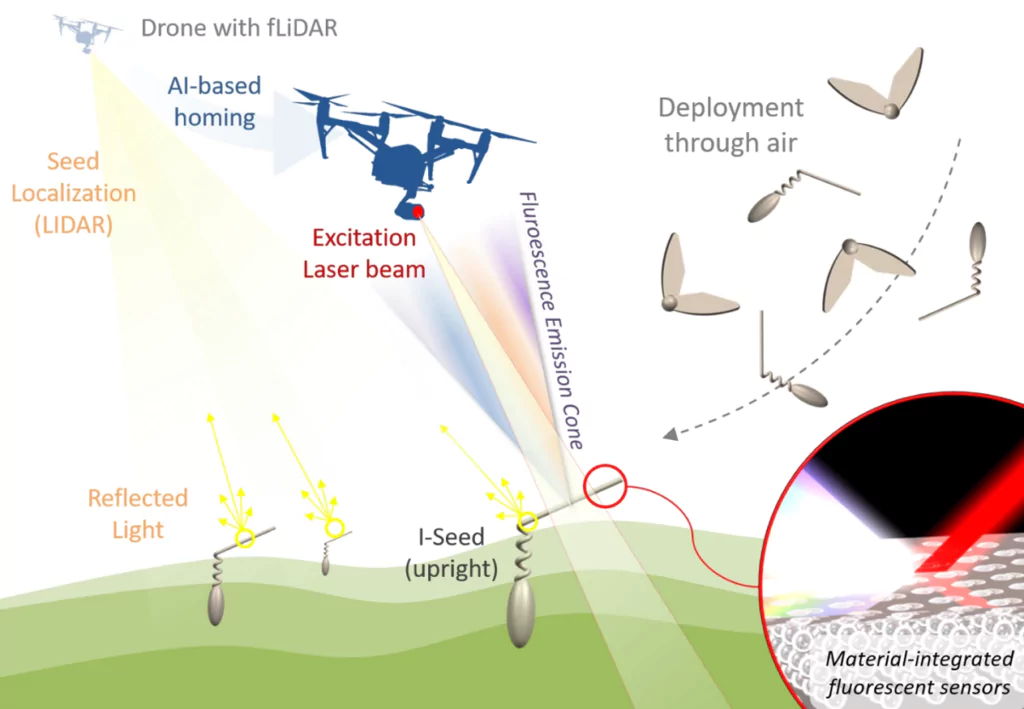
I-Seed unites bioinspired soft robotics, material science, and environmental science, with the aim of developing a new generation of self-deployable and biodegradable soft miniaturized robots that mimic the behavior of plant seeds. These robots, composed of artificial plant structures and sensor materials, are designed to monitor in-situ environmental parameters in air and topsoil, such as the presence of pollutants, moisture, CO2 levels, temperature, and water quality. Within this project, we are engineering fluorescent sensor materials whose optical properties are dependent on environmental factors. All these fluorescent materials will be chosen for their degradability and environmental compatibility.
ARNIM: Agglomeration Of Nanoparticles in Microgravitation
Modern methods of “self-arrangement” allow us to produce larger structures from nanoparticles whose geometry is defined to a certain degree. This is very interesting for materials: for example, electrically conductive metal nanoparticles can be arranged in an insulating matrix to maximize or minimize conductivity, depending on whether a dielectric is required or a conductor.
Unfortunately, gravity gets in the way here: larger arrangements of metal particles are very filigree but heavy enough to be torn by their own weight so that, for example, connectivity and thus conductivity is lost. In the ARNIM project, supported by the German Aerospace Center (DLR), we are investigating whether this can be prevented by switching off gravity. To do this, we first use a drop tower (ZARM in Bremen) and “throw” agglomeration experiments in such a way that gravity is eliminated for a few seconds. In the future, experiments on board rockets or the international space station are also planned, which will allow longer agglomeration experiments.
If it turns out that the agglomerates are actually destroyed by their weight, we have to strengthen them – for example by using nanowires. But it could also be that it is not gravity at all, but details of the agglomeration process. These questions are therefore at the heart of the project.
AGGLOSENSE: MEASURING MECHANICAL DEFORMATION WITH CONDUCTIVE NANOCOMPOSITES
Normally, composites of elastomers and conductive carbon particles are used if the material is to be and remain conductive. This is, for example, how antistatic shoe soles or gaskets are produced. In the DFG-funded AggloSense project, we want to achieve the opposite: maximum change in electrical conductivity during deformation.
In cooperation with Professor Tanja Schilling from the University of Freiburg, we are investigating what the conductivity of such composites depends on. Carbon particles (so-called “carbon black”) are in fact not spheres, but very complex agglomerates with often fractal structures. In the material they touch each other in a way that is difficult to predict. By comparing the structure of specifically produced materials with simulated arrangements and measurements of conductivity with and without deformation, we hope to find out how the change in conductivity can be made large.
Confelcon: Conformal Electrical Contacts
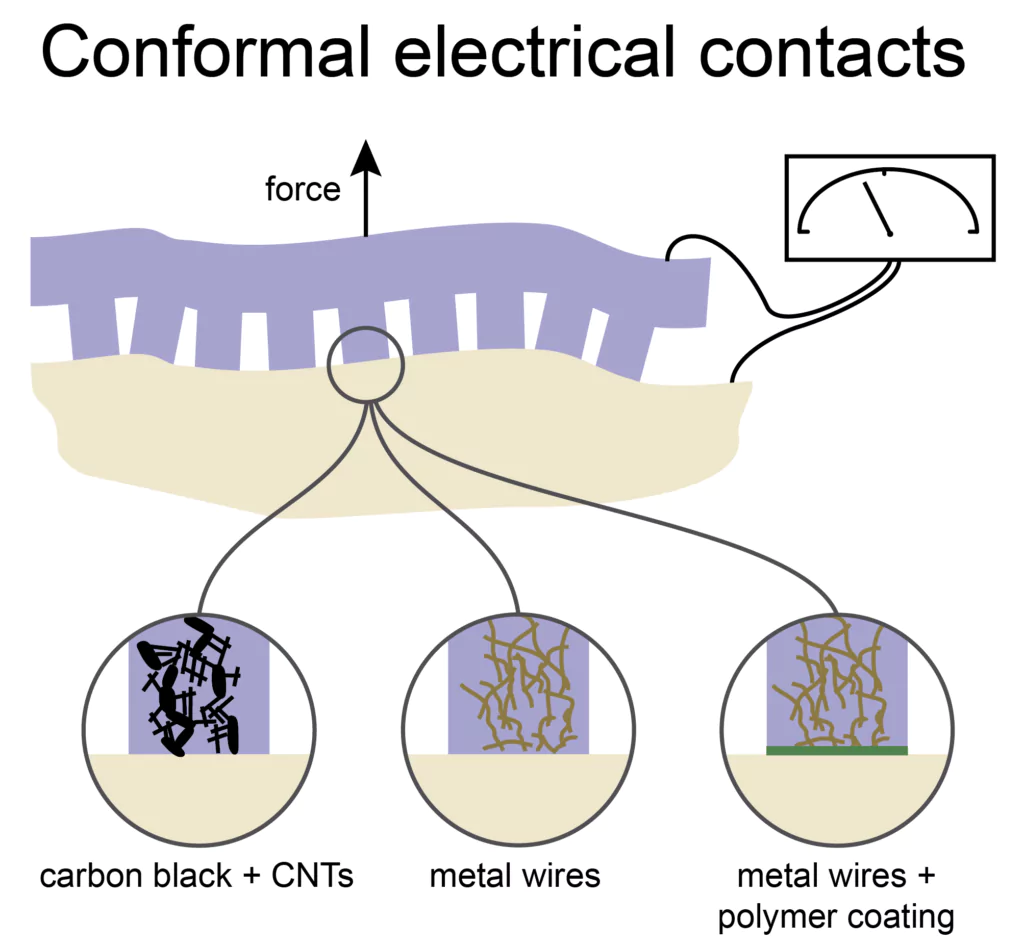
Connecting biological objects with electronics requires soft electrical contacts. To that end, we explore the fabrication of micro-fibrillar adhesion devices from electrically conductive materials. Detailed characterization of these devices reveals the relationship between adhesion properties and electrical resistivity. Their application as electrically tunable devices is also explored.
ActiN: Active nanocomposites
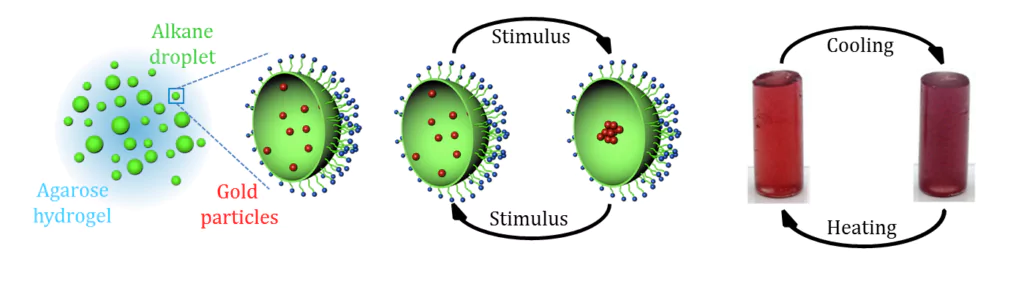
Embedded nanoparticles lend today’s nanocomposites useful properties such as color, strength, or a high refractive index. Their arrangement affects these properties but does not usually change after material synthesis because the particles are bound too strongly in the matrix. We investigate nanocomposites in which metal nanoparticles can move and reorganize in reponse to a stimulus. Thus, the color or other properties of the composite change. In this project, we synthesize model particles and study how they can be embedded such that they retain a certain mobility.
IMPROVe-STEM: New materials for the proliferation and expansion of stem cells
This interdisciplinary project aims at the scalable growth of mesenchymal stem cells using new carrier materials for proliferation. In collaboration with cell biologists, biochemists, chemists and material scientists, we modify surfaces of microspheres so as to increase cell adhesion, help cell proliferation and allow for their easy detachment from these microbeads. The materials-oriented part of the project involves surface characterization of beads which are about 100 µm in size followed by their surface modification such as by polymer graft, plasma activation, and changing surface roughness and surface charges. The project is a part of “European territorial cooperation” INTERREG.


HYBDI: Hybrid Dielectric Layers
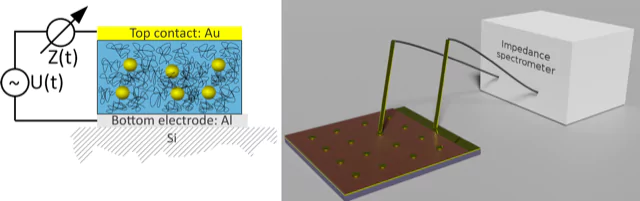
In addition to conductive layers, dielectric layers are also required for printed electronics, e.g. for capacitor elements. Pure polymer layers show a limited polarization in the electric field and hence a relatively low dielectric constant. We investigate hybrid layers of gold nanoparticles separated by insulating ligands. On the one hand, the polarization capability of the hybrid material and the dielectric constant of the layer are to be increased by the metallic particles. On the other hand, a charge transport between the nanoparticles and the failure of the dielectric layer is to be prevented.
Completed Projects
IGLU: INKJET PRINTING OF RFID ANTENNAS ON PAPER WITH HYBRID INKS
In the NanoSpekt project, we developed sinter-free hybrid inks to apply electrical conductors to sensitive surfaces without sintering – including paper and cardboard. In this project, in cooperation with the Papiertechnische Stiftung (PTS), we are investigating how this material can be used to print RFID antennas for contactless identification of packaging directly on carton.
Paper and cardboard are very important, but also difficult substrates: their surface is porous, and during printing the ink penetrates, making the electrical conduction more difficult. Furthermore, paper begins to curl when heated too much and cartons are folded, which can easily damage conductive structures. Therefore, in this AiF-funded cooperation, we are investigating how to make the connection between the cardboard and the ink strong enough – and how to incorporate additional functions into cartons, preferably directly at the manufacturer.
NanoSpekt: Transparent conductive materials based on nanoparticles
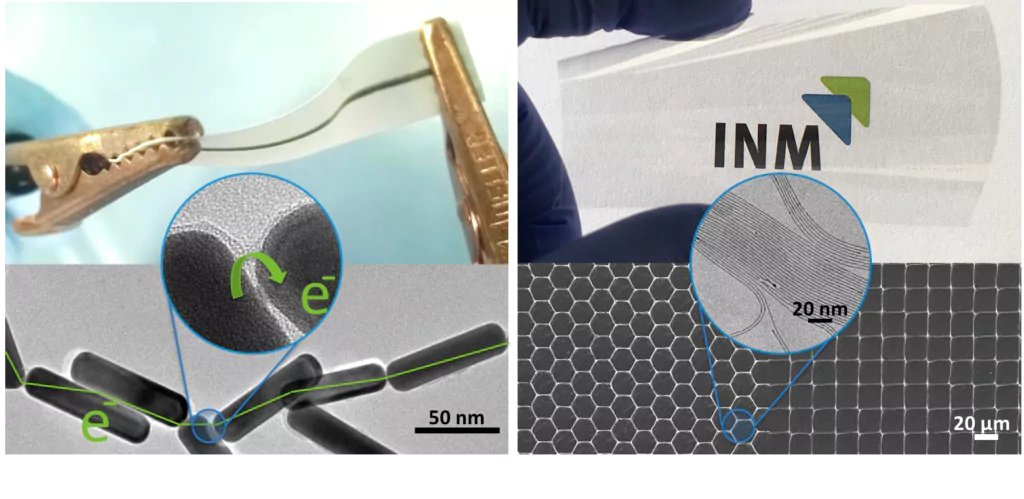
Flexible and printed electronics require new materials. Here, we focus on optically transparent materials for the electronics of the future. This BMBF-funded research project, a part of the NanoMatFutur initiative, uses nanoparticles with defined shapes and arrangements inside polymers to make transparent electrodes for touch-screen display or solar cells, for example. Chemists, material scientists and an engineer collaborate very closely to create new materials that can be processed with well-established wet coating and printing techniques.
SteelParticles: Colloidal characterization of particles from steel
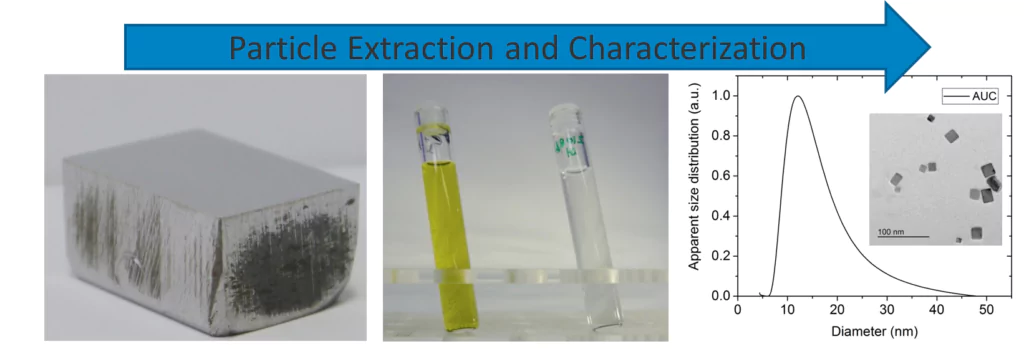
Microalloyed steels contain carbonitride nanoparticles which are responsible for their compelling mechanical properties and good weldability.
In cooperation with the Dillinger Hütte, a steel mill in Saarland, we are investigating the size distribution, chemical composition and morphology of the particles contained in the provided steels. Particle analysis is performed using methods that we developed for colloidal particles and that are not usually employed in metallography.
Publications:
- Hegetschweiler et al., J. Mater. Sci., 2019, 54, 5813-5824. DOI: 10.1007/s10853-018-03263-0
- Hegetschweiler et al., Anal. Chem., 2019, 91, 943-950. DOI: 10.1021/acs.analchem.8b04012
- Hegetschweiler et al., Part. Part. Syst. Charact., 2021, 38, 2000236. DOI: 10.1002/ppsc.202000236
- Meili-Borovinskaya et al., J. Chromatogr. A, 2021, 1641, 461981. DOI: 10.1016/j.chroma.2021.461981
- Webel et al., Ultramicroscopy, 2021, 223, 113219. DOI: 10.1016/j.ultramic.2021.113219
AggloTox: Agglomeration of nanoparticle-protein mixtures
Mixtures of nanoparticles and proteins tend to form hybrid agglomerates. We are interested in the agglomeration mechanisms and the structure of such agglomerates to better understand their role in medicine, ecology, and biomaterials.
Formation Mechanism for Stable Hybrid Clusters of Proteins and Nanoparticles (ACS)
ACS NANO, DOI: 10.1021/acsnano.5b01043
DINAFFF: Nanoparticle analysis with Field-Flow Fractionation
Field-flow fractionation can fractionate particles after size, but it is often plagued by losses of particles due to adsorption and agglomeration. This AiF-ZIMM-project (supported by the BMWi) aims to reduce such losses and make FFF suitable as a standard technique for nanoparticle detection in products, the environment, and food.
HOP-X: Particle-polymer hybrid X-ray imagers
Digital imagers for medical X-ray are based on ceramic layers. This project is a BMBF-funded effort, coordinated by Siemens, to build X-ray imagers based on a new material that contains conductive polymers and inorganic particles. The particles absorb and convert X-ray photons, the polymer transports the charges to electrodes. The Structure Formation Group is mainly concerned with the analysis of the particle-polymer composites’ structures, its origins in fabrication, and its effect on detector performance.
MobiNano: Mobility and interaction of agglomeration nanoparticles
Interactions drives particles to agglomerate, mobility allows them to follow this drive. We use flow setups and synchrotron Small-Angle X-ray Scattering (SAXS) to study early stages of agglomeration. The results help us to better understand the formation of composites, crystallization mechanisms, and biomineralization phenomena.
NanoConfine: Arrangement of particles in emulsion droplets
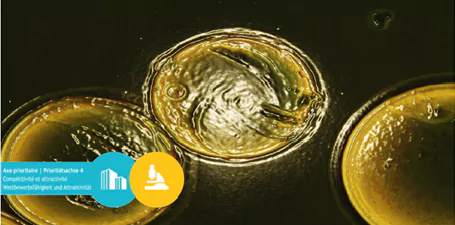
Nanoparticles that are trapped in emulsion droplets react to their confinement depending on the surfactant. Some of them form beautifully ordered “supraparticles”, fully defined structures that remind of noble gas condensates or small metal clusters. We study how nanoparticles interact with each other and liquid-liquid interfaces in this DFG-funded project. Tanja Schilling at the University of Luxembourg use simulations to predict and understand structure formation, we explore it experimentally.
References:
Publications
Van Impelen, David | Perius, Dominik | González-García, Lola | Kraus, Tobias
DOI:
Silver microflakes and -spheres are common fillers for electrically conductive screen-printing pastes. Here, we report on the effects of filler shapes and sizes on conductivity, sintering, and recyclability. We printed pastes based on flakes and spheres, treated them at 110 °C to 300 °C, and evaluated the electrical conductivity of the resulting layers. The electrical conductivity of the layers treated at 110 °C was dominated by particle–particle contact resistances; flakes yielded layers that were five times more conductive than sphere-based layers due to differences in the particle–particle contact area. Increasing temperature led to a reduction of the resistivity of all layers through sintering. At 300 °C, prints based on spheres were 4 times more conductive than those from flakes. Tomography of the sintered structures showed that the difference was caused by a lower tortuosity factor for spheres. In a final study, we showed that silver flakes and spheres could be recycled after sintering and reused for a new generation of prints without losing electrical performance. The more porous structure of sintered flakes allowed for higher recycling yields compared to spheres. At 140 °C, 91.6% of the flakes and 69.7% of the spheres were recovered as reusable dispersions.
Pusse, Sebastian | Niebuur, Bart-Jan | Kraus, Tobias | Presser, Volker | Balzer, Bizan N. | Gallei, Markus
DOI:
The synthesis of an amphiphilic three-arm block copolymer (AB)3-BCP, which consists of poly(methyl methacrylate) (PMMA) and poly(butyl methacrylate) (PBMA) in the hydrophobic inner block, is reported. The hydrophilic block segment is based on poly(2-hydroxyethyl methacrylate) (PHEMA) originating from 2-(trimethylsiloxyl)ethyl methacrylate (HEMA-TMS). The preparation is carried out in two steps using a core-first approach. Using atom transfer radical polymerization (ATRP) as a controlled polymerization technique, three (AB)3-BPCs with HEMA contents of 15 to 38 mol−1 % are prepared, applying different reaction conditions. Porous structures are generated from these BCPs by applying a self-assembly and nonsolvent-induced phase separation (SNIPS) protocol. Complex surface structures are observed using scanning electron microscopy (SEM). Bulk morphologies are investigated for a better understanding of the underlying self-assembly. For PHEMA-rich (AB)3-BCPs, non-regular lamellar microphases are observed in transmission electron microscopy (TEM) and confirmed by small-angle X-ray scattering (SAXS). The porous structures and their expected swelling characteristics are analyzed using atomic force microscopy (AFM) in air and water. Time-resolved measurements in water indicate a rapid swelling after immersion into the water bath. The present study paves the way for exciting porous materials based on the herein synthesized amphiphilic three-arm block copolymers useful for applications as absorber materials and coatings.
Mustafa, H. | Nexha, Albenc | Kister, Thomas | Bartholomeus, H. | Kraus, Tobias | Kooistra, L.
DOI:
Lanthanide-doped upconversion microparticles (UCMP) enable composites for luminescence thermometry with long luminescence lifetime and narrowband absorption and emission spectra. Being non-toxic, easily synthesizable, and having a bright, stable emission makes them an attractive candidate for in-vivo monitoring of key environmental parameters such as temperature. We use them to create soft, biodegradable, miniaturized seed-like robots endowed with fluorescence tags for the sustainable environmental monitoring of topsoil and air above soil environments. Our aim is an airborne platform with a sufficient signal-to-noise ratio to identify the concentration of targeted soil parameters. Here, we study the photoluminescence of Er, Yb: NaYF4 UCMPs embedded in polylactic acid (PLA) polymeric matrix to assess their suitability for remote read-out. We assessed the signal-to-noise ratio in terms of excitation intensity, UCMP concentration, working distance, and sample orientation. We evaluated the signal stability over long exposure time as well as for amplitude-modulated excitation. Finally, we carried out ratiometric and lifetime measurements of luminescence emission in order to demonstrate the feasibility of such sensors in measuring the variation of temperature. Overall, the rare-earth doped UCMPs embedded in biodegradable polymer can be used for remote thermometry, displaying a significant signal-to-noise ratio for luminescence emission detection and subsequent derivation of temperature.
Moreira Lana, Gabriela | Fehlberg, Maja | Herbeck-Engel, Petra | Heppe, Gisela | Schlüßler, Raimund | Jähnke, Torsten | Arzt, Eduard | Bennewitz, Roland
DOI:
Replica molding is a widely used technique for the fabrication of polymer microstructures. As structural dimensions decrease, anti-stick surface treatment of the mold becomes increasingly critical to ensure clean demolding and preserve structural integrity. We fabricated arrays of micropillars with 20 µm diameter and 60 µm height using medical-grade polydimethylsiloxane (PDMS), MDX4-4210, and observed a high fraction of collapsed pillars for the first molding after fluorosilanization of the mold to reduce sticking. To address this issue, we systematically investigated the surface treatment protocol for the molds, made from the PDMS Sylgard 184. We provide results from complementary measurement methods, to show that an additional vacuum step partially removes unbound fluorosilane, but does not improve pillar stability. In contrast, a method based on multiple replications, where the first replication effectively removes residual fluorosilane from the mold, significantly enhances structural stability. Mechanical testing further revealed that the presence of fluorosilane lowers the Young’s modulus of both PDMS materials, MDX4-4210 and Sylgard 184, suggesting interference with the curing process. Confocal Brillouin microscopy indicated an elongation of replicated pillars and revealed a softening close to the surfaces, as well as mechanical inhomogeneities in collapsed pillars. We discuss modifications to the molding protocol to improve the reproducibility and mechanical stability of the replicated microstructures, offering insights towards more reliable routes for the fabrication of residue-free, high-aspect ratio features with controlled surface chemistry.
Van Impelen, David | González-García, Lola | Kraus, Tobias
DOI:
Silver-coated copper microparticles combine the oxidation resistance of silver with the low cost of copper. They are interesting components for printed conductive structures. We studied whether printed films of such particles can be printed and sintered at low temperatures in air to create highly conductive films and whether it is possible to recover the particles from them for recycling. Pastes containing 1.5 μm to 5 μm spheres and 3 μm flakes with L-ascorbic acid were prepared, screen-printed, and treated at temperatures of 110 °C to 300 °C in air. The bulk resistance of films treated below 160 °C were two orders of magnitude higher than that of bulk copper, ρCu, and limited by particle-particle contact resistances. They were reduced by treating the prints at 160 °C to 250 °C, leading to bulk film resistances down to 41ρCu. We demonstrate that the high mobility of silver enables the formation of necks that bridge the copper cores and reduce resistivity in this temperature window. The sintered prints retained their conductivity for at least 6 months. Treatments at higher temperatures in air were detrimental: resistances increased above 250 °C. These temperatures led to dewetting of the silver coating and fast copper oxidation, resulting in a continuously increasing resistance. In a final study, we demonstrated that films treated below 200 °C can be recycled by recovering the metal powder from the printed conductors and that the powder can be printed again.
Klos, Michael | González-García, Lola | Kraus, Tobias
DOI:
Hybrid core–shell nanoparticles with metal cores and conductive polymer shells yield materials that are sinter-free and highly conductive but mechanically weak. Conventional composites of such nanoparticles are electrically insulating. Here, we introduce microscale phase-separated nanocomposites of hybrid gold-PEDOT:PPS particles in insulating poly(vinyl alcohol) (PVA). They combine electrical conductivities of up to 2.1 × 10⁵ S/m at 10 vol % PVA with increased mechanical adhesion on polyethylene terephthalate and glass substrates. We studied the effects of the PVA molecular weight, hydrolyzation degree, and volume fraction. Composites with 10 vol % highly hydrolyzed PVA at a MW of 89–98 kDa had the highest conductivities and stabilities; highly hydrolyzed PVA even increased the conductivity of the hybrid particle layers. We propose the formation of hydrogen bonds between PVA and PEDOT:PSS that lead to demixing and the formation of stable, structured composites. Finally, we demonstrated the inkjet-printability of inks containing PVA in water with viscosities of 1.6–2.0 Pa s at 50.1 s–1 and prepared bending-resistant electrical leads.
Groppe, Philipp | Reichstein, Jakob | Carl, Simon | Cuadrado Collados, Carlos | Niebuur, Bart-Jan | Zhang, Kailun | Apeleo Zubiri, Benjamin | Libuda, Jörg | Kraus, Tobias | Retzer, Tanja | Thommes, Matthias | Spiecker, Erdmann | Wintzheimer, Susanne | Mandel, Karl
DOI:
The structure of supraparticles (SPs) is a key parameter for achieving advanced functionalities arising from the combination of different nanoparticle (NP) types in one hierarchical entity. However, whenever a droplet-assisted forced assembly approach is used, e.g., spray-drying, the achievable structure is limited by the inherent drying phenomena of the method. In particular, mixed NP dispersions of differently sized colloids are heavily affected by segregation during the assembly. Herein, the influence of the colloidal arrangement of Pt and SiO2 NPs within a single supraparticulate entity is investigated. A salt-based electrostatic manipulation approach of the utilized NPs is proposed to customize the structure of spray-dried Pt/SiO2 SPs. By this, size-dependent separation phenomena of NPs during solvent evaporation, that limit the catalytic performance in the reduction of 4-nitrophenol, are overcome by achieving even Pt NP distribution. Additionally, the textural properties (pore size and distribution) of the SiO2 pore framework are altered to improve the mass transfer within the material leading to increased catalytic activity. The suggested strategy demonstrates a powerful, material-independent, and universally applicable approach to deliberately customize the structure and functionality of multi-component SP systems. This opens up new ways of colloidal material combinations and structural designs in droplet-assisted forced assembly approaches like spray-drying.
Gödrich, Sebastian | Brodoceanu, Daniel | Kuznetsov, Volodymyr | Kraus, Tobias | Papastavrou, Georg
DOI:
Soft lithography, in particular microcontact printing (µCP), represents a well-established and widespread class of lithographic patterning techniques. It is based on a directed deposition of molecules or colloidal particles by a transfer process with a micro-structured stamp. A critical aspect of µCP is the adhesion cascade that enables the directed transfer of the objects. Here, the interfacial properties of a µCP-stamp are tuned electrochemically to modify the adhesion cascade. During the printing process, the µCP-stamp is submerged in an electrolyte solution and acted as a working electrode whose surface properties depended on the externally applied potential, thus enabling in situ rapid switching of its adhesion properties. As a proof of principle, defined particle patterns are selectively removed from a monolayer of colloidal particles. The adhesion at the particle/solid interface and the transfer mechanisms are determined by using the colloidal probe technique based on atomic force microscopy (AFM). In this case, a single particle is brought into contact with an electrode with the same surface chemistry as the µCP-stamp. Hence, it became possible to determine the electrochemical potential ranges suitable to establish an adhesion cascade.
Brasse, Yannic | Laguna Moreno, Mariano | Blum, Simon | Horter, Tim | Janek, Florian | Gläser, Kerstin | Emmerechts, Carl | Clanet, Jean-Michel | Verhaert, Michèle | Grymonprez, Benoit | Kraus, Tobias
DOI:
Recycling of Waste from Electrical and Electronic Equipment (WEEE) is crucial in preventing resource depletion and promoting a circular economy. The increasing fraction of printed and in-mold electronics is particularly challenging. The combinations of polymers and printed metals are difficult to disassemble due to the strong interfaces that are formed to create reliable in-mold devices. The relatively low metal content makes recycling uneconomical and those valuable materials are then lost to landfill or incineration. Separation layers enable design-for-recycling with minimal modifications during the fabrication process, while preserving product performance and reliability. We present a scalable method for preparing polymer separation layers for printed and in-mold electronics. Slot-die coating is used to prepare water-soluble polymer films with a dry thickness of less than 10 μm on commodity polymer substrates. This separation layer improves the bending stability of inkjet- and screen-printed circuits. Furthermore, it is compatible with typical polymer processing methods, such as thermoforming and injection molding. Various methods, including plasma treatment, are presented to ensure adhesion of the modified interfaces. Finally, we investigate the material recovery and demonstrate the release of the integrated metal within a few minutes by dissolving the separation layer in water. This material recovery process can be readily integrated into current WEEE recycling processes.
Bassani, Carlos L. | Anders, Greg van | Banin, Uri | Baranov, Dmitry | Chen, Qian | Dijkstra, Marjolein | Dimitriyev, Michael S. | Efrati, Efi | Faraudo, Jordi | Gang, Oleg | Gaston, Nicola | Golestanian, Ramin | Guerrero-Garcia, G. Ivan | Gruenwald, Michael | Haji-Akbari, Amir | Ibanez, Maria | Karg, Matthias | Kraus, Tobias | Lee, Byeongdu | VAan Lehn, Reid C. | Macfarlane, Robert J. | Mognetti, Bortolo M. | Nikoubashman, Arash | Osat, Saeed | Prezhdo, Oleg V. | Rotskoff, Grant M. | Saiz, Leonor | Shi, An-Chang | Skrabalak, Sara | Smalyukh, Ivan I. | Tagliazucchi, Mario | Talapin, Dmitri V. | Tkachenko, Alexei V. | Tretiak, Sergei | Vaknin, David | Widmer-Cooper, Asaph | Wong, Gerard C.L. | Xingchen Ye | Zhou, Shanbin | Rabani, Eran | Engel, Michael | Travesset, Alex
DOI:
We explore the potential of nanocrystals (a term used equivalently to nanoparticles) as building blocks for nanomaterials, and the current advances and open challenges for fundamental science developments and applications. Nanocrystal assemblies are inherently multiscale, and the generation of revolutionary material properties requires a precise understanding of the relationship between structure and function, the former being determined by classical effects and the latter often by quantum effects. With an emphasis on theory and computation, we discuss challenges that hamper current assembly strategies and to what extent nanocrystal assemblies represent thermodynamic equilibrium or kinetically trapped metastable states. We also examine dynamic effects and optimization of assembly protocols. Finally, we discuss promising material functions and examples of their realization with nanocrystal assemblies.