

Particle suspensions that conduct electricity while flowing
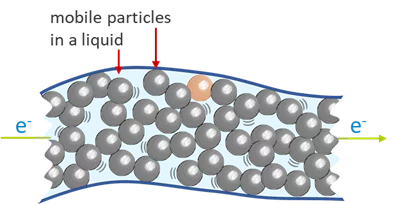
Electrofluids research group investigates new alternatives as soft, electrical components. We use conductive particles that form electrical and mechanical networks in liquid matrices. This novel approach combines classical percolation of particles in composites and fluid dynamics. Our research encompasses particle characterization and agglomeration studies, surface functionalization, electrical and rheological measurements, 3D printing, and device integration
The research on Electrofluids is supported by the European Research Council (ERC)

Team Members
Research
Electronic components and robotic actuators are traditionally built from metals and semiconductors. The Junior Research Group Electrofluids investigates “Electrofluids” as a liquid alternative: suspensions that conduct electrons while flowing as liquids. Fluids in elastic enclosures can replace solid leads and enable truly soft devices. Sufficient conductivity requires highly concentrated suspensions of conductive particles. They form transient conductive networks at manageable viscosity. We study suspensions of common conductive materials such as carbon, silver, gold, and copper, and avoid specialized low-melting alloys of gallium or other expensive elements.
The group studies the interplay between particle-particle friction, contact resistance, percolation, bulk resistance, and suspension viscosity. We use both custom-synthesized and commercial particles in a size range of tens of nanometres to few microns and with different shapes, modify their surfaces with conventional and p-conjugated surfactants and formulate concentrated suspensions that exhibit large conductivity at low viscosity. The combination of different particle sizes, shapes, and fluids enables tuning the properties of the fluid towards specific application cases, for example to create highly flexible leads for logic signals versus high-power connections for the connection of actuators.
The specific aims of this research group are:
- to design highly concentrated suspensions that form transient percolating networks,
- to use this knowledge and synthesize fluids with tunable electrical conductivity at low viscosity,
- to demonstrate that Electrofluids can be tailored for particular applications.
News
We launch our NEWS section!
Here, we want to share with you our last announcements and achievements, so please stay posted!
Congratulations and “welcome”, Niclas Hautz!
Niclas Hautz has successfully defended his Master thesis in Material Science entitled „Effect of water on electromechanical properties of polymer-based carbon black composites“. A work carried out in collaboration between Electrofluids group and Structure Formation group at INM. Congratulations! We are twice as happy because, far from being a goodbye, this brings more time together: Niclas starts today as PhD student in the Electrofluids group. We wish you all the best!
Goodbye 2022!
We had last week the traditional Christmas party together with the Structure Formation Group, a fun way to say goodbye to the year. Some of us went first play laser tag, unfortunately, Electrofluids (in red) could not beat SFG (in blue)…but they had 1 more player! After that we spent some time at the traditional Christmas Martket in Saarbrücken followed by a nice German dinner. We all wish you a happy Christmas and a good start into the year and are looking forward to more science and fun in 2023!
Dr. Lola González-García is now associated Junior Professor at the Saarland University!
Congratulations to our group leader Jun.-Prof. Dr. Lola González-García, who is now associated Junior Professor at the Department of Materials Science and Engineering of the Saarland University.

Proudly winners of the Corn Hole tournament!
Congratulations to our group leader Jun.-Prof. Dr. Lola González-García, who is now associated Junior Professor at the Department of Materials Science and Engineering of the Saarland University.
We welcome Niclas Hautz!
Niclas Hautz is a material scientist. He received his bachelor’s degree from Saarland University in 2021. Currently, he is doing his master’s degree at the Saarland University in the field of Material Science. He joins the Leibniz INM to do his master thesis at the Electrofluids group on the topic of composite technology, with special interest in double-percolating systems. Welcome to Electrofluids, we wish you all the best!
We welcome Sergio Lago Garrido!
Sergio Lago is an industrial chemical engineer. He completed his Bachelor degree in the university from Huelva, Spain. Now, he is working on his Master degree in chemical engineering with the specialization of Food and Pharmaceutical Products Engineering. He joins the Leibniz INM to work on his thesis in the Electrofluids group with focus on carbon nanotubes soft conductors. Welcome to Electrofluids, we wish you all the best!
Congratulations to Hendrik Rolshausen for defending his Master Thesis!
Our Master Student, Hendrik Rolshausen, has defended successfully his thesis entitled “Surface Modification and Characterization of Silver Particles and their Use in conductive Materials”. Congratulations!
Electrofluids @Nano2022 in Sevilla (06-10 June)
Dr. Lola González-García will present the last results on Electrofluids (and beyond) in Sevilla at the 16th International Conference on Nanostructured Materials (Nano2022).
- Monday, 6th of June at 11.15 h, S7_1: Electrofluids: electronic flowing leads based on conductive particle suspensions.
- Monday, 6th of June at 18.00 h, S11_3: Direct nanoimprinting of metal nanostructures: a method to fabricate flexible, transparent electrodes.
- Tuesday, 7th of June at 18.00 h, S7_3: Sinter-free inks of metal-polymer hybrid particles for printed electronics.
Check our paper published in Advanced Materials Technologies
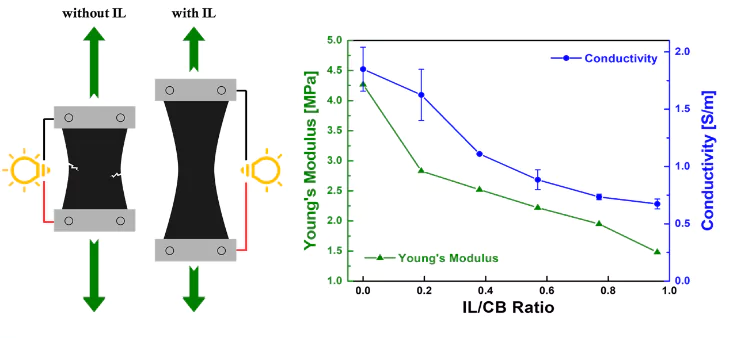
Our collaboration with the Structure Formation Group at INM (Tobias Kraus) has resulted in a very interesting work on „Microscopic Softening Mechanisms of an Ionic Liquid Additive in an Electrically Conductive Carbon-Silicone Composite“. You can find the article: LINK. Congratulations to all the authors!
We welcome Dr. Srishti Arora!
Dr. Srishti Arora is a soft matter physicist. She completed her Ph.D. from Laboratoire Charles Coulomb, Université Montpellier, France in 2017 followed by her first Postdoctoral studies at Northwestern University, USA. Her research work broadly encompasses the synthesis of colloidal particles, preparation of complex fluids, polymeric gels, etc., and understanding their behavior under extreme mechanical stress utilizing rheological techniques coupled with microscopy/or high-speed imaging. Currently, she is working on the development of electronic suspensions and investigating their rheoelectrical properties.
Publications
Klos, Michael | González-García, Lola | Kraus, Tobias
DOI:
Hybrid core–shell nanoparticles with metal cores and conductive polymer shells yield materials that are sinter-free and highly conductive but mechanically weak. Conventional composites of such nanoparticles are electrically insulating. Here, we introduce microscale phase-separated nanocomposites of hybrid gold-PEDOT:PPS particles in insulating poly(vinyl alcohol) (PVA). They combine electrical conductivities of up to 2.1 × 10⁵ S/m at 10 vol % PVA with increased mechanical adhesion on polyethylene terephthalate and glass substrates. We studied the effects of the PVA molecular weight, hydrolyzation degree, and volume fraction. Composites with 10 vol % highly hydrolyzed PVA at a MW of 89–98 kDa had the highest conductivities and stabilities; highly hydrolyzed PVA even increased the conductivity of the hybrid particle layers. We propose the formation of hydrogen bonds between PVA and PEDOT:PSS that lead to demixing and the formation of stable, structured composites. Finally, we demonstrated the inkjet-printability of inks containing PVA in water with viscosities of 1.6–2.0 Pa s at 50.1 s–1 and prepared bending-resistant electrical leads.
Schmidt, Dominik S. | Kraus, Tobias | González-García, Lola
DOI:
Flexible and stretchable electronics require both sensing elements and stretching-insensitive electrical connections. Conductive polymer composites and liquid metals are highly deformable but change their conductivity upon elongation and/or contain rare metals. Solid conductive composites are limited in mechanoelectrical properties and are often combined with macroscopic Kirigami structures, but their use is limited by geometrical restraints. Here, we introduce “Electrofluids”, concentrated conductive particle suspensions with transient particle contacts that flow under shear that bridge the gap between classic solid composites and liquid metals. We show how Carbon Black (CB) forms large agglomerates when using incompatible solvents that reduce the electrical percolation threshold by 1 order of magnitude compared to more compatible solvents, where CB is well-dispersed. We analyze the correlation between stiffness and electrical conductivity to create a figure of merit of first electrofluids. Sealed elastomeric tubes containing different types of electrofluids were characterized under uniaxial tensile strain, and their electrical resistance was monitored. We found a dependency of the piezoresistivity with the solvent compatibility. Electrofluids enable the rational design of sustainable soft electronics components by simple solvent choice and can be used both as sensor and electrode materials, as we demonstrate.
Grammes, Thilo | Maurer, Johannes H. | González-García, Lola | Kraus, Tobias
DOI:
Silver nanowires (AgNW) find use in transparent conductive electrodes with applications in solar cells, touch screens, and wearables. Unprotected AgNW are prone to atmospheric corrosion and lose conductivity over time. Known passivation techniques either require submersion of pre-deposited AgNW in liquid compounds or the modification of AgNW inks prior to deposition, which alters viscosity and complicates deposition. Here, new possibilities for stabilization of pre-deposited AgNW networks without need for submersion are explored. It is demonstrated that AgNW networks can be stabilized either by argon or hydrogen plasma treatment or by solvent vapor annealing with ethanol, methanol, or ethyl acetate. These treatments yielded stable electrical resistance over at least nine weeks, whereas untreated or thermally annealed AgNW layers quickly lost conductivity. The potential of solvent vapor annealing is further explored by demonstrating a new processing technique for stable polymer matrix composites containing AgNW. Co-deposited layers of AgNW with polystyrene microbeads are annealed in ethyl acetate vapor to stabilize the AgNW while at the same time merging polymer beads into a closed film around the AgNW. The resulting composites maintained stable resistance and transmittance for at least seven weeks.

Drzic, Juraj | Escudero, Alberto | González-Garcia, Lola | Kraus, Tobias
DOI:
We report the synthesis of AgNP@PEDOT:PSS hybrid conductive particles with silver cores and polythiophene shells that can be used to formulate sinter-free inks for printing electronics. First, Ag nanocrystals capped with the weakly bound ligand aminohexanoic acid (ε-Ahx) are prepared. The ligand shell is exchanged by reacting the dispersion with the polymer ionomer mixture poly(3,4-ethylene dioxythiophene):polystyrene sulfonate (PEDOT:PSS). The particles are characterized by electron microscopy, dynamic light scattering, Z potential, and Raman spectroscopy, confirming the replacement of the ligands on the metal particle surface. The resulting dispersion is colloidally stable as confirmed by DLS. Inks with a solid content of the hybrid particles of 300 mg mL−1 were prepared and deposited on different substrates. The new particles are components for hybrid inks that become electrically conductive without any chemical or thermal post-deposition treatment. We show that silver-based hybrid inks can be deposited on different substrates and possess an average conductivity after 24 h of drying at room temperature of 1.726 × 10⁶ S m−1 ± 0.326 × 10⁶ S m−1, only one order of magnitude lower than elemental silver and within the same order of magnitude as their gold ink counterpart.

Engel, Lukas F. | Gonzalez-Garcia, Lola | Kraus, Tobias
DOI:
We report on the unusual, advantageous ageing of flexible transparent electrodes (FTEs) that were self-assembled from oleylamine-capped gold nanospheres (AuNPs) by direct nanoimprinting of inks with different particle concentrations (cAu = 3 mg mL−1 to 30 mg mL−1). The resulting lines were less than 2.5 μm wide and consisted of disordered particle assemblies. Small-Angle X-ray Scattering confirmed that particle packing did not change with ink concentration. Plasma sintering converted the printed structures into lines with a thin, electrically conductive metal shell and a less conductive hybrid core. We studied the opto-electronic performance directly after plasma sintering and after fourteen days of storage at 22 °C and 55% rH in the dark. The mean optical transmittance [T with combining macron]400–800 in the range from 400 nm to 800 nm increased by up to ≈ 3%, while the sheet resistance Rsh strongly decreased by up to ≈ 82% at all concentrations. We correlated the changes with morphological changes visible in scanning and transmission electron microscopy and identified two sequential ageing stages: (I) post-plasma relaxation effects in and consolidation of the shell, and (II) particle re-organization, de-mixing, coarsening, and densification of the core with plating of Au from the core onto the shell, followed by solid-state de-wetting (ink concentrations cAu < 15 mg mL−1) or stability (cAu ≥ 15 mg mL−1). The plating of Au from the hybrid core improved the FTEs' Figure of Merit FOM = [T with combining macron]400–800·Rsh−1 by up to ≈ 5.8 times and explains the stable value of ≈ 3.3%·Ωsq−1 reached after 7 days of ageing at cAu = 30 mg mL−1.
Buchheit, Roman | Niebuur, Bart-Jan | González-Garcia, Lola | Kraus, Tobias
DOI:
Hybrid dielectrics were prepared from dispersions of nanoparticles with gold cores (diameters from 2.9 nm to 8.2 nm) and covalently bound thiol-terminated polystyrene shells (5000 Da and 11 000 Da) in toluene. Their microstructure was investigated with small angle X-ray scattering and transmission electron microscopy. The particles arranged in nanodielectric layers with either face-centered cubic or random packing, depending on the ligand length and core diameter. Thin film capacitors were prepared by spin-coating inks on silicon substrates, contacted with sputtered aluminum electrodes, and characterized with impedance spectroscopy between 1 Hz and 1 MHz. The dielectric constants were dominated by polarization at the gold–polystyrene interfaces that we could precisely tune via the core diameter. There was no difference in the dielectric constant between random and supercrystalline particle packings, but the dielectric losses depended on the layer structure. A model that combines Maxwell–Wagner–Sillars theory and percolation theory described the relationship of the specific interfacial area and the dielectric constant quantitatively. The electric breakdown of the nanodielectric layers sensitively depended on particle packing. A highest breakdown field strength of 158.7 MV m−1 was found for the sample with 8.2 nm cores and short ligands that had a face-centered cubic structure. Breakdown apparently is initiated at the microscopic maxima of the electric field that depends on particle packing. The relevance of the results for industrially produced devices was demonstrated on inkjet printed thin film capacitors with an area of 0.79 mm2 on aluminum coated PET foils that retained their capacity of 1.24 ± 0.01 nF@10 kHz during 3000 bending cycles.
Engel, Lukas F. | Gonzalez-Garcia, Lola | Kraus, Tobias
DOI:
We directed the self-assembly of nanoscale colloids via direct nanoimprint lithography to create flexible transparent electrodes (FTEs) with metal line widths below 3 μm in a roll-to-roll-compatible process. Gold nanowires and nanospheres with oleylamine shells were imprinted with soft silicone stamps, arranged into grids, and converted into metal lines in a plasma process. We studied the hierarchical structure and opto-electronic performance of the resulting grids as a function of particle geometry and concentration. The performance in terms of optical transmittance was dominated by the line width. Analysis of cross-sections indicated that plasma sintering only partially removed the insulating ligands and formed lines with thin conductive shells and a non-conductive core. We provide evidence that the self-assembly of high-aspect nanowires can compensate for defects of the stamp and substrate irregularities during imprinting, while spheres cannot. The wire-based electrodes thus outperformed the sphere-based electrodes at ratios of optical transmittance to sheet resistance of up to ≈ 0.9 %·Ωsq-1, while spheres only reached ≈ 0.55 %·Ωsq-1.
Engel, Lukas F. | González-García, Lola | Kraus, Tobias
DOI:
We study the stability of flexible transparent electrodes (FTEs) that were self-assembled from ultra-thin gold nanowires (AuNW) by direct nanoimprinting of inks with different particle concentrations (1 to 10 mg mL−1). The resulting lines were less than 3 μm wide and contained bundles of AuNW with oleylamine (OAm) ligand shells. Small-angle X-ray scattering confirmed a concentration-independent bundle structure. Plasma sintering converted the wire assemblies into lines with a thin metal shell that contributes most to electrical conductivity and covers a hybrid core. We studied the relative change in sheet resistance and the morphology of the FTEs with time. The sheet resistance increased at all concentrations, but at different rates. The metal shell aged by de-wetting and pore formation. The hybrid core de-mixed and densified, which led to a partial collapse of the shell. Residual organics migrated through the shell via its pores. Lines formed at low concentration (cAu = 2 to 3 mg mL−1) contained less residual organics and aged slower than those formed at high cAu ≥ 5 mg mL−1. We passivated the conductive shell with thin, adsorbed layers of PEDOT:PSS and found that it decelerated degradation by slowing surface diffusion and hindering further rupture of the shell. Thick capping layers prevented degradation entirely and stopped pore formation.
Zhang, Long | Schmidt, Dominik S. | González-García, Lola | Kraus, Tobias
DOI:
Abstract The microstructural changes caused by the addition of the ionic liquid (IL) 1-ethyl-3-methylimidazolium bis(trifluoromethylsulfonyl)imide to polydimethylsiloxane (PDMS) elastomer composites filled with carbon black (CB) are analyzed to explain the electrical, mechanical, rheological, and optical properties of IL-containing precursors and composites. Swelling experiments and optical analysis indicate a limited solubility of the IL in the PDMS matrix that reduces the cross-linking density of PDMS both globally and locally, which reduces the Young's moduli of the composites. A rheological analysis of the precursor mixture shows that the IL reduces the strength of carbon–carbon and carbon–PDMS interactions, thus lowering the filler–matrix coupling and increasing the elongation at break. Electromechanical testing reveals a combination of reversible and irreversible piezoresistive responses that is consistent with the presence of IL at microscopic carbon–carbon interfaces, where it enables re-established electrical connections after stress release but reduces the absolute conductivity.
Castillo-Seoane, Javier | Gonzalez-Garcia, Lola | Obrero-Perez, José M. | Aparicio, Francisco J. | Borrás, Ana | González-Elipe, Agustín R. | Barranco, Ángel | Sanchez-Valencia, Juan R.
DOI:
The opto-electronic properties of small-molecules and functional dyes usually differ when incorporated into solid matrices with respect to their isolated form due to an aggregation phenomenon that alters their optical and fluorescent properties. These spectroscopic modifications are studied in the framework of the exciton theory of aggregates, which has been extensively applied in the literature for the study of molecular aggregates of the same type of molecules (homoaggregation). Despite the demonstrated potential of the control of the heteroaggregation process (aggregation of different types of molecules), most of the reported works are devoted to intramolecular aggregates, complex molecules formed by several chromophores attached by organic linkers. The intramolecular aggregates are specifically designed to hold a certain molecular structure that, on the basis of the exciton theory, modifies their optical and fluorescent properties with respect to the isolated chromophores that form the molecule. The present article describes in detail the incorporation of Rhodamine 6G (Rh6G) and 800 (Rh800) into polymeric matrices of poly-(methyl methacrylate), PMMA. The simultaneous incorporation of both dyes results in an enhanced fluorescent emission in the near-infrared (NIR), originating from the formation of ground-state Rh6G–Rh800 intermolecular heteroaggregates. The systematic control of the concentration of both rhodamines provides a model system for the elucidation of the heteroaggregate formation. The efficient energy transfer between Rh6G and Rh800 molecules can be used as wavelength shifters to convert effectively the light from visible to NIR, a very convenient wavelength range for many practical applications which make use of inexpensive commercial detectors and systems.